


“How much NAD+ should I take?” is one of the most common questions patients bring to a consultation – and there is no single correct answer. NAD+ dosage depends on the delivery method, your goals, your baseline NAD+ status, and how your body responds.
This guide explains typical NAD+ dosage ranges for IV therapy, injections, oral supplements, and patches. It also walks through the factors that influence your ideal dose, loading versus maintenance strategies, and signs that your dose may need to be adjusted.
Why NAD+ dosage matters
NAD+ is a coenzyme involved in hundreds of cellular reactions. Too little may leave you without the support you are looking for. Too much, too fast can cause uncomfortable side effects like chest pressure, flushing, or nausea.
The goal is not the highest dose possible. The goal is a dose that raises your NAD+ availability enough to support your cellular goals while staying comfortable and sustainable over time. That number varies by person and by delivery method.
Typical NAD+ dosage by delivery method
Here is a quick reference for how NAD+ is usually dosed across the main formats. These are general ranges, not prescriptions.
| Delivery method | Typical single dose | Typical weekly total | How often |
|---|---|---|---|
| NAD+ IV infusion | 250-500 mg | 250-1,500 mg (loading) / 250-500 mg (maintenance) | 2-3x weekly (loading), monthly (maintenance) |
| NAD+ IM injection (shot) | 100-200 mg | 200-600 mg | 1-3x weekly |
| NAD+ subcutaneous injection | 50-150 mg | 100-450 mg | 2-3x weekly or daily micro-doses |
| Oral NAD+ (liposomal) | 100-300 mg | 700-2,100 mg | Daily |
| Oral NMN (precursor) | 250-600 mg | 1,750-4,200 mg | Daily |
| Oral NR (precursor) | 250-500 mg | 1,750-3,500 mg | Daily |
| NAD+ transdermal patch | Varies (slow release) | Varies by product | Daily or several times weekly |
Notice that oral doses are much higher than injected or IV doses. This is because only a fraction of an oral dose reaches the bloodstream after digestion. A 500 mg IV dose is not equivalent to a 500 mg oral dose in terms of what actually reaches your cells.
NAD+ IV therapy dosage
NAD+ IV doses at clinical settings typically range from 100 mg at the low end up to 1,000 mg or more for aggressive protocols. Most standard wellness protocols fall in the 250 mg to 500 mg range per session.
Entry doses (100-250 mg)
First-time NAD+ IV patients often start at 100 mg or 250 mg. This lets the body adjust to the infusion and lets your provider see how you respond.
Entry doses are particularly important because NAD+ tolerance varies significantly between individuals. Someone who feels flushing and chest pressure at 250 mg may tolerate 500 mg easily a month later after several exposures.
At 100 mg, a session can be completed in roughly one hour or less. This makes introductory NAD+ accessible even for patients who are unsure about committing to a longer infusion. If the starting dose is well tolerated, your provider can scale up gradually at future sessions.
Standard doses (300-500 mg)
Once tolerance is established, many patients settle into the 300 mg to 500 mg range. This is considered a therapeutic wellness dose for ongoing protocols. A 500 mg NAD+ IV session is a common anchor dose for loading phases at RWA Center.
Sessions at this dose typically run 2 to 3 hours. The extra time allows for a slower drip rate, which minimizes flushing and chest pressure while still delivering a substantial dose. Most patients find this range the sweet spot between efficacy and practicality.
High-dose protocols
Some clinical protocols go up to 750 mg or 1,000 mg per session. These longer, higher-dose infusions are typically reserved for specific indications under physician guidance and can require 4 to 6 hours of infusion time.
Higher is not automatically better. The body can only use so much NAD+ at once, and pushing the dose too high often increases side effects without proportionally increasing benefit.
How to choose your NAD+ IV dose
Factors that influence your starting IV dose include:
- Experience with NAD+: First-timers start lower
- Goals: Energy and mental clarity often respond to lower doses; deeper longevity or recovery goals may benefit from higher doses
- Tolerance: Patients sensitive to flushing or chest pressure benefit from a slower, smaller start
- Time available: Lower doses mean shorter sessions
- Budget: Dose-based pricing means the right dose is also a financial decision
Your provider should guide this choice based on a proper consultation rather than leaving it to you to select from a menu.
NAD+ injection dosage
NAD+ injections use smaller per-dose amounts than IV infusions because they are given more frequently. Typical ranges depend on whether the injection is subcutaneous or intramuscular.
Subcutaneous NAD+ injection dose
Subcutaneous NAD+ injections are absorbed gradually through tissue beneath the skin. Typical doses range from 50 mg to 150 mg per injection, with the most common protocols landing around 100 mg.
This route is often preferred for at-home protocols because the injection is easier to self-administer and the slower absorption tends to produce fewer flushing reactions.
Intramuscular NAD+ injection dose
Intramuscular NAD+ doses are typically 100 mg to 200 mg per shot. Absorption is faster than subcutaneous, which is why patients sometimes feel a brief warm or flushed sensation shortly after the injection.
Common in-clinic NAD+ shot doses at RWA Center are 100 mg and 200 mg, administered by a provider.
NAD+ injection dosage per day
Most NAD+ injection protocols are not daily. Frequency is typically two to three times per week, not every day. This is because NAD+ is not like insulin or a daily medication – weekly rhythms with higher per-dose amounts tend to produce better patient outcomes than daily micro-doses.
Some specialized protocols do use daily subcutaneous injections at very low doses (25-50 mg) to keep NAD+ availability steady. These are typically used under close medical supervision rather than as a default approach.
Typical weekly NAD+ injection protocol
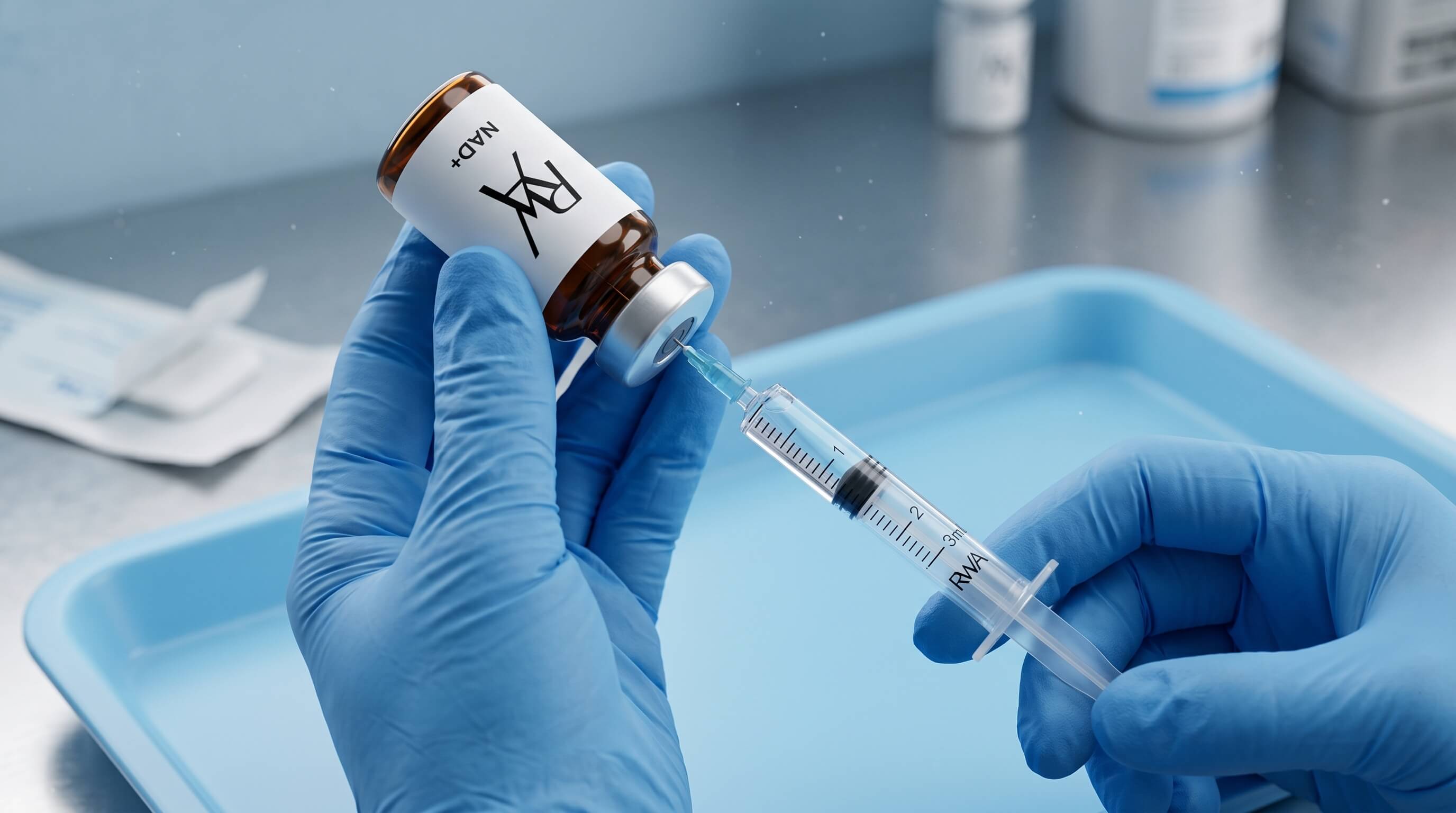
A common protocol looks like this:
- Loading (weeks 1-2): 100-200 mg NAD+ injection, 3 times per week
- Transition (weeks 3-4): 100-200 mg, 2 times per week
- Maintenance: 100-200 mg, once weekly or every 10-14 days
These are general patterns, not individual prescriptions. Your actual protocol should reflect your goals, response, and provider guidance.
NAD+ patch dosage
Transdermal NAD+ patches deliver the molecule through the skin over several hours. Patch dosing is typically described in terms of wear time rather than milligrams, because absorption varies by individual skin type, placement, and patch technology.
Patches are a lower-intensity option best suited to patients who want to avoid needles or who are continuing support between injection visits. They are generally not a full replacement for higher-dose clinical protocols but can be a useful complement.
Not sure how much NAD+ is right for you?
NAD+ dosing is not one-size-fits-all. Our Beverly Hills providers design your protocol after a medical consultation based on your goals, baseline and response.
These statements have not been evaluated by the FDA. Not intended to diagnose, treat, cure or prevent any disease. NAD+ therapy is provided only after medical consultation by a licensed provider.
Factors that influence your ideal NAD+ dose
Your ideal dose is shaped by more than just delivery method. The table below outlines the main variables.
| Factor | How it affects your dose |
|---|---|
| Age | NAD+ declines with age, so older patients may benefit from higher doses or longer loading phases |
| Body weight | Larger body mass may need higher total doses to reach target effect |
| Primary goal | Energy support often needs less than longevity or intensive recovery protocols |
| Prior NAD+ experience | First-time patients start lower; returning patients can tolerate faster infusion rates |
| Health status | Certain conditions require conservative dosing or exclude NAD+ altogether |
| Lifestyle factors | High-stress, high-training, or high-travel lifestyles often call for higher maintenance doses |
| Budget and time | Practical realities matter – a dose you can maintain consistently outperforms a larger dose you skip |
| Response to prior sessions | Providers adjust up or down based on how you felt and what shifted |
How much NAD+ is too much?
NAD+ has a wide safety margin in clinical use, but excessive doses can cause discomfort and may not be biologically useful. The body can saturate NAD+ pathways, meaning there is a point beyond which extra dose does not produce extra benefit.
Signs that your dose is too high
- Significant chest tightness or pressure during IV infusion
- Intense flushing of the face, chest, or neck
- Nausea that does not resolve with a slower drip
- Muscle cramping or abdominal discomfort
- Headache during or after the session
- Strong fatigue or “wiped out” feeling after treatment
If these appear, the solution is usually a lower per-session dose, a slower infusion rate, or splitting the dose across more sessions.
Safety ceiling
There is no universally agreed-upon maximum, but most clinical protocols cap single sessions at around 1,000 mg. Doses above that are rare and require very careful pacing. More frequent lower doses are generally preferred over fewer very high doses.
NAD+ loading vs maintenance dosing
Most NAD+ protocols are divided into two phases.
Loading phase
The goal of loading is to raise NAD+ levels quickly. Loading is typically 2-4 weeks of higher-frequency dosing.
- IV therapy: 4-10 sessions over 2-4 weeks, often at 500 mg or more
- Injections: 2-3 injections per week at 100-200 mg
- Combined: Weekly IV session plus 2 injections per week
Maintenance phase
Once NAD+ is raised, maintenance focuses on keeping it there without the intensity of loading.
- IV therapy: One session every 4-8 weeks
- Injections: One per week or every 10-14 days
- Combined: Monthly IV plus a weekly injection
Some patients eventually transition entirely to at-home injections or patches for maintenance, returning for an IV only periodically.
Single sessions vs package dosing
Most NAD+ clinics offer both single sessions and multi-session packages. The choice affects both dose strategy and cost per session.
When single sessions make sense
- You are trying NAD+ for the first time and want to see how you respond
- You only want occasional boosters rather than a structured protocol
- Your schedule does not allow for a committed loading phase right now
- You are combining NAD+ with other treatments and need flexibility
When packages make sense
- Your provider has recommended a loading phase (4-10 sessions)
- You plan to use NAD+ consistently for at least 3 months
- You want a lower per-session cost and predictable scheduling
- You are committing to NAD+ as part of a broader wellness program
At RWA Center, 250 mg and 500 mg IV packages are offered in 3-pack and 6-pack bundles with a 20% discount compared to single sessions. If your provider has already mapped out a loading schedule, package pricing usually makes the most sense.
Pairing NAD+ with other treatments
Dose planning should also consider what else you are doing. NAD+ is often paired with other wellness protocols, and those pairings can affect your ideal NAD+ dose.
- Peptide therapy: Many peptides that support recovery or metabolism work well alongside NAD+ and may allow lower NAD+ doses
- Ozone or EBOO therapy: These can stack with NAD+ to support cellular health through different mechanisms
- Nutrient IVs: B-complex, magnesium, and other cofactors may enhance how your body uses the NAD+ you receive
- Exercise and caloric restriction: Both naturally raise NAD+ levels; combining them with treatment may reduce the dose needed
Always tell your provider about every supplement, medication, and therapy you are using so they can design a protocol that accounts for the full picture.
NAD+ injections vs NAD+ IV infusions
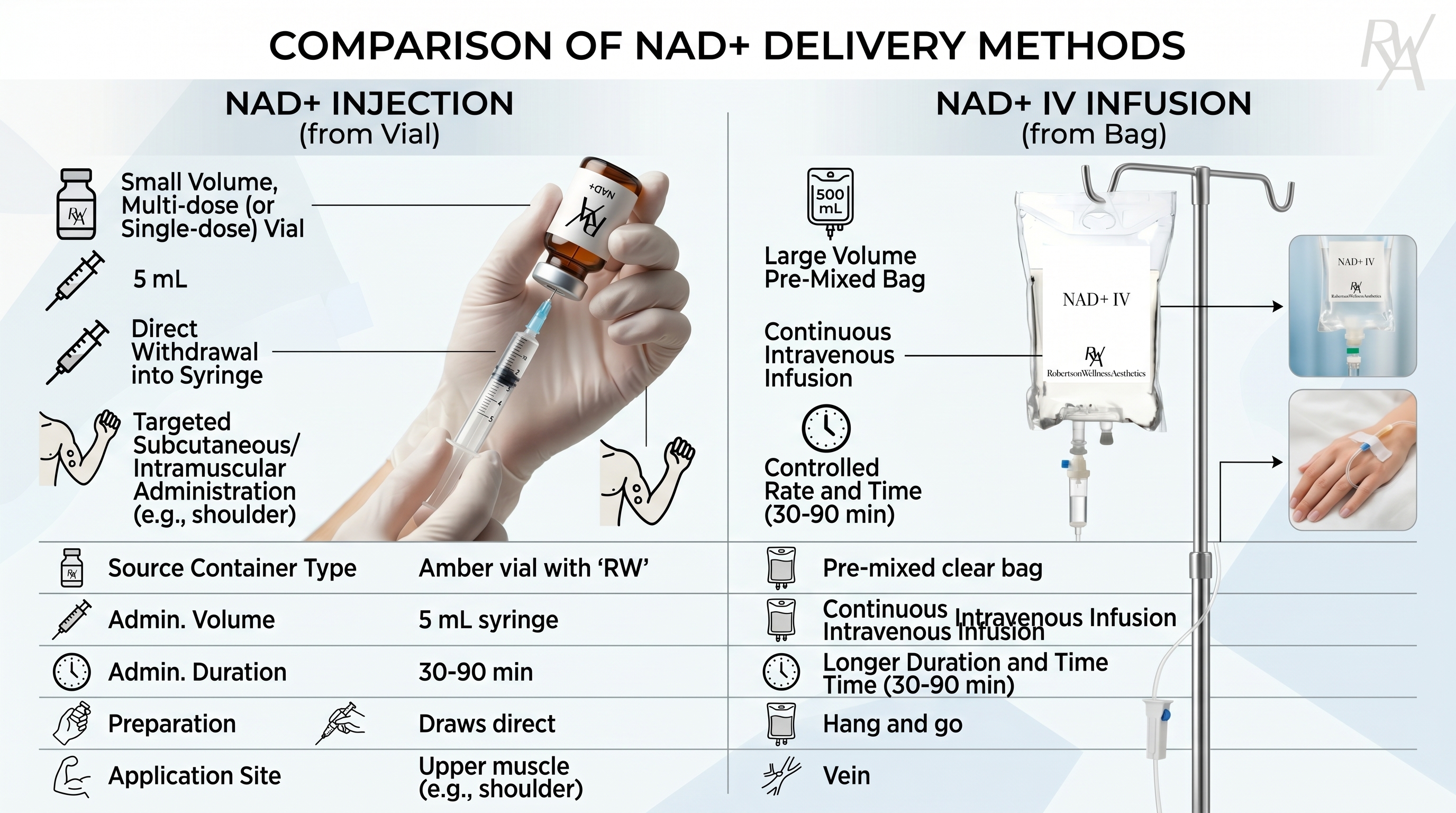
Both deliver NAD+ into the bloodstream, but the experience and use cases differ. An IV infusion delivers a large dose over two to four hours in a clinic. A NAD+ injection delivers a smaller, more frequent dose in just a few minutes.
Many patients use both. A clinical loading series of NAD+ IV sessions raises baseline levels, and weekly injections maintain those levels between visits. This pairing is often more cost-effective and time-efficient than running IV sessions alone.
Signs your NAD+ dose is working (or not)
Because NAD+ effects are often subtle and cumulative, it helps to know what to watch for when assessing whether your dose is on track.
Signs your dose is working
- Steadier energy throughout the day, especially in the afternoon
- Sharper focus and faster mental recall
- Improved sleep quality (falling asleep faster, waking less)
- Better recovery after exercise or travel
- A general sense of being “less run down”
Signs your dose may be too low
- No noticeable shift after a full loading series (6+ sessions)
- Effects wear off within hours rather than days
- You need to push through fatigue the next day
Signs your dose may be too high
- Strong flushing, chest pressure, or nausea during sessions
- Feeling unusually fatigued the day after treatment
- Muscle cramping or abdominal discomfort during infusion
If any of these appear, discuss adjustments with your provider. A protocol that works is one you can tolerate consistently.
Frequently asked questions
How much NAD+ should I inject per day?
Most NAD+ injection protocols are not daily. A typical schedule is 100-200 mg, 2-3 times per week. Daily injections, if used, are typically much smaller (25-50 mg) and done under medical supervision.
How much NAD+ IV therapy is too much?
Most clinical protocols stay within 250-1,000 mg per session. Doses above that are uncommon and require very slow infusion rates. Pushing higher usually increases side effects without proportionally increasing benefit.
How often should I get NAD+ IV therapy?
Loading: 2-3 sessions per week for 2-4 weeks. Maintenance: once every 4-8 weeks. Your provider will adjust this based on your goals and response. Learn more in our NAD IV therapy FAQs.
Is a higher NAD+ dose always better?
No. NAD+ follows a saturation curve – once cellular pathways are supplied, additional dose does not produce proportionally more benefit and may increase side effects. The right dose is the lowest one that achieves your goals comfortably.
Can you take NMN and NAD+ together?
Many patients do combine them, though this should be discussed with your provider. The two work through related but distinct pathways. Combining them is not inherently dangerous, but it can be unnecessarily expensive if the goals overlap.
Can my NAD+ dose be adjusted over time?
Yes, and most protocols are adjusted as patients respond. A typical arc is: start low, scale up during loading, stabilize at a maintenance dose, then adjust based on how you feel and what goals shift.
What dose do you recommend at RWA Center?
RWA Center offers NAD+ IV infusions from 100 mg up to 500 mg, with 3-pack and 6-pack options for extended protocols. NAD+ shots are available in 100 mg and 200 mg. Your specific recommendation is made during a medical consultation rather than selected from a menu.
What if I feel nothing at my starting dose?
This is common and does not mean NAD+ is not working. Cellular changes take weeks to manifest as noticeable shifts. If you genuinely feel nothing after a full loading series, your provider may increase the dose, change the delivery method, or reassess whether NAD+ is the right fit for your goals.
NAD+ dosing at RWA Center
NAD+ dosing at RWA Center in Beverly Hills is personalized through medical consultation. Rather than offering fixed menu options, providers design a protocol based on your history, goals, and response over time.
Whether you are considering a single introductory NAD+ shot or planning a loading series of IV infusions, the starting point is the same: a proper evaluation that helps you pick a dose you can maintain comfortably and effectively. You can explore the broader IV treatments menu to see what else may complement your NAD+ protocol.
The information provided is for educational purposes only and is not intended as medical advice. Certain therapies discussed may be investigational and are not approved by the FDA for the diagnosis, treatment, cure, or prevention of disease. Always consult with a qualified healthcare professional before beginning any new wellness protocol.
Get your personalized NAD+ protocol
Talk to a provider about the right dose, route and cadence – and whether a package fits your goals.
These statements have not been evaluated by the FDA. Not intended to diagnose, treat, cure or prevent any disease. NAD+ therapy is provided only after medical consultation by a licensed provider.


