
If you are starting testosterone replacement therapy (TRT), one of the first practical questions is how the testosterone is actually delivered. The three most common methods are injections, pellets, and gels. Each works through a different route into the body, and each has its own trade-offs in dosing control, convenience, cost, and how it is monitored. This guide walks through how the three compare so you can have an informed conversation with your provider. For a broader overview of the program itself, see our men’s health and testosterone therapy page.
How testosterone delivery methods differ
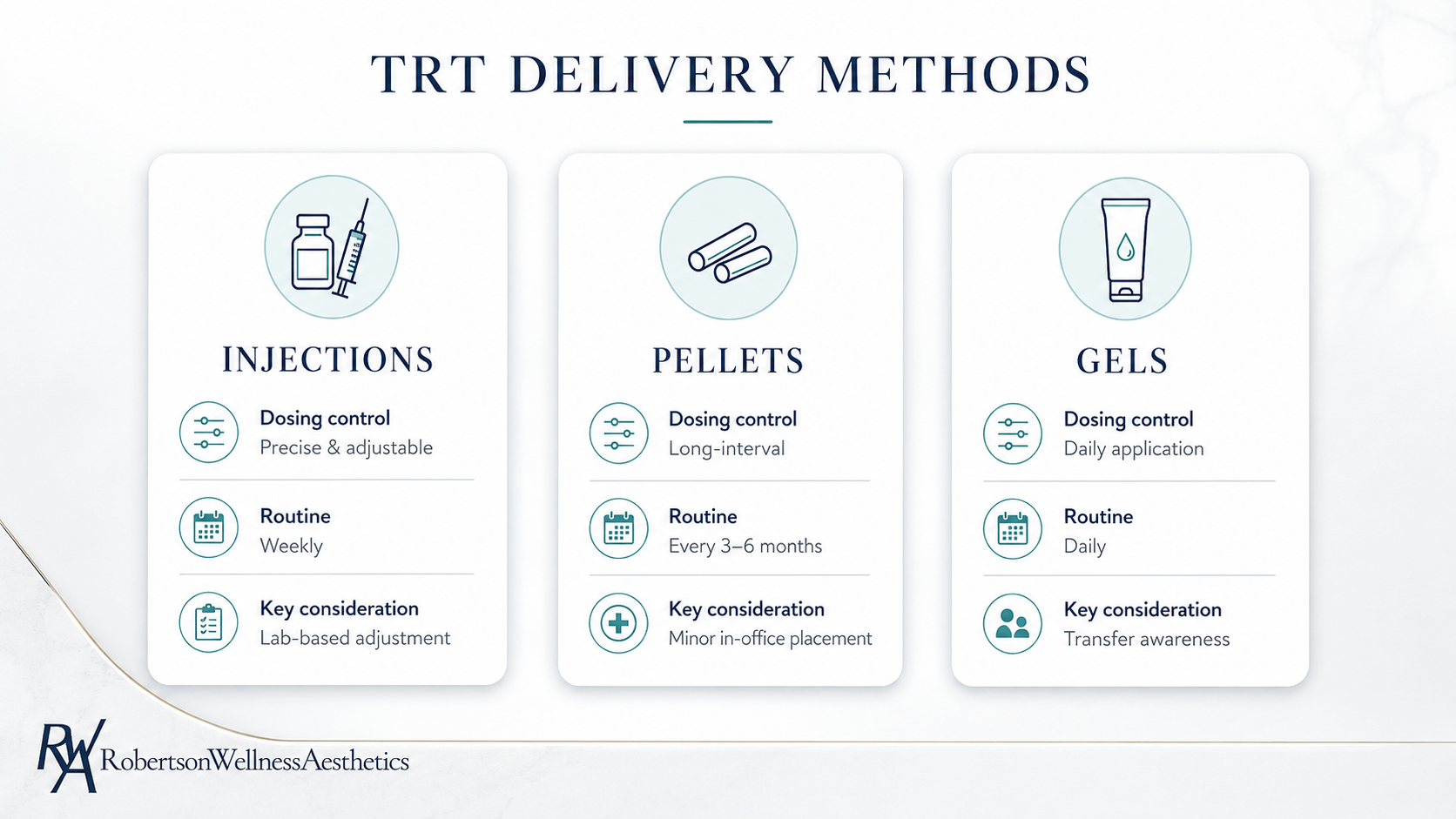
All three methods deliver testosterone, but they differ in how the hormone enters your system and how steady your levels stay between doses. Injections place testosterone directly into muscle or the fatty tissue under the skin. Pellets are implanted under the skin and release testosterone slowly over months. Gels are applied to the skin daily and absorbed through it.
The right choice depends on your goals, your lifestyle, how much dose flexibility you want, and how closely you and your provider want to be able to fine-tune your levels over time.
Testosterone injections
Injectable testosterone, such as testosterone cypionate or enanthate, is given into the muscle or just under the skin, typically on a weekly schedule. Dosing can be adjusted precisely based on your follow-up labs, which is the main reason many clinics rely on it. You can either self-inject at home on your own schedule or come in for clinician-administered injections.
Strengths: precise, easily adjustable dosing; predictable results; generally the most cost-effective option; flexible between at-home and in-office administration.
Considerations: requires a needle on a regular schedule, and some men prefer to avoid injecting at home, in which case in-office visits are an option.
Testosterone pellets
Pellets are small implants placed under the skin during a minor in-office procedure, usually every three to six months. They release testosterone slowly and steadily, so there is nothing to do day to day between placements.
Strengths: long intervals between dosing; steady release; no daily or weekly routine to maintain.
Considerations: the dose generally cannot be adjusted once the pellet is in place until the next cycle, so fine-tuning is limited; placement is a minor surgical procedure with the usual small risks such as site irritation, infection, or pellet extrusion.
Testosterone gels
Gels are applied to the skin once daily and absorbed transdermally. They are needle-free and simple to use, which appeals to men who want to avoid injections entirely.
Strengths: no needles; easy daily application; FDA-approved transdermal products are widely available.
Considerations: they require consistent daily use, absorption can vary from person to person, and there is a real risk of transferring testosterone to others through skin contact, which is an important safety point if you live with a partner or children.
Injections vs pellets vs gels at a glance
| Method | How it is given | Dosing control | Routine | Key consideration |
|---|---|---|---|---|
| Injections | Into muscle or under the skin, weekly | High – easily adjusted by labs | Weekly, at home or in office | Involves a regular needle |
| Pellets | Implanted under the skin every 3 to 6 months | Low – set until next cycle | Every few months | Minor surgical placement |
| Gels | Applied to the skin once daily | Moderate – varies with absorption | Daily | Risk of skin-to-skin transfer |
Injections, pellets or gels: which TRT method?
Each delivery method has trade-offs in convenience, cost and how steady your levels stay. Our Beverly Hills physicians help you choose the one that fits your routine.
TRT is prescribed by a licensed physician after evaluation. These statements have not been evaluated by the FDA and are not intended to diagnose, treat, cure or prevent any disease.
Why we focus on injections at Robertson Wellness
At our Beverly Hills clinic we specialize in testosterone injections because they give us the most predictable, adjustable, and cost-effective results. Injectable testosterone lets us titrate your dose precisely based on your follow-up bloodwork, which is central to keeping your levels in a healthy range over time rather than guessing. You can self-inject at home on your schedule or come in weekly for clinician-administered injections, whichever fits your life. Pellets and gels are alternative methods used elsewhere; we have found that injections offer the dose flexibility we rely on to keep your results consistent.
Cost and monitoring considerations
Cost and monitoring differ by method. Injections tend to be the most economical over time and pair naturally with the regular bloodwork that safe testosterone therapy requires, including checks on total and free testosterone, hematocrit, estradiol, and PSA. Pellets carry the cost of a procedure each cycle, and gels are an ongoing daily prescription. For a full breakdown of what testosterone therapy costs at our clinic, including what is included in each program, see our guide to TRT cost in Beverly Hills. Whichever method you use, ongoing lab monitoring is what keeps treatment both effective and safe.
Which method is right for you?
There is no single best method for everyone. Injections suit men who want precise, adjustable dosing and the best value, and who are comfortable with a weekly routine or in-office visits. Pellets may appeal to those who want the fewest touchpoints and do not mind a minor procedure. Gels suit men who want to avoid needles entirely and can apply them consistently while managing the transfer risk. Your goals, your comfort with needles, your daily routine, and considerations such as fertility all factor in, so this is a decision best made with a provider who can review your labs and history. If you are weighing your options, our guide to TRT in Beverly Hills covers what to expect from start to finish.
Frequently asked questions
Are testosterone injections better than gels or pellets?
No single method is best for everyone, but injections allow the most precise, adjustable dosing and tend to be the most cost-effective, which is why we use them. The right method for you depends on your goals, lifestyle, and provider’s assessment.
Do testosterone injections hurt?
Most men tolerate them well. The needles used are small, and once you are shown the technique, self-injection at home is manageable. If you would rather not inject yourself, in-office weekly injections are an option.
How often do I need testosterone injections?
Most protocols are weekly, though the exact schedule and dose are set by your provider and adjusted based on your follow-up labs to keep your levels in a healthy range.
Can I switch from gels or pellets to injections?
Yes. Many men move to injections for the dose precision and value. If you are currently on another method, discuss the transition at your consultation so your provider can plan it around your labs.
Medically reviewed by Biana Borchenko, FNP-BC.
This content is for general educational purposes only and is not medical advice. Statements have not been evaluated by the Food and Drug Administration. Testosterone replacement therapy is a prescription treatment that requires evaluation, lab testing, and ongoing monitoring by a qualified provider. Individual results vary. Please consult a licensed clinician to determine whether treatment is appropriate for you.
Choose your TRT method with a physician
Talk to a physician about the delivery method that best fits your routine and goals.
TRT is prescribed by a licensed physician after evaluation. These statements have not been evaluated by the FDA and are not intended to diagnose, treat, cure or prevent any disease.