


Peptide therapy is gaining traction among health-conscious adults in the United States who are looking beyond conventional medicine for tools that may support cognitive performance, neurological resilience, and long-term brain health. Among the peptides drawing the most serious attention is Semax – a neuropeptide with decades of research behind it and a growing presence in integrative wellness clinics.
This guide covers what Semax is, how it may work in the body, how to use and store the nasal spray, what the research suggests about dosing, potential side effects to be aware of, and how to access medically supervised Semax therapy at Robertson Wellness and Aesthetics (RWA Center) in Beverly Hills.
What is Semax peptide?
Semax is a synthetic heptapeptide derived from a fragment of adrenocorticotropic hormone (ACTH), a hormone naturally produced by the pituitary gland. It was originally developed in Russia at the Institute of Molecular Genetics and has been studied in scientific literature for several decades. In Eastern Europe, it has been used in clinical settings for neurological support and cognitive applications.[1]
Semax is also referred to as N-Acetyl Semax in its acetylated form, which is considered more stable and potentially more bioavailable than the base peptide. At RWA Center, Semax is available in two formulations:
- Nasal spray: 1.25 mg/mL in a 10 mL spray – a non-invasive delivery route that reaches the central nervous system through the olfactory nerve pathway, bypassing the blood-brain barrier.
- Injectable: 2.5 mg/mL in a 5 mL vial, administered subcutaneously under medical guidance for more predictable systemic bioavailability.
Both formulations are available following a medical consultation. A prescription from a licensed provider is required. Semax is considered investigational in the United States and is not approved by the FDA for the diagnosis, treatment, cure, or prevention of any disease.
How Semax works in the body
Understanding the mechanism of action helps set realistic expectations about what Semax may and may not do.
BDNF upregulation
The most well-documented mechanism of Semax is its ability to upregulate brain-derived neurotrophic factor (BDNF) – a protein that plays a central role in neurogenesis, synaptic plasticity, and the formation and maintenance of neural connections.[2] BDNF is sometimes described as a kind of fertilizer for neurons. Higher BDNF expression is associated with improved learning, memory consolidation, and mental resilience. Semax appears to stimulate BDNF production in the hippocampus, a region of the brain closely linked to memory and learning.
Neurotransmitter modulation
Semax also appears to modulate key neurotransmitter systems – particularly dopamine and serotonin.[3] These systems are central to mood regulation, motivation, and executive cognitive function. By influencing these pathways, Semax is being studied for its potential role in supporting emotional stability alongside cognitive clarity.
Neuroprotective and anti-inflammatory activity
Emerging research suggests Semax may play a role in modulating neuroinflammatory pathways and supporting healthy microvascular circulation in the brain.[4] Some preclinical and early clinical research has explored its potential in contexts involving cerebral ischemia, though much of this evidence is preliminary or derived from Eastern European clinical populations and should be interpreted cautiously.
Potential benefits of Semax – what the research suggests
The following potential benefits are drawn from available preclinical and clinical research. Language throughout this section is intentionally cautious. Individual results vary significantly, and Semax is not approved to treat any medical condition.
Table 1: Semax – potential areas of benefit and research status
| Area of interest | What research suggests | Evidence stage |
|---|---|---|
| Working memory and attention | Semax is being studied for potential support of working memory, processing speed, and sustained attention[5] | Preclinical and limited clinical |
| Neuroprotection | Some studies suggest it may support neural tissue integrity; explored in cerebral ischemia recovery contexts[4] | Early clinical (Eastern Europe) |
| Mood and stress resilience | May play a role in supporting emotional stability through dopaminergic and serotonergic modulation[3] | Preclinical and anecdotal |
| BDNF support | Appears to upregulate BDNF expression in the hippocampus, supporting neurogenesis and synaptic function[2] | Preclinical (well-documented) |
| Neuroinflammation | Emerging research suggests a potential role in modulating inflammatory pathways in neural tissue[4] | Early and preclinical |
These potential benefits are based on published research and do not constitute medical claims. Semax is not FDA-approved for any of the above indications. Always consult a qualified provider before beginning any peptide protocol.
Semax is not FDA-approved and remains investigational, so any cognitive or energy effects are described only as something it may support, never as a treatment. Men exploring this area sometimes review it alongside our men’s energy and vitality program.
Nasal spray vs. injectable – which delivery method is right for you?
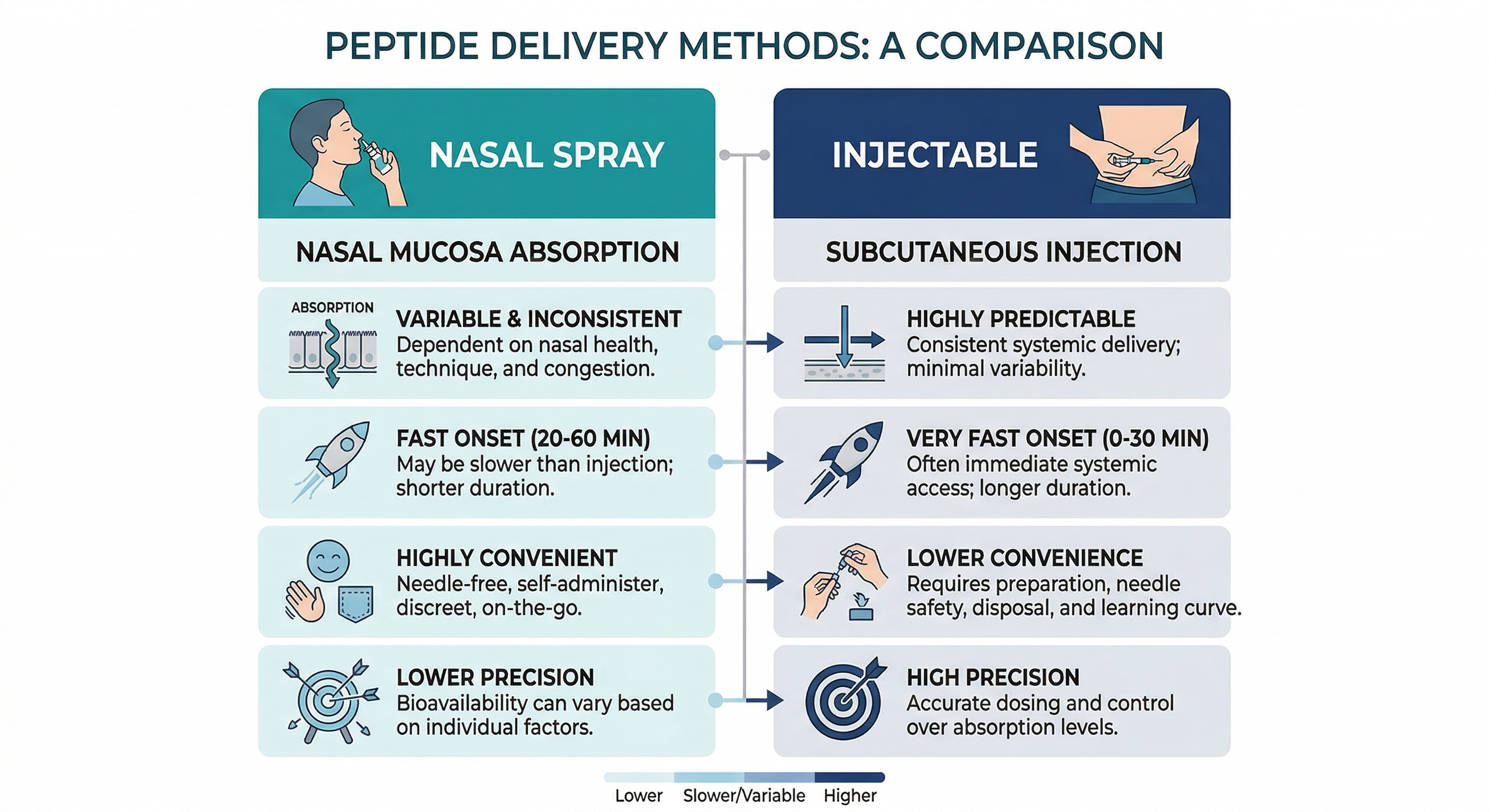
Semax is available in both nasal spray and injectable form at RWA Center. Each delivery route has distinct practical and pharmacokinetic considerations. The right choice depends on individual circumstances, health goals, and provider guidance.
Table 2: Semax nasal spray vs. injectable – delivery comparison
| Factor | Nasal spray (1.25 mg/mL) | Injectable (2.5 mg/mL) |
|---|---|---|
| Administration | Self-administered via nasal applicator | Self-injected subcutaneously with provided supplies |
| Absorption route | Olfactory nerve pathway to the CNS via the nasal mucosa | Direct systemic absorption into the bloodstream |
| Bioavailability | Variable; depends on mucosal health and technique | More consistent and predictable |
| Invasiveness | Non-invasive, needle-free | Minimally invasive, small needle |
| Ease of use | Very convenient, suitable for beginners | Requires proper technique instruction |
| Best suited for | Those preferring needle-free protocols or new to peptide therapy | Those seeking dosing precision or with mucosal sensitivity |
Neither route is universally superior. Your RWA Center provider will help determine the most appropriate delivery method based on your health profile and goals.
How to use Semax nasal spray – step-by-step guide
Proper administration technique is important for achieving consistent absorption through the nasal mucosa. The following reflects general best practices; always follow the specific instructions provided by your RWA Center provider.
- Prepare your environment: Wash your hands thoroughly with soap and water. Gently blow your nose to clear any congestion before administration.
- Prime the spray: If using a new bottle, press the pump 3-5 times away from yourself until a fine mist appears. Re-prime if the bottle has not been used for several days.
- Position correctly: Tilt your head slightly forward – not back. Insert the applicator tip just inside one nostril and angle it gently toward the outer wall of the nasal passage, away from the nasal septum.
- Administer the dose: Press the pump firmly and smoothly to release one spray while gently inhaling through the nose. Do not sniff forcefully.
- Repeat if directed: Repeat in the other nostril per your provider’s specific guidance.
- Wait before blowing: Avoid blowing your nose or sniffing strongly for at least 5 minutes after administration to allow the peptide to absorb through the mucosal lining.
- Clean the applicator: Wipe the tip with a clean tissue after each use and replace the cap securely.
Semax nasal spray is most commonly administered in the morning. This timing aligns with natural BDNF rhythms and reduces the likelihood of sleep disruption from its alerting properties. Some protocols call for a second dose in the early afternoon – your provider will specify what is appropriate for your situation.
Semax nasal spray dosage – what the research and clinical experience suggest
Dosing for Semax nasal spray is highly individualized and must be determined by a licensed provider based on your health history, goals, and response. The ranges below reflect what has been reported in published research and clinical practice – they are informational only and do not constitute a dosing recommendation.[5]
Table 3: Semax nasal spray dosage – general reported ranges
| Parameter | Reported range | Notes |
|---|---|---|
| Concentration at RWA Center | 1.25 mg/mL in a 10 mL spray | Per provider’s prescription |
| Typical reported dose range* | 1-3 sprays per nostril, 1-2 times daily | Provider-determined; not a recommendation |
| Frequency* | Once or twice daily, usually in the morning | Timing affects tolerability and sleep |
| Typical cycle length* | 2-4 weeks on, followed by an equal or longer break | Cycling helps maintain receptor sensitivity |
| Dose adjustment | Based on individual response and health goals | Always reviewed at follow-up consultation |
* These ranges are informational only and reflect published research or clinical practice reports. Your provider at RWA Center will determine the appropriate dose and protocol for your specific situation. Individual results vary.
Semax is typically used in cycles rather than continuously. This approach is thought to help preserve receptor sensitivity over time, though optimal cycling strategies remain an area of ongoing investigation. Book a peptide consultation at the RWA Center to receive a personalized Semax protocol.
Considering Semax for focus and recovery?
Semax is dosed individually – nasal spray or injectable – as part of a supervised protocol. Our Beverly Hills providers tailor it after a medical consultation based on your goals.
These statements have not been evaluated by the FDA. Not intended to diagnose, treat, cure or prevent any disease. Peptide therapy is provided only after medical consultation by a licensed provider.
Semax nasal spray side effects – what to be aware of
Semax has a generally favorable safety profile in the available literature, with most reported adverse effects being mild and transient.[5] That said, as with any bioactive compound used off-label, individual responses vary and medical oversight is important.
Table 4: Semax nasal spray – reported side effects and management guidance
| Reported effect | Route/context | What to do |
|---|---|---|
| Mild nasal irritation or congestion | Nasal spray route; most common in early use | Reduce spray volume temporarily; allow mucosal adjustment |
| Transient headache | Either route; more common early in the protocol | Ensure adequate hydration; notify your provider if persistent |
| Mild fatigue or energy shift | Some users report an adjustment period in the first week | Monitor response; discuss dosing timing with your provider |
| Elevated alertness or sleep disruption | Timing-dependent; more likely with afternoon dosing | Shift administration to the morning |
| Mild mood or appetite changes | Rare; may relate to dopaminergic modulation | Report to your provider promptly for protocol review |
| Mild injection site reaction | Injectable route only; redness or swelling at the injection site | Rotate injection sites; maintain aseptic technique |
This table reflects reports from published research and clinical use. It does not represent a complete safety profile. Report any unexpected or persistent effects to your provider immediately. Semax is investigational in the United States and is not FDA-approved for therapeutic use.
Individuals with a history of seizure disorders, active psychiatric conditions, or who are currently using psychoactive medications should discuss these factors thoroughly with a provider before considering Semax. Pregnant or breastfeeding individuals should not use this therapy.
How to store Semax nasal spray
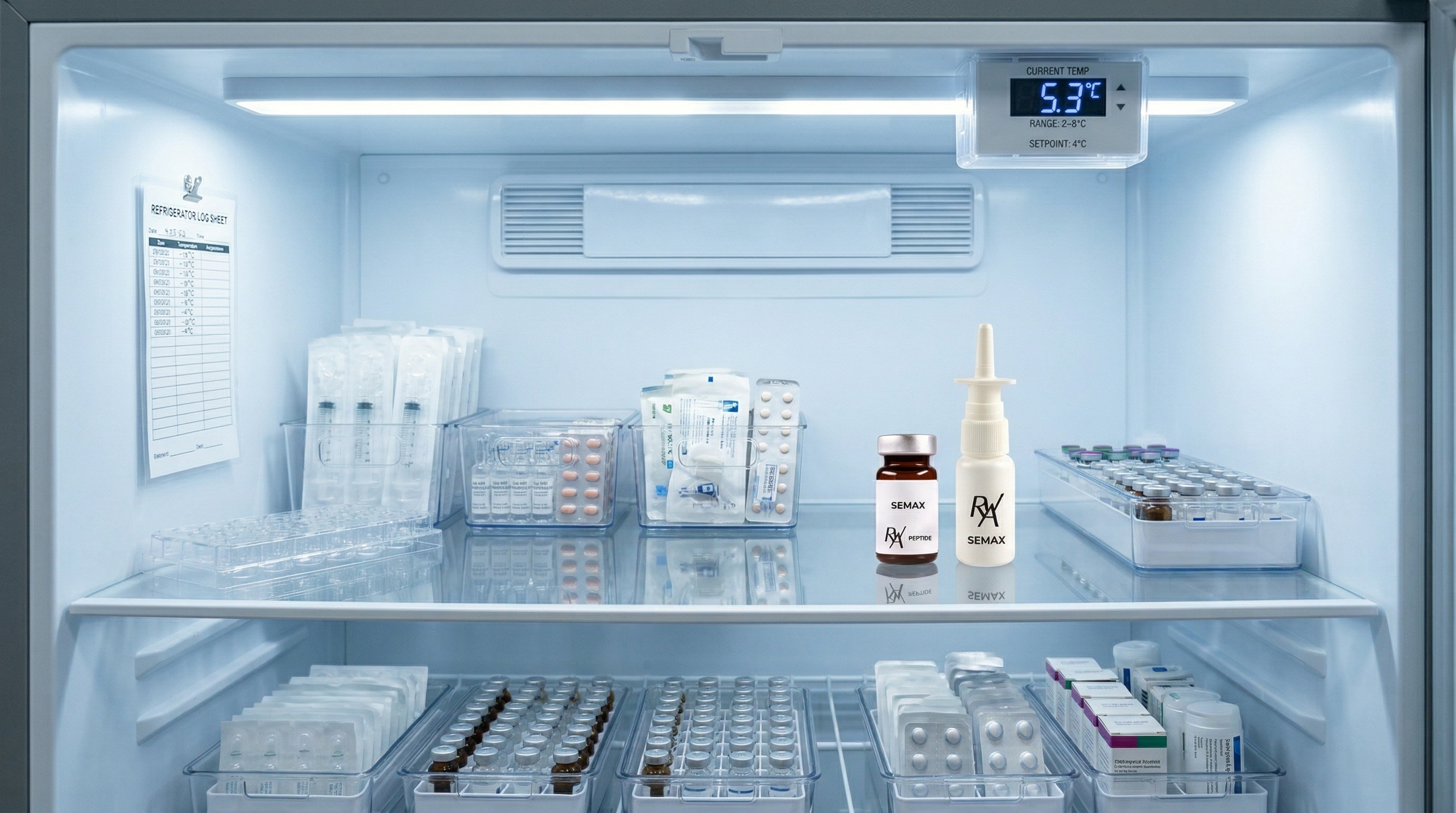
Peptides are sensitive biological compounds. Proper storage is essential to preserving the stability and effectiveness of your Semax formulation. Heat, light, and freeze-thaw cycles can degrade the active peptide before use.
Table 5: Semax storage guidelines – nasal spray and injectable
| Condition | Nasal spray | Injectable vial |
|---|---|---|
| Before opening | Refrigerate at 2-8 degrees C (36-46 degrees F) | Refrigerate at 2-8 degrees C (36-46 degrees F) |
| After opening | Keep refrigerated; use within 28-30 days | Keep refrigerated once reconstituted; use within 28-30 days |
| Light exposure | Store away from direct light; keep in original packaging | Use amber or opaque container; avoid direct light |
| Freezing | Do not freeze the prepared spray solution | Lyophilized powder may be frozen; reconstituted solution should not be |
| Traveling | Keep cool with an ice pack; do not leave in a hot vehicle | Keep cool with an ice pack; do not leave in a hot vehicle |
| Signs of degradation | Cloudiness, color change, or unusual odor – discard immediately | Cloudiness, visible particles, or color change – discard immediately |
Always follow the specific storage instructions provided with your RWA Center formulation. If you have any questions, contact the clinic directly at (310) 407-0542.
Who may consider Semax therapy
This section does not constitute medical advice or a clinical recommendation. The following is a general overview of the types of individuals who, after a proper medical consultation, may explore Semax as part of a personalized wellness protocol.
- Health-conscious adults focused on cognitive longevity and mental performance, given Semax’s study in the context of memory, BDNF support, and neuroprotection.
- Individuals interested in a proactive approach to brain health who are already working within an integrative or regenerative medicine framework.
- Those pursuing broader longevity and cellular health optimization protocols that may include complementary therapies such as NAD+ IV therapy, blood testing, or TruAge biological age assessment.
- Adults who prefer a needle-free option and find the nasal spray delivery route more accessible than injectable peptide protocols.
Semax is not appropriate for everyone. A thorough medical consultation is required before starting any peptide protocol. Individuals with certain underlying medical conditions, those taking psychoactive medications, and pregnant or breastfeeding individuals should not use Semax.
What to expect during treatment at RWA Center
Peptide therapy at RWA Center begins with a medical consultation at $350, which includes a comprehensive clinical health assessment, full medical history review, and body composition evaluation. This allows the clinical team to determine whether Semax is appropriate and to develop an individualized protocol tailored to your specific goals.
Following consultation, you will receive your Semax formulation along with detailed instructions on administration technique, dosing schedule, storage, and what to monitor during your cycle. Follow-up appointments allow the team to review your response and adjust the protocol as needed.
Some patients report noticing subtle changes within the first one to two weeks of a consistent protocol, though individual experiences vary widely and no specific outcomes are guaranteed.
Semax peptide therapy at Robertson Wellness and Aesthetics
Robertson Wellness and Aesthetics (RWA Center) is located at 8920 Wilshire Blvd, Suite 320, Beverly Hills, CA 90211. The clinic offers a medically supervised, full-spectrum approach to integrative wellness.
The peptide therapy program at RWA Center covers a broad range of evidence-informed peptides alongside Semax, including Selank for stress and mood support, the Semax-Selank 50:50 combination, BPC-157 for tissue recovery, Sermorelin for growth hormone support, and Cerebrolysin and Dihexa for additional cognitive support options.
Complementary services at RWA Center that pair well with a Semax protocol include:
- NAD+ IV therapy – cellular energy and mitochondrial support
- EBOO (extracorporeal blood ozone and oxygenation) – systemic oxygenation and immune support
- TruAge biological age testing – epigenetic aging assessment to track longevity progress
- Blood testing and biomarker analysis – baseline and follow-up labs to inform and monitor your protocol
- Concierge services – at-home or private-setting protocols for qualifying patients
Table 6: Relevant RWA Center services for Semax patients
| Service | Relevance to Semax users | Link |
|---|---|---|
| Peptide therapy – full menu | View all available peptides including Semax, Selank, and the 50:50 combo | View peptide menu |
| Blood testing | Baseline and follow-up labs to monitor wellness and guide protocol adjustments | Learn more |
| NAD+ IV therapy | Cellular energy support that complements cognitive peptide protocols | Learn more |
| TruAge biological age testing | Epigenetic age testing to track longevity and cellular health progress | Learn more |
| EBOO therapy | Ozone-based blood oxygenation for systemic cellular support | Learn more |
| Concierge services | At-home or private-office peptide and wellness protocols | Learn more |
To schedule a consultation, visit rwacenter.com or call (310) 407-0542. Currently serving California residents. Due to recent FDA regulatory updates affecting certain compounded substances, peptide availability may be subject to change – a consultation is required to confirm current availability.
Safety considerations and the importance of medical supervision
Semax is generally reported to be well tolerated in the available literature.[5] However, because it is not FDA-approved for therapeutic use in the United States, its administration is considered off-label or investigational, making medical supervision essential rather than optional.
Quality and purity of the source formulation matter significantly. RWA Center sources peptides through licensed compounding pharmacies to ensure product integrity. Sourcing Semax from unverified online channels carries meaningful risk of impurity, incorrect concentration, or contamination.
Personalized care for your wellness journey
Semax represents one of the more thoroughly researched neuropeptides in the wellness space, with a body of literature that spans decades and multiple research contexts. That said, it is not a guaranteed solution, and responsible use requires education, medical oversight, and realistic expectations.
At RWA Center, the clinical team is committed to helping patients navigate this space with clear information and personalized guidance. If you are curious about Semax peptide therapy – whether via nasal spray or injection – the right first step is a medical consultation. Individual results vary, and no specific outcomes are guaranteed.
Visit rwacenter.com or call (310) 407-0542 to learn more or book your consultation today.
References
- Menshanov PN, et al. (2014). “Anxiolytic effects of semax in rats with genetic predisposition to depressive-like state.” Doklady Biological Sciences. 459(1):357-360.
- Dolotov OV, et al. (2006). “Semax, an analog of ACTH(4-7), regulates BDNF and trkB expression in the rat hippocampus.” Peptides. 27(12):3058-3067.
- Grigor’eva ME, et al. (2002). “Semax activates dopaminergic and serotonergic brain systems in rodents.” Neuroscience Letters.
- Gusev EI, et al. (1997). “The neuroprotective effects of semax in ischemic brain.” Zhurnal Nevrologii i Psikhiatrii imeni S.S. Korsakova. 97(6):10-15. [Russian language source]
- Medvedev VE, et al. (2015). “Clinical experience with Semax peptide in neurological and cognitive applications.” Zhurnal Nevrologii i Psikhiatrii. 115(6):33-40. [Russian language source]
- Nasonov EL, et al. (2001). “Clinical studies of Semax peptide in acute ischemic stroke.” Russian multicenter trial data.
Important information
The information provided in this article is for educational purposes only and is not intended as medical advice. Certain therapies discussed may be investigational and are not approved by the FDA for the diagnosis, treatment, cure, or prevention of disease. Always consult with a qualified healthcare professional before beginning any new wellness protocol. Individual results vary and no specific outcomes are guaranteed. Peptide availability is subject to regulatory changes and medical suitability assessment. References to research reflect published literature and do not constitute an endorsement of any specific therapeutic use.
Add Semax to your peptide protocol
Talk to a provider about whether Semax fits your goals and the best route and dose for you.
These statements have not been evaluated by the FDA. Not intended to diagnose, treat, cure or prevent any disease. Peptide therapy is provided only after medical consultation by a licensed provider.


