


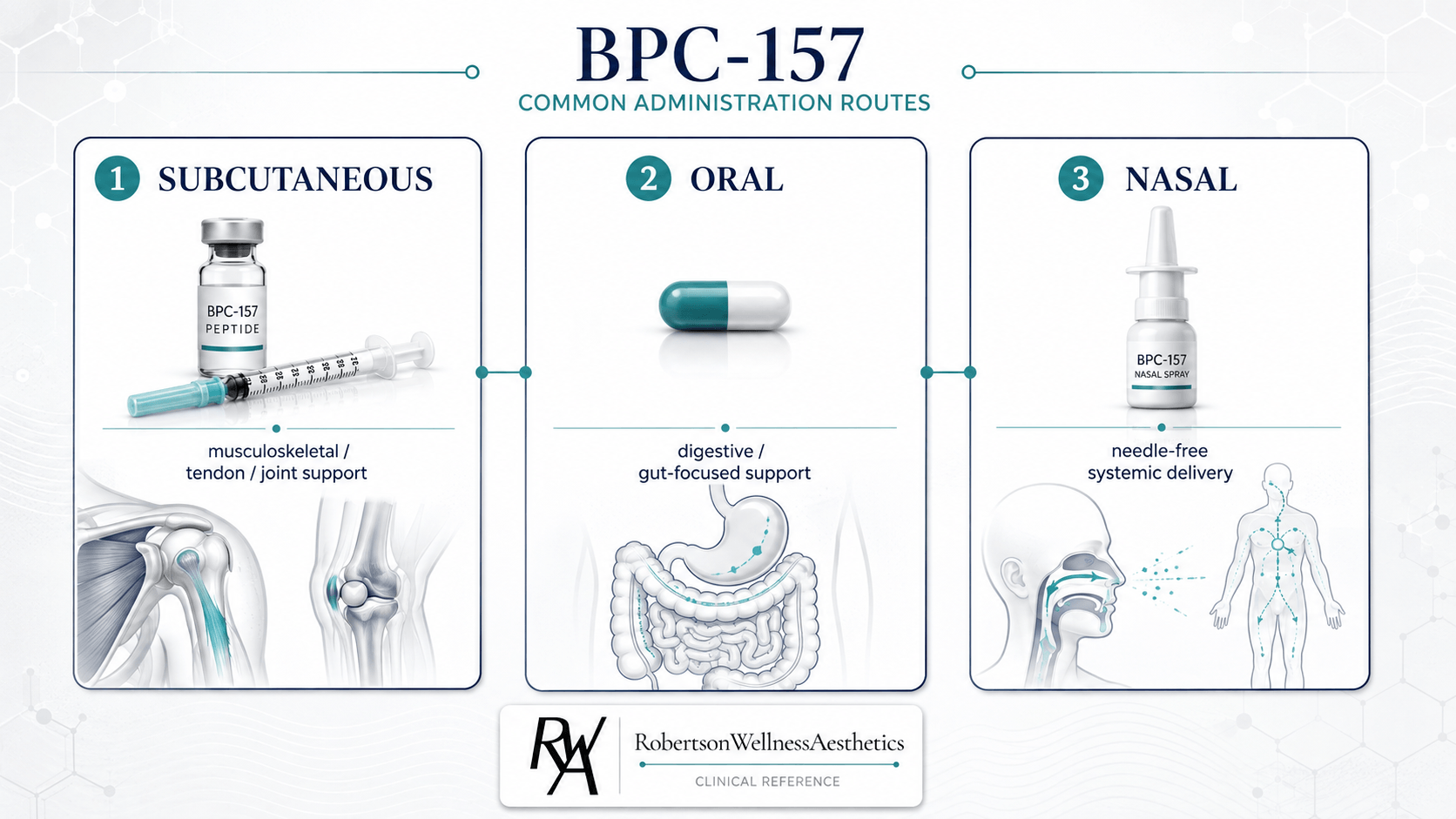
In published research and supervised clinical practice, BPC-157 is most often dosed at 200-500 mcg per day, injected subcutaneously near the area of concern or taken orally for gut-focused support, in cycles of 4-8 weeks. There is no FDA-approved human dose: every figure below comes from animal research and reported clinical use, which is why at Robertson Wellness & Aesthetics in Beverly Hills BPC-157 dosing is always set by a physician after an evaluation, not copied from a chart.
BPC-157 dosage at a glance
| Route | Typical reported dose | Frequency | Most used for |
|---|---|---|---|
| Subcutaneous injection | 200-500 mcg | 1-2x daily | Tendon, ligament, muscle, joint recovery |
| Oral (capsules) | 250-500 mcg | 1-2x daily | Gut lining and GI support |
| Nasal spray | Per labeled metered dose, typically 1-2 sprays | 1-2x daily | Systemic support without needles |
| Cycle length | 4-8 weeks | Followed by a break | All protocols |
These are reference ranges reported in the literature and clinical practice, not medical advice. Your dose depends on body weight, goal, route, and your health history.
What is BPC-157 and why does dosing start with the source?
BPC-157 (Body Protection Compound-157) is a synthetic 15-amino-acid peptide derived from a protective protein found in human gastric juice. In animal studies it has shown accelerated healing of tendons, ligaments, muscle, and the gut lining, largely through promotion of angiogenesis (new blood vessel formation), upregulation of growth factor receptors, and modulation of the nitric oxide system (Sikiric et al., Current Pharmaceutical Design, 2018; Chang et al., Journal of Applied Physiology, 2011). In plain terms: it appears to help injured tissue rebuild its blood supply and repair scaffolding faster.
Dosage only means something if the peptide is real and accurately concentrated. Research-chemical websites sell unverified vials where the actual content can differ from the label, which makes any “dosage chart” unreliable. RWA dispenses pharmacy-sourced BPC-157 in verified concentrations, which is the precondition for the numbers below meaning anything at all.
How is BPC-157 dosage determined?
Most human protocols are extrapolated from animal studies, where effective doses commonly cluster around 10 mcg per kilogram of body weight per day (Sikiric et al., Current Pharmaceutical Design, 2018). Translated conservatively to adults, that produces the familiar 200-500 mcg daily range. Three variables move the number within that range:
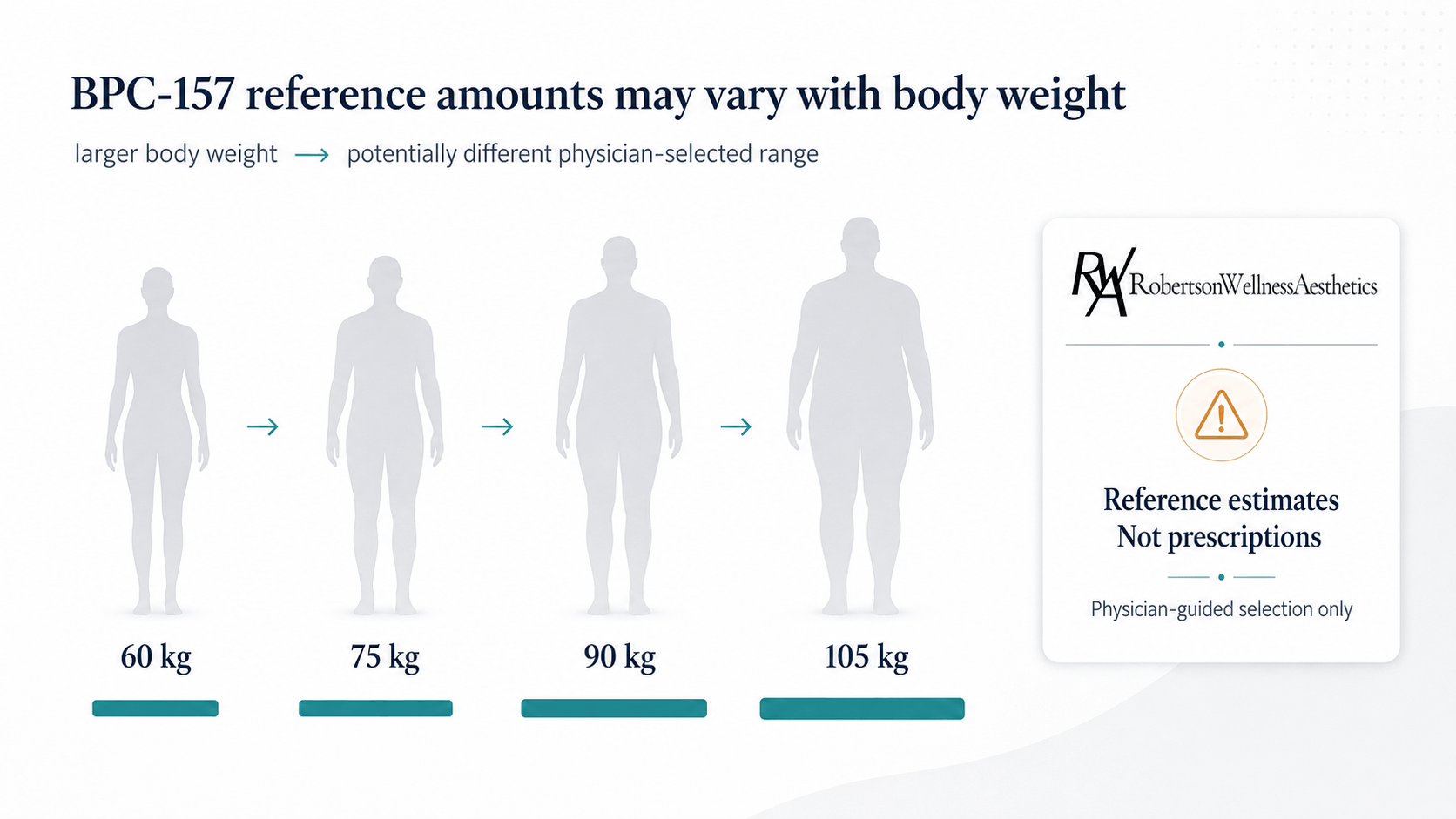
- Body weight – heavier patients are typically dosed at the upper end.
- Goal – a localized tendon issue is approached differently from systemic gut support.
- Route – injection delivers more predictable systemic levels; oral dosing is favored for the GI tract, where BPC-157 was originally studied.
Weight-based reference estimates
| Body weight | Estimated daily range (at ~2.5-6 mcg/kg practical range) |
|---|---|
| 60 kg (132 lb) | 150-360 mcg |
| 75 kg (165 lb) | 190-450 mcg |
| 90 kg (198 lb) | 225-540 mcg |
| 105 kg (231 lb) | 260-630 mcg |
Treat this as a conversation starter with your physician, not a prescription: human dose-response data for BPC-157 simply does not exist yet, and honest dosing stays conservative because of that gap.
BPC-157 injection dosage: the subcutaneous protocol
Subcutaneous injection is the most common clinical route for musculoskeletal goals. A typical supervised protocol looks like this:
- Dose: 200-500 mcg once daily, or split into two smaller injections morning and evening.
- Site: into the fatty layer near (not into) the area of concern – many clinicians believe local delivery helps, though systemic absorption occurs regardless.
- Technique: insulin syringe, alcohol-prepped skin, rotated injection sites.
- Duration: 4-8 weeks depending on response, then reassess.
Reconstitution math: mcg to units to mL
If your BPC-157 comes as a lyophilized 10 mg vial, add bacteriostatic water to set the concentration, then convert:
- 10 mg vial + 3 mL bacteriostatic water = 10,000 mcg / 3 mL ≈ 333 mcg per 0.1 mL.
- On a standard U-100 insulin syringe, 0.1 mL = 10 units. So a 250 mcg dose ≈ 7-8 units; 500 mcg ≈ 15 units.
Getting this arithmetic wrong is the single most common self-dosing error we see. When RWA dispenses injectable BPC-157, the syringe-unit conversion is written out for your exact vial and dose, so there is nothing to calculate at home.
Oral BPC-157 dosage: when capsules make sense
BPC-157 is unusual among peptides in that it is stable in gastric juice – it was discovered in the gut and the strongest animal evidence is for GI protection (Sikiric et al., Current Pharmaceutical Design, 2018). That makes oral dosing (typically 250-500 mcg once or twice daily) a rational choice when the goal is gut-lining support rather than a tendon or joint. For combined goals, some physicians pair a lower oral dose with injections. Learn more about our oral and injectable formats on the BPC-157 product page.
BPC-157 nasal spray dosage
Nasal administration is a needle-free middle path: the nasal mucosa absorbs peptides efficiently, and metered sprays deliver a consistent microdose. Typical use is 1-2 sprays once or twice daily, following the labeled concentration of the specific spray – concentrations vary between formulations, so sprays from different sources are not interchangeable. RWA offers nasal peptide formats for patients who want daily consistency without injections; our clinical team matches the spray’s labeled dose to the same mcg targets described above. If you are comparing formats, our guide to nasal spray vs injectable peptides explains the absorption trade-offs.
BPC-157 dosage by goal
Tendon and ligament recovery
Commonly 250-500 mcg daily subcutaneously near the site for 4-6 weeks, often alongside physical therapy. Animal tendon studies showed improved fibroblast migration and tendon-to-bone healing (Chang et al., Journal of Applied Physiology, 2011).
Muscle and post-procedure recovery
Similar dosing, frequently split into twice-daily injections during the first two weeks, then once daily.
Gut and GI support
Oral route preferred: 250-500 mcg daily for 6-8 weeks, sometimes paired with a gut-focused peptide such as KPV – see our KPV peptide guide for how the two differ.
Systemic recovery and general repair
Lower daily dose (200-300 mcg) for a longer 8-week cycle, injection or nasal route.
How long does BPC-157 take to work?
Most patients who respond notice early changes – less soreness, easier movement, calmer digestion – within 1-2 weeks, with more meaningful progress at 4-6 weeks, which is why cycles are built around that window. Response time varies with the severity and age of the issue, dose and route, sleep, protein intake, and whether the underlying stressor (training load, NSAID use, gut irritants) has been addressed. If nothing has changed by week 4, the protocol – or the diagnosis – should be revisited with your physician rather than simply increasing the dose.
Cycle length: how long and when to stop
- Acute injury: 4-6 week cycle, stop after resolution.
- Chronic or gut-focused goals: 6-8 weeks, then a break of roughly half the cycle length before reassessing.
- When to stop early: injection-site reactions that worsen, new or unusual symptoms, or no benefit by week 4-6.
Continuous year-round use is not supported by any published evidence and is not something we recommend.
BPC-157 and TB-500 together: stack dosing
The popular “Wolverine” combination pairs BPC-157 (200-500 mcg daily) with TB-500 (commonly 2-2.5 mg twice weekly, a different schedule because of its longer action). The two peptides are dosed on their own schedules rather than mixed into one number; the practical adjustment is usually running BPC-157 daily while TB-500 provides the slower systemic background. Our full TB-500 vs BPC-157 comparison covers when a stack is worth considering and when one peptide is enough.
Skip the guesswork: get your BPC-157 dose set by a physician
Verified pharmacy-sourced peptide, your syringe-unit conversion written out for you, and a protocol matched to your goal – in clinic in Beverly Hills or by concierge visit.
Peptide therapies are provided by a licensed physician after evaluation. These statements have not been evaluated by the FDA and are not intended to diagnose, treat, cure or prevent any disease.
Safety, side effects, and who should not take BPC-157
Reported side effects are generally mild: injection-site redness or soreness, and occasionally headache, nausea, or fatigue. The more important caution is what we do not know – BPC-157 has no completed human clinical trials, so its long-term safety profile is unestablished. Because it promotes angiogenesis, individuals with an active or recent cancer diagnosis should not use it. It is also not appropriate during pregnancy or breastfeeding, and anyone on multiple medications should review interactions with a physician first.
On the regulatory side: BPC-157 is not FDA-approved for any indication. The FDA has placed BPC-157 in Category 2 of its bulk drug substances list for compounding, citing insufficient safety data (FDA, bulk drug substances evaluation). This is exactly why physician supervision, verified sourcing, and conservative dosing matter more for this peptide than for most – and why we walk every patient through this honestly at the consultation, whether in clinic or through our concierge service across Beverly Hills and West LA.
Frequently asked questions about BPC-157 dosage
What is the correct BPC-157 dosage for a tendon injury?
Most supervised protocols use 250-500 mcg daily by subcutaneous injection near the injury for 4-6 weeks, alongside rehab. Your exact dose should be set by a physician based on weight and severity.
How do I convert BPC-157 mcg to insulin syringe units?
It depends on your reconstitution. With a 10 mg vial in 3 mL of bacteriostatic water, 0.1 mL (10 units on a U-100 syringe) contains about 333 mcg – so 250 mcg is roughly 7-8 units.
How long should a BPC-157 cycle last?
Typically 4-8 weeks: shorter for acute injuries, longer for gut or systemic goals, followed by a break before any repeat cycle.
Is oral or injectable BPC-157 better for gut health?
Oral. BPC-157 is stable in gastric juice and the strongest animal evidence is for GI protection, so capsules deliver it directly where it acts. Injections are preferred for tendon, ligament, and muscle goals.
Can I take BPC-157 every day?
Daily dosing within a defined 4-8 week cycle is standard. Continuous, open-ended daily use is not supported by evidence and is not recommended.
What is the maximum BPC-157 dosage?
There is no established human maximum because no human dose-finding trials exist. Supervised practice rarely exceeds 500-600 mcg daily; taking more provides no proven benefit and adds unknown risk.


