


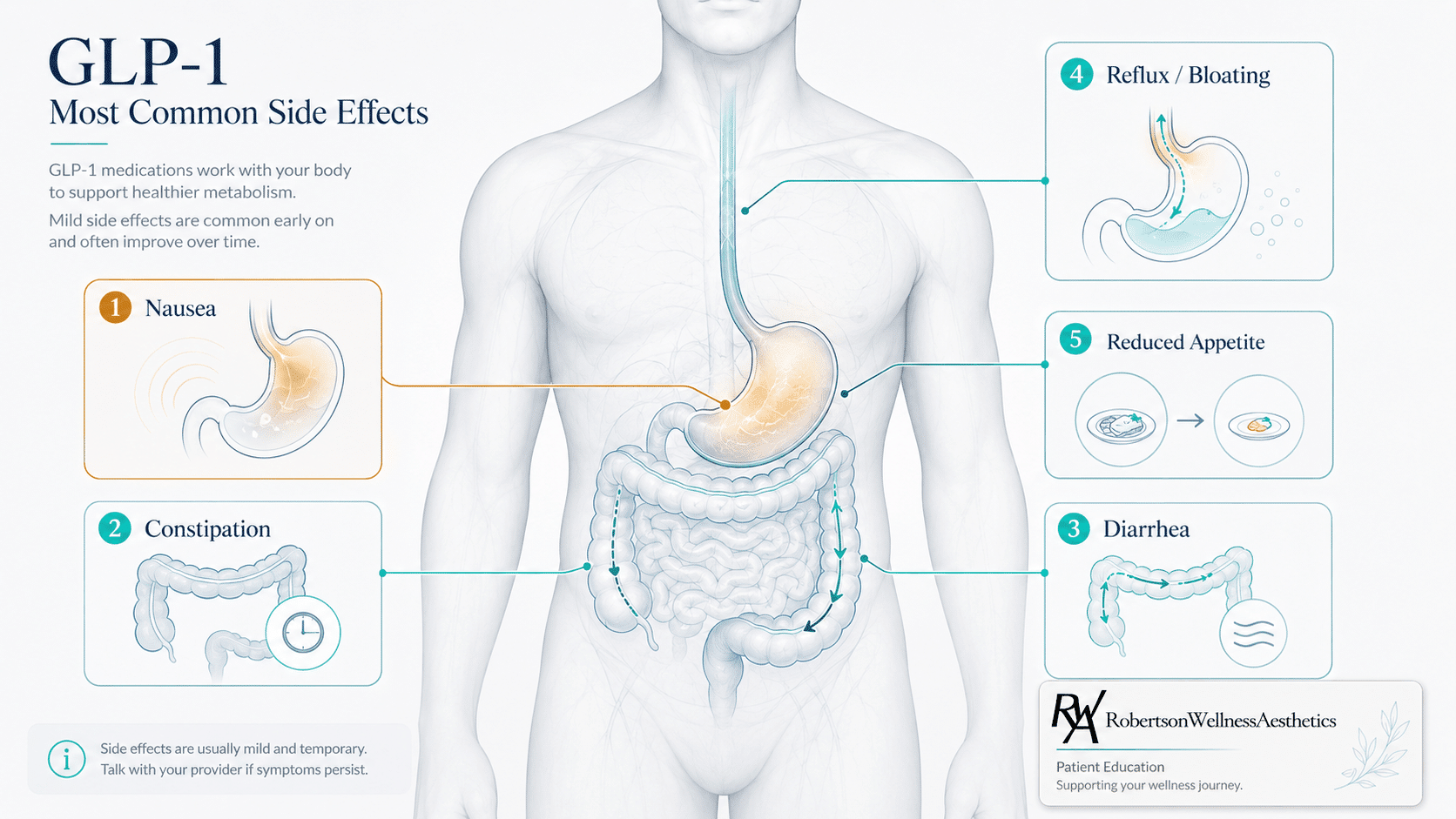
Most GLP-1 side effects are gastrointestinal, appear in the first days after a dose or a dose increase, and ease within a few weeks as your body adapts. Nausea is the most common, followed by constipation, diarrhea, vomiting, and reflux. They are usually manageable with slower dose escalation, smaller and lower-fat meals, and steady hydration — and they are the main reason people stop treatment unnecessarily, when an adjustment would have solved the problem. A small number of side effects are not routine and warrant a call to your provider the same day. Here is the realistic timeline, what to do about each effect, and where the line is between “normal” and “get this checked.”
When do GLP-1 side effects start and how long do they last?
The pattern is predictable enough to plan around, because side effects track your dose changes rather than the calendar.
| Timing | What typically happens |
|---|---|
| First 24–72 hours after a dose | Nausea and reduced appetite are usually most noticeable, often peaking on day 1–2 and easing before the next weekly injection |
| First few weeks | The adjustment period. GI effects are most common here and generally improve as the body adapts |
| After each dose increase | Symptoms often return briefly, then settle again — this is why titration is gradual |
| Beyond 8–12 weeks at a stable dose | Most people tolerate treatment well; persistent or worsening symptoms at this stage should be evaluated rather than endured |
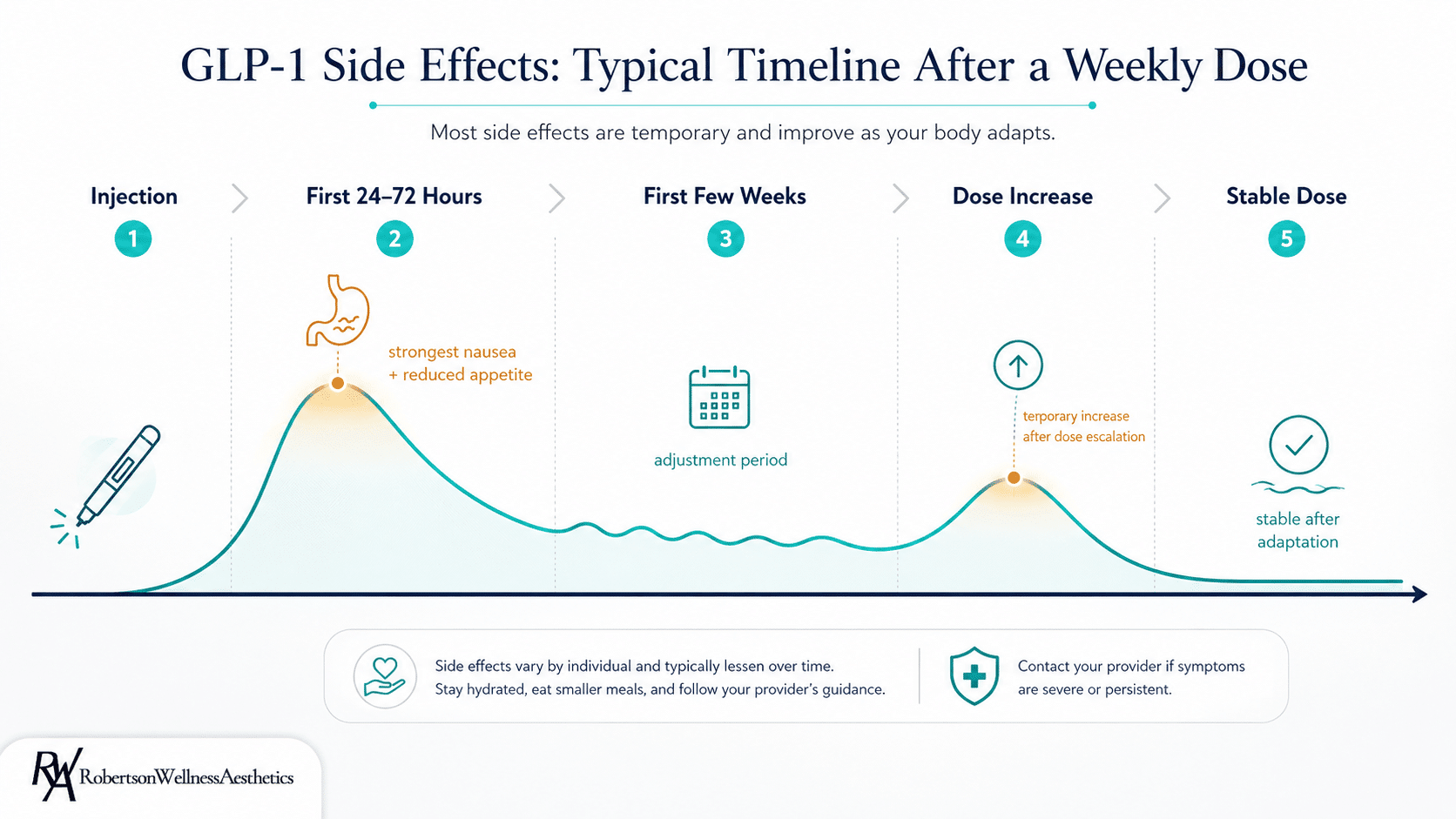
The practical takeaway: a rough week after a dose increase is expected and usually temporary. A rough week that keeps getting worse, or that arrives out of nowhere at a dose you have tolerated for months, is different information — and worth a call.
Common GLP-1 side effects and how to manage them
These affect a meaningful share of patients and are the reason most people search for this topic. None of them require heroics — they respond to fairly simple adjustments.
Nausea
The most common effect, driven largely by slowed stomach emptying. What helps: eat smaller portions and stop at the first sense of fullness rather than pushing through; favor lower-fat, lower-sugar meals, since fat slows gastric emptying further; avoid lying down right after eating; and sip fluids between meals instead of drinking large volumes with food. Bland foods during the first days after a dose are genuinely easier. If nausea is severe or prevents you from keeping fluids down, that is a call to your provider, not something to wait out.
Constipation
Very common and often underestimated. What helps: fluid intake first — constipation on a GLP-1 is frequently a hydration problem in disguise — then fiber (increased gradually, since a sudden jump can worsen bloating), and daily movement. Your provider can advise on whether an over-the-counter stool softener or magnesium is appropriate for you; don’t start one without asking, especially if you take other medications.
Diarrhea and vomiting
Less common than nausea but more consequential, because both drive fluid loss. The main risk here is not discomfort — it is dehydration, which in more serious cases has been linked to kidney injury. Prioritize steady fluid and electrolyte replacement, and contact your provider if you cannot keep fluids down for more than a day. For patients who become significantly depleted, IV hydration therapy can restore fluids and electrolytes quickly under clinical supervision.
Reflux, burping, and bloating
Also linked to slower gastric emptying. Smaller meals, staying upright for a while after eating, and avoiding carbonated drinks and very fatty meals all help. Persistent reflux is worth mentioning at your follow-up, since it may influence dosing.
Fatigue and headache
Often secondary rather than direct — a consequence of eating and drinking less rather than the medication itself. Adequate protein, fluids, and not under-eating usually resolve it. Persistent fatigue deserves evaluation, since it can also reflect nutritional gaps that show up on comprehensive blood testing.
Struggling with side effects on a GLP-1?
Most side effects are a titration problem, not a reason to quit. Our Beverly Hills physicians adjust your doseand schedule, troubleshoot nutrition and hydration, and monitor you with follow-up labs — so you can stayon treatment comfortably instead of stopping and starting over.
*$450 initial consultation can be waived with the purchase of a package. These statements have not been evaluatedby the FDA. GLP-1 medications are prescribed only after a medical evaluation by a licensed provider, are notappropriate for everyone, and individual results vary. This article is not a substitute for medical advice.
Cosmetic and body-composition changes
These get less attention in clinical summaries but drive a lot of real-world concern, and they are worth understanding accurately.
- “Ozempic face” and facial volume loss. This is not a direct drug effect — it is what rapid fat loss looks like in the face, where volume loss is most visible. Slower, steadier weight loss tends to be kinder to facial appearance than a rapid drop.
- Hair thinning. Typically telogen effluvium, a temporary shedding pattern triggered by rapid weight loss and reduced nutrient intake rather than by the medication itself. It generally resolves, and adequate protein, iron, and overall calories help.
- Muscle loss. The one worth taking seriously. Any substantial weight loss includes some lean mass, and losing muscle undermines metabolic rate and long-term maintenance. Protecting it means prioritizing protein intake and resistance training throughout treatment — not after. This is a core reason body-composition assessment belongs in a medical weight loss program rather than tracking scale weight alone.
Serious side effects: when to call your provider
These are uncommon, but they are the reason GLP-1 therapy should be medically supervised. Contact your provider promptly — or seek urgent care — for any of the following:
- Severe, persistent abdominal pain, especially pain radiating to the back, with or without vomiting — a possible sign of pancreatitis.
- Upper-right abdominal pain, fever, or yellowing of the skin or eyes — possible gallbladder problems, which can become more likely with rapid weight loss.
- Inability to keep fluids down, markedly reduced urination, or dizziness on standing — signs of dehydration that can affect kidney function.
- A lump or swelling in the neck, hoarseness, trouble swallowing, or shortness of breath — symptoms to report given the boxed warning about thyroid C-cell tumors.
- Signs of an allergic reaction — rash, swelling of the face or throat, or difficulty breathing. Seek emergency care.
- Vision changes, particularly in people with diabetes and retinopathy.
Both semaglutide and tirzepatide carry the FDA’s boxed warning regarding thyroid C-cell tumors observed in rodent studies, and both are contraindicated in anyone with a personal or family history of medullary thyroid carcinoma (MTC) or Multiple Endocrine Neoplasia syndrome type 2 (MEN 2). They are generally avoided in people with a history of pancreatitis and are not used in pregnancy. Screening for these before a first prescription is standard — and is one of the clearest differences between supervised care and an unvetted online prescription.
Which GLP-1 has the fewest side effects?
There is no clear winner, and anyone claiming one is oversimplifying. Semaglutide and tirzepatide have broadly similar side-effect profiles, dominated by the same gastrointestinal effects, because they act on overlapping pathways. In the head-to-head SURMOUNT-5 trial, both were generally tolerated at maximum tolerated doses, with GI effects most common in each group.
What actually differs is the individual. Some people tolerate one considerably better than the other, and that only becomes apparent in practice. Two factors matter far more than the choice of molecule: how gradually the dose is escalated, and whether someone adjusts the plan when symptoms appear. If you are struggling on one medication, switching under supervision is a legitimate option — see our comparison of semaglutide vs tirzepatide for how the two differ overall.
How to reduce GLP-1 side effects: a practical checklist
- Escalate slowly. The single most effective lever. Staying longer at a tolerated dose before increasing is usually better than pushing to a target on schedule.
- Eat smaller, more frequent meals and stop at comfortable fullness rather than finishing a portion out of habit.
- Reduce fat and fried foods, particularly in the 48 hours after a dose, since fat compounds delayed gastric emptying.
- Hydrate deliberately. Between meals rather than during, and consistently — this prevents both constipation and dehydration.
- Prioritize protein and resistance training from week one to protect lean mass.
- Time your dose thoughtfully. Some people prefer dosing on a day when a quieter following day is possible.
- Limit alcohol. It is often less well tolerated on GLP-1 therapy and adds to GI upset and dehydration.
- Report symptoms early. Most problems are far easier to solve at week one than at week six.
For patients in Beverly Hills and across Greater LA who prefer support without a clinic visit, follow-ups and hydration support are also available through our concierge services.
Medical Disclaimer
These statements have not been evaluated by the Food and Drug Administration for all uses discussed. This article is for educational purposes only and is not intended to diagnose, treat, cure, or prevent any disease, and it is not a substitute for individualized medical advice. GLP-1 medications are prescription drugs that must be prescribed and supervised by a licensed healthcare provider following a medical evaluation. They are not appropriate for everyone, carry a boxed warning regarding thyroid C-cell tumors, and are contraindicated in patients with a personal or family history of medullary thyroid carcinoma or MEN 2. Do not start, stop, or change a dose without consulting your provider. Compounded formulations are not FDA-approved, and the FDA does not verify the safety or effectiveness of compounded drugs. Individual results may vary. If you experience severe abdominal pain, difficulty breathing, or signs of an allergic reaction, seek medical care immediately.
Frequently asked questions
How long do GLP-1 side effects last?
Most gastrointestinal side effects appear within the first days after a dose or dose increase and ease over the following weeks as your body adapts. They commonly return briefly after each dose escalation. If side effects persist beyond the adjustment period, worsen over time, or appear suddenly at a previously tolerated dose, contact your provider rather than waiting them out.
Do GLP-1 side effects go away?
For most people, yes — the common GI effects tend to diminish once the dose stabilizes. Slower titration and dietary adjustments speed that process considerably. A minority of patients continue to have difficulty, in which case adjusting the dose, changing the schedule, or switching medications under supervision are all reasonable options.
When do side effects start after an injection?
Typically within the first 24 to 72 hours, with nausea and appetite suppression often most noticeable on the first or second day and easing before the next weekly dose.
How can I avoid or reduce side effects?
The most effective steps are escalating the dose slowly, eating smaller and lower-fat meals, stopping at comfortable fullness, hydrating consistently between meals, limiting alcohol, and prioritizing protein and resistance training. Reporting symptoms early lets your provider adjust before a problem becomes a reason to quit.
Which GLP-1 has the least side effects?
Neither semaglutide nor tirzepatide is clearly gentler — their side-effect profiles are broadly similar and dominated by gastrointestinal effects. Tolerance is highly individual, and how gradually the dose is increased matters more than which medication you choose. Some people who struggle with one do well on the other.
Is muscle loss on a GLP-1 avoidable?
Some lean-mass loss accompanies any significant weight loss, but it can be substantially reduced. Adequate protein intake and consistent resistance training throughout treatment are the main protective factors, which is why body composition — not just scale weight — should be tracked in a supervised program.
When should I be worried about a side effect?
Seek prompt medical attention for severe or persistent abdominal pain (especially radiating to the back), inability to keep fluids down, markedly reduced urination, yellowing of the skin or eyes, a neck lump or trouble swallowing, or any sign of an allergic reaction such as facial swelling or difficulty breathing. Routine nausea that improves between doses is a different situation from any of these.
Get support instead of stopping
Side effects are the most common reason people abandon GLP-1 therapy — and usually the most fixable one. Robertson Wellness and Aesthetics provides physician-supervised GLP-1 weight management in Beverly Hills, with individualized titration, follow-up labs, and practical troubleshooting so treatment stays tolerable. New to GLP-1 medications? Start with our guide to GLP-1 for weight loss without diabetes, or book a consultation with our clinical team.


