


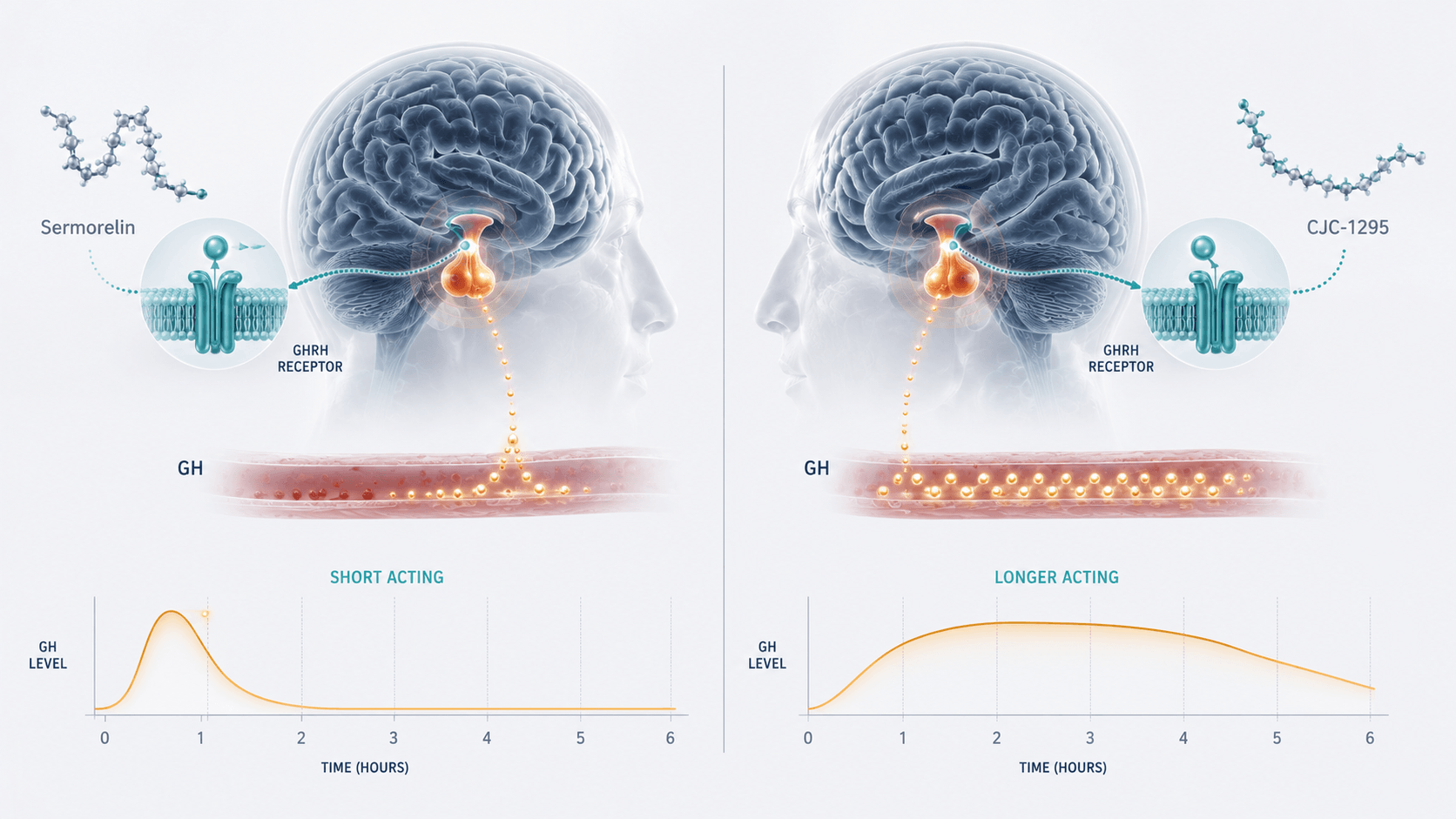
Sermorelin, ipamorelin, and CJC-1295 are all growth-hormone (GH) peptides, but they aren’t interchangeable. The simplest way to understand them: sermorelin and CJC-1295 are GHRH analogues that tell your pituitary to release more growth hormone, differing mainly in how long they act (sermorelin is short-acting; CJC-1295 is longer-acting). Ipamorelin works through a different receptor — it mimics ghrelin to trigger a clean GH pulse without raising cortisol — which is why it’s often paired with a GHRH analogue. None are FDA-approved for anti-aging or body composition, and all should be physician-supervised. Here is how the three compare and how a provider decides which fits.
Sermorelin vs ipamorelin vs CJC-1295 at a glance
| Sermorelin | CJC-1295 | Ipamorelin | |
|---|---|---|---|
| Class | GHRH analogue | GHRH analogue (long-acting) | GH secretagogue (ghrelin mimic / GHRP) |
| Receptor | GHRH receptor | GHRH receptor | Ghrelin / GH-secretagogue receptor |
| Duration | Short-acting (clears quickly) | Longer-acting, extended signal | Short, selective GH pulse |
| Key trait | Oldest, most physiologic; mimics natural GHRH | Sustained GH elevation | GH release without raising cortisol or prolactin |
| Often combined with | Ipamorelin | Ipamorelin | A GHRH analogue (CJC-1295 or sermorelin) |
| FDA status | None are FDA-approved for anti-aging/body composition; use is off-label and compounded (sermorelin was previously approved for pediatric GH deficiency, later discontinued) | ||
How growth-hormone peptides work
All three share one core idea: rather than injecting synthetic growth hormone directly, they prompt your own pituitary gland to release more of your GH in a natural, pulsatile pattern. That’s considered a more physiologic approach than direct HGH, and it’s why these are called GH secretagogues (substances that trigger secretion). The rise in GH also raises IGF-1, the downstream hormone that mediates many of GH’s effects on tissue repair, body composition, and recovery. Importantly, none of these are anabolic steroids, and they do not directly raise testosterone. The distinction that matters is which receptor each one uses.
Sermorelin
Sermorelin is a GHRH analogue — specifically a fragment of natural growth-hormone-releasing hormone — that binds the GHRH receptor in the pituitary. It is the oldest and most studied of the three, and was once FDA-approved (as Geref) for pediatric growth-hormone deficiency before being discontinued for commercial reasons around 2008; today it is available only as a compounded medication. Because it is short-acting, sermorelin produces a brief, natural GH pulse that closely mimics the body’s own rhythm.
CJC-1295
CJC-1295 is also a GHRH analogue, but engineered to last longer in the body, extending the “release GH” signal for a more sustained elevation. That longer action is its main point of difference from sermorelin.
It is frequently prescribed together with ipamorelin, a combination RWA offers as CJC-1295 + Ipamorelin peptide therapy. For how CJC-1295 compares with another GHRH peptide used for fat loss, see our guide comparing tesamorelin and CJC-1295.
Ipamorelin
Ipamorelin is the odd one out mechanistically: it is a ghrelin-receptor peptide (a GHRP), not a GHRH analogue. It triggers a GH pulse through the ghrelin/GH-secretagogue receptor, and its signature advantage is selectivity — it stimulates GH with minimal effect on cortisol (a stress hormone) or prolactin, which is why it is considered a “cleaner” secretagogue. Because it acts on a different pathway than sermorelin and CJC-1295, combining a GHRH analogue with ipamorelin can reinforce GH release through two complementary routes.
Which is better — and why they’re often combined
There is no universal winner; the three differ mainly in duration and receptor. Sermorelin offers a short, physiologic pulse and the longest track record. CJC-1295 offers a longer, more sustained signal. Ipamorelin adds a clean GH pulse from a separate pathway. This is exactly why the most common real-world approach is a combination — typically a GHRH analogue (CJC-1295 or sermorelin) plus ipamorelin — so the two mechanisms reinforce one another. Whether any single peptide or a combination fits depends on your goals, your labs, and a physician’s assessment, not a blanket ranking.
Not sure which GH peptide fits your goals?
The right peptide — or combination — is a clinical decision. Our Beverly Hills physicians review yourgoals and labs, explain the trade-offs honestly, and provide pharmaceutical-grade, compounded GH peptidetherapy under medical supervision when it’s appropriate.
These statements have not been evaluated by the FDA. These peptides are not FDA-approved for anti-aging orbody composition; use is off-label and prescribed only after a medical evaluation by a licensed provider.Not appropriate for everyone. Compounded medications are not FDA-approved. Individual results vary.
Who are GH peptides for — and who are they not for?
Growth-hormone peptides are generally considered for adults — often men and women over 40 — whose goals center on recovery, sleep quality, and body composition, who have realistic expectations, and who want a physician-supervised, signaling-based approach rather than direct HGH. Candidacy is a clinical decision that depends on goals, baseline labs (including IGF-1), and full medical history, which is why a consultation and comprehensive blood testing come first.

They are not appropriate for everyone. GH peptides are generally avoided in anyone with active or a history of cancer (given growth hormone’s effects on cell growth), during pregnancy, and they warrant caution in people with diabetes or blood-sugar concerns because GH can affect insulin sensitivity. They are also not a treatment for low testosterone — that is a separate axis addressed through men’s health and hormone optimization, not GH peptides.
Side effects, safety, and FDA status
Reported side effects across these peptides are generally mild and similar: injection-site reactions (redness, itching, swelling), water retention, headache, flushing, and occasionally tingling or numbness. Ipamorelin’s selling point is that it tends to avoid the cortisol and prolactin elevation seen with some older secretagogues. Long-term safety data in healthy aging adults is more limited than for many established therapies, which is a reason physician oversight and periodic labs matter.
On regulation, the honest picture is important: none of these peptides is FDA-approved for anti-aging, recovery, or body composition. Sermorelin was previously approved for a pediatric indication and later discontinued; all three are now used off-label and prepared by compounding pharmacies, and the compounding landscape for peptides has been under active regulatory review. Legitimate care means pharmaceutical-grade product from compliant pharmacies under the supervision of a licensed clinical team — not research chemicals bought online.
Medical Disclaimer
These statements have not been evaluated by the Food and Drug Administration. This article is for educational purposes only and is not intended to diagnose, treat, cure, or prevent any disease. Sermorelin, ipamorelin, and CJC-1295 are not FDA-approved for anti-aging or body-composition uses; such use is off-label and must be prescribed and supervised by a licensed healthcare provider following an individual evaluation. They are not appropriate for everyone, including people with active cancer or during pregnancy. Compounded medications are not FDA-approved, and the FDA does not verify the safety or effectiveness of compounded drugs. Individual results may vary. Always consult a qualified healthcare provider before beginning any new treatment.
Frequently asked questions
What is the difference between sermorelin and ipamorelin?
They work through different receptors. Sermorelin is a GHRH analogue that acts on the GHRH receptor to prompt a natural GH pulse, while ipamorelin is a ghrelin-receptor peptide that triggers GH release through a separate pathway without raising cortisol. Because the pathways are complementary, the two are often combined.
Can you take sermorelin (or CJC-1295) with ipamorelin?
Yes — combining a GHRH analogue (sermorelin or CJC-1295) with ipamorelin is a common approach because the two mechanisms reinforce one another. CJC-1295 + Ipamorelin is one of the most frequently used pairings. Any combination should be prescribed and dosed by a physician.
Which is better, sermorelin or CJC-1295?
Neither is universally better; they differ mainly in duration. Sermorelin is short-acting and closely mimics natural GHRH, while CJC-1295 is engineered to last longer for a more sustained GH signal. The right choice depends on your goals, response, and a physician’s assessment.
Are GH peptides steroids, and do they raise testosterone?
No. Sermorelin, ipamorelin, and CJC-1295 are growth-hormone secretagogues that act on the GH/IGF-1 axis — they are not anabolic steroids and do not directly raise testosterone. If low testosterone is the concern, testosterone therapy, not GH peptides, is the appropriate evaluation.
How soon do GH peptides work?
Effects such as improved sleep may be noticed relatively early, while changes in recovery and body composition typically develop over weeks to months and vary with dose, adherence, sleep, nutrition, and activity. Reputable clinics set realistic expectations and re-check labs rather than promising a fixed outcome by a fixed date.
Talk to a physician before choosing a GH peptide
If you’re weighing sermorelin, ipamorelin, or CJC-1295, the most valuable step is a consultation and bloodwork — not an online purchase. Robertson Wellness and Aesthetics offers physician-supervised peptide therapy in Beverly Hills, with in-clinic and concierge options. Book a consultation to find out which peptide — or combination — fits your goals, your labs, and your health history.
[AUTHOR BIO — credentials required before publish] This article should be attributed to and medically reviewed by a licensed RWA provider (MD/DO/NP as appropriate). Insert the named provider, title, credentials, and a one-paragraph bio establishing relevant experience in peptide therapy and hormone optimization. Example placeholder: “Medically reviewed by [Provider Name, Credentials], [role] at Robertson Wellness and Aesthetics, Beverly Hills.”


