


Exosome therapy uses tiny cell-derived messenger particles — exosomes — to deliver biological signals that may support tissue repair, skin rejuvenation, and reduced inflammation. Often sourced from mesenchymal stem cells, exosomes are being studied as a next step in regenerative medicine because they carry the “instructions” cells use to communicate, without transplanting whole cells. It is important to be clear from the outset: no exosome product is currently FDA-approved for any treatment, the science is still emerging, and reputable clinics offer it as an investigational wellness option under medical supervision — not as a proven cure. Here is an honest look at what exosome therapy is, what it may do, and what the evidence and regulators actually say.
What are exosomes?
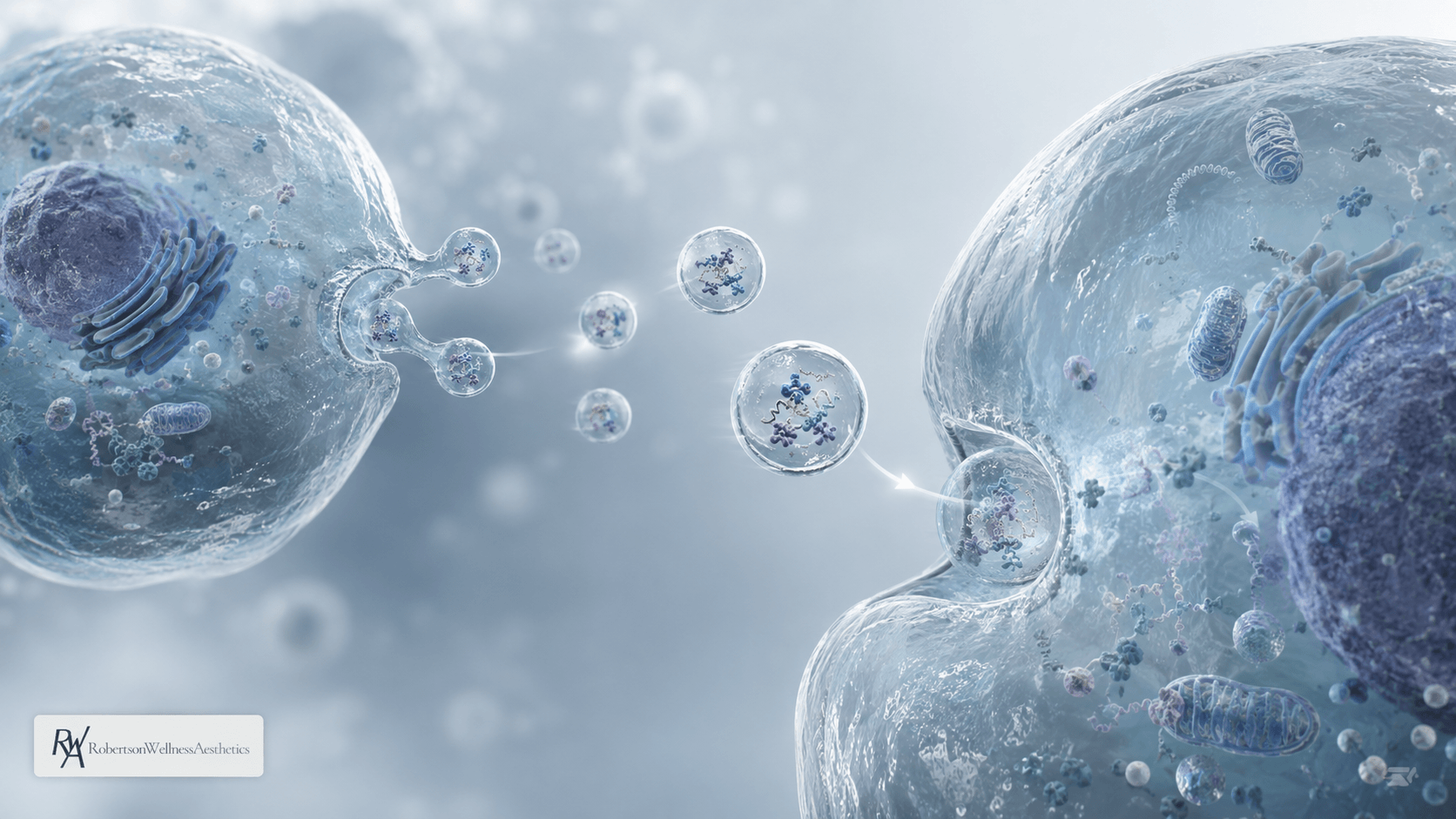
Exosomes are extracellular vesicles — extremely small, membrane-bound particles (roughly 30 to 150 nanometers) that virtually all cells release. Think of them as microscopic delivery packages: each one carries a cargo of proteins, lipids, and genetic material such as messenger RNA and microRNA, and ferries those signals from one cell to another. Through this cargo, exosomes influence how recipient cells behave — nudging processes involved in repair, immune signaling, and cell-to-cell communication. According to research summarized by Stanford Medicine, this signaling role is precisely what makes exosomes interesting for regenerative applications.
In therapy, the exosomes used are typically derived from mesenchymal stem cells (MSCs). Rather than injecting the stem cells themselves, the approach isolates the vesicles those cells produce — the idea being to deliver the beneficial signaling molecules while avoiding some of the complexity of whole-cell transplantation.
How does exosome therapy work? (mechanism)
The working theory is that MSC-derived exosomes act as messengers that help coordinate the body’s own repair responses. When delivered, their cargo of growth factors and regulatory RNA may signal recipient cells to reduce inflammation, support the formation of new blood vessels, and encourage tissue regeneration. In plain terms, exosomes don’t replace damaged tissue directly — they are thought to carry the biological “messages” that prompt your own cells to repair and regenerate more effectively.
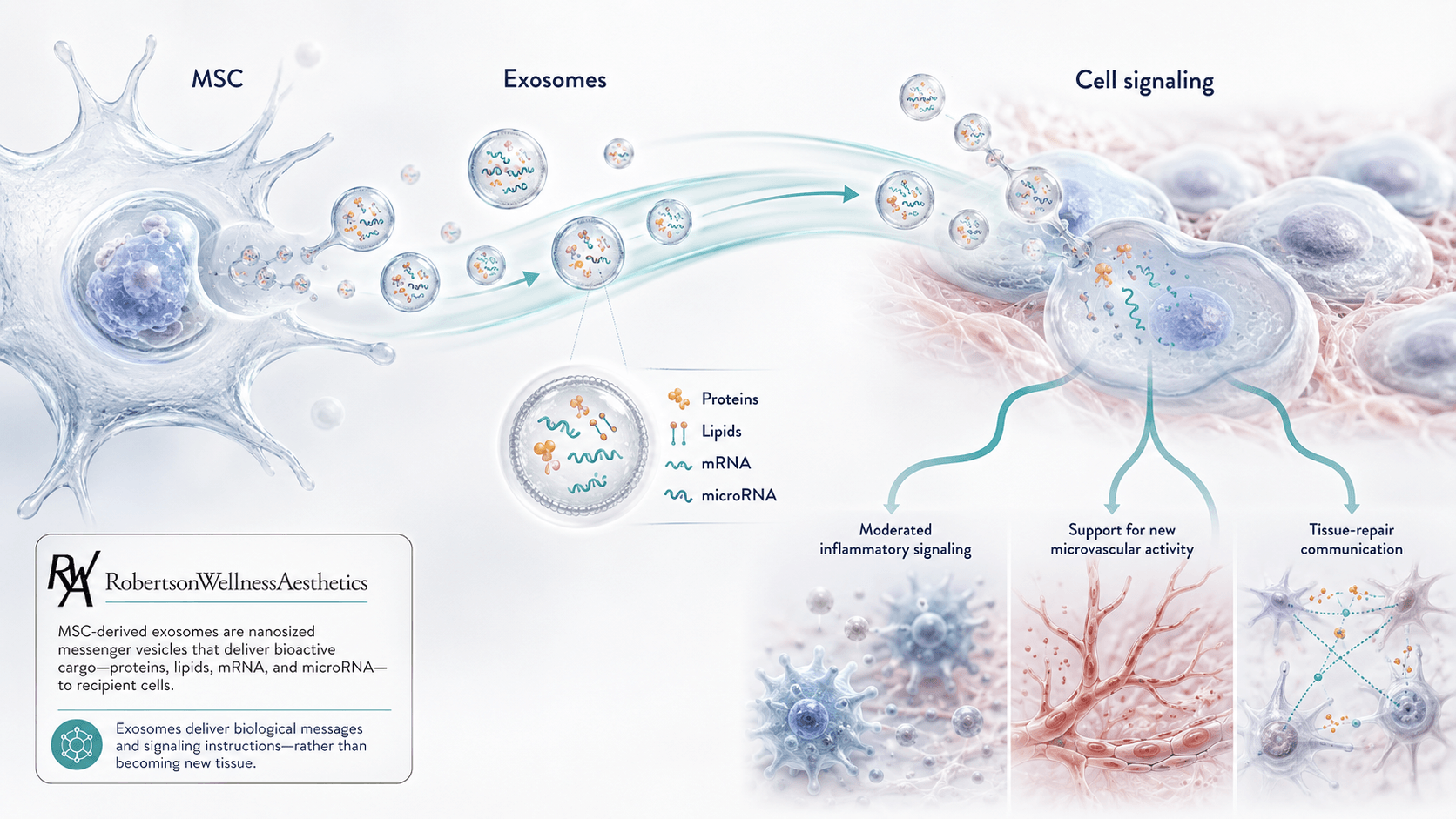
This mechanism is why exosomes are studied as a potential alternative or complement to platelet-rich plasma (PRP), which works on a similar signaling principle. Depending on the goal, exosomes may be applied topically alongside a procedure such as microneedling, injected into a target area, or delivered intravenously in a wellness setting. A peer-reviewed overview, “Exosomal therapy — a new frontier in regenerative medicine” (PMC, 2021), describes the biology in detail while noting that clinical translation is still in progress.
What is exosome therapy used for?
Exosome therapy is being explored across several areas. It’s important to frame these as areas of active study and wellness use, not established, approved treatments:
- Skin and aesthetics. Exosomes are studied for skin rejuvenation, tone and texture, and post-procedure recovery, frequently paired with microneedling to enhance delivery.
- Hair restoration. Research is examining exosomes as a signaling-based approach to support hair follicles.
- Orthopedic and recovery goals. Because of their role in tissue signaling and inflammation, exosomes are studied for joint and soft-tissue recovery.
- Systemic wellness and longevity. In wellness settings, IV exosomes are used with anti-aging and recovery goals, often alongside other longevity-focused care such as NAD+ IV therapy or peptide therapy.
The honest bottom line on effectiveness: early research is promising and the biological rationale is strong, but large, rigorous human trials are still limited, and outcomes are not guaranteed. Anyone considering exosome therapy should weigh it as an emerging option, not a sure thing.
Is exosome therapy FDA-approved?
No. As of this writing, there are no FDA-approved exosome products for any medical indication. The FDA issued public safety notifications in 2019 and 2020 warning consumers about unapproved exosome products marketed as regenerative treatments, and it has continued enforcement action against companies making unproven claims. Any exosome product marketed to treat, cure, or prevent a disease is considered an unapproved drug or biologic.
This does not mean exosomes are fringe science — the research is legitimate and advancing, including compliant investigational trials — but it does mean patients should be cautious. A responsible clinic will describe exosome therapy as investigational and wellness-oriented, be transparent about its non-approved status, and source products from reputable, quality-controlled laboratories rather than making disease-cure promises. If a provider claims exosomes are an FDA-approved cure for a specific condition, that is a red flag.
Is exosome therapy safe?
The most significant safety concerns documented by regulators have involved unregulated or contaminated products. The FDA has reported adverse events — including serious infections — linked to unapproved exosome preparations. Because these products are not standardized or FDA-verified, quality varies enormously between sources, which is the single biggest safety variable.
That is why sourcing and medical oversight matter more here than in almost any other wellness treatment. Reputable care means products from laboratories with rigorous screening and quality control, administration by a licensed clinician, and a candid conversation about the limits of the evidence. It is generally not appropriate for people with active cancer (given exosomes’ role in cell signaling), during pregnancy, or for anyone who hasn’t been evaluated. A consultation and, where relevant, comprehensive blood testing help determine whether it’s a reasonable option for you.
Curious whether exosome therapy fits your goals?
Exosome therapy is an emerging, investigational option best approached with clear expectations. Our Beverly Hillsphysicians explain what the evidence does and doesn’t support, source from quality-controlled labs, andsupervise treatment — so you can make an informed decision, not a hyped one.
Starting price; confirmed at consultation. These statements have not been evaluated by the FDA. No exosomeproduct is FDA-approved; exosome therapy is investigational, is not intended to diagnose, treat, cure, orprevent any disease, and is not appropriate for everyone. Individual results vary.
Exosomes vs. PRP vs. stem cells: how they differ
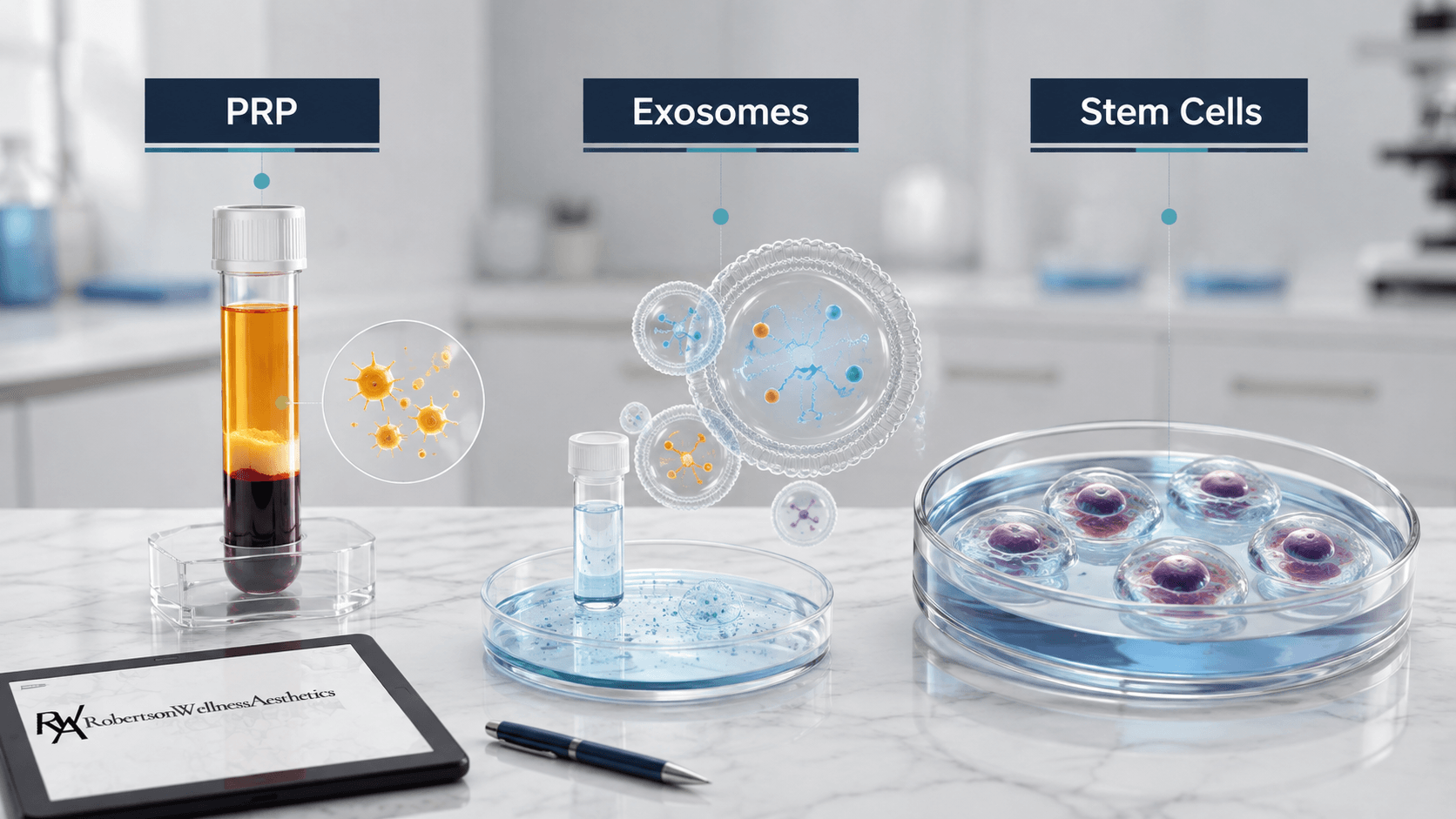
These regenerative approaches are related but distinct. PRP (platelet-rich plasma) concentrates growth factors from your own blood and is widely used in aesthetics and orthopedics. Stem cell therapy introduces whole cells with the aim of differentiation and repair. Exosomes sit conceptually in between — they are the signaling vesicles that cells (including stem cells) release, delivering the messages without the cells themselves. Exosomes are often discussed as a potential PRP alternative because both rely on signaling molecules, though PRP has a longer track record. Which approach makes sense — if any — depends on your goals and a clinician’s assessment. For skin goals, exosomes are frequently combined with microneedling with PRP.
Exosome therapy at RWA: an evidence-honest approach
At Robertson Wellness and Aesthetics, exosome IV therapy is offered within a physician-supervised, longevity-focused practice in Beverly Hills. That means realistic expectations, quality-controlled sourcing, and integration with the rest of your care — from NAD+ infusions to biological age testing — overseen by our clinical team. For patients who prefer treatment at home, hotel, or office, concierge visits are available across Greater LA.
Medical Disclaimer
These statements have not been evaluated by the Food and Drug Administration. This article is for educational purposes only and is not intended to diagnose, treat, cure, or prevent any disease. No exosome product is currently FDA-approved for any medical indication; exosome therapy is investigational and is offered as a wellness option under medical supervision. The FDA has issued safety warnings regarding unapproved exosome products. This treatment is not appropriate for everyone, and individual results may vary. Always consult a qualified healthcare provider before beginning any new treatment.
Frequently asked questions
Does exosome therapy really work?
The biological rationale is strong and early research is promising, particularly for skin and tissue signaling, but large, rigorous human trials are still limited and no exosome product is FDA-approved. It is best viewed as an emerging, investigational option with realistic expectations — not a proven or guaranteed treatment.
Is exosome therapy FDA-approved?
No. There are no FDA-approved exosome products for any medical use, and the FDA has warned consumers about unapproved exosome products marketed as regenerative treatments. Reputable clinics offer it transparently as an investigational wellness option, not as an approved cure.
Are exosomes the same as stem cells?
No. Exosomes are the tiny signaling vesicles that cells — including stem cells — release. Exosome therapy delivers those messenger particles and their cargo, rather than transplanting whole stem cells.
Is exosome therapy safe?
The main documented risks involve unregulated or contaminated products, including reports of serious infections. Because exosome products are not FDA-standardized, sourcing quality and medical supervision are the most important safety factors. It is generally avoided in people with active cancer or during pregnancy, and candidacy should be confirmed by a licensed provider.
Is exosome therapy better than PRP?
Neither is universally “better.” PRP has a longer clinical track record, while exosomes are a newer, signaling-based approach sometimes used as an alternative or complement. The right choice depends on your goals and a clinician’s assessment, and the two are sometimes combined.
Talk to a physician about exosome therapy
If regenerative or anti-aging options interest you, the most valuable step is a consultation that separates evidence from marketing. Robertson Wellness and Aesthetics offers physician-supervised exosome IV therapy in Beverly Hills, with in-clinic and concierge options and a candid, evidence-honest approach. Book a consultation to discuss whether it fits your goals and health history.


