
EBOO + UV Light therapy (extracorporeal blood oxygenation and ozonation combined with ultraviolet blood irradiation, offered at RWA Center as O3UV) is a clinician-administered procedure in which a portion of your blood is drawn through a closed sterile circuit, passed through a hollow-fiber filter, exposed to a controlled oxygen-ozone mixture and to ultraviolet light, and returned to your body in the same session. It is the most technically involved form of ozone therapy: instead of treating a single small volume of blood, the circuit runs continuously for about 60 to 75 minutes. EBOO is used as a wellness and supportive therapy, not as a treatment for any disease, and it is not approved by the FDA for any medical indication.
This guide explains what actually happens to your blood during each stage of the procedure, what the published research does and does not show, who is a candidate, what to expect, side effects and contraindications, and what a session costs at our EBOO + UV Light clinic in Beverly Hills.
What is EBOO, and how is it different from other ozone therapies?
EBOO stands for extracorporeal blood oxygenation and ozonation. “Extracorporeal” simply means outside the body: blood leaves through one IV line, is treated in a machine, and re-enters through a second line, similar in principle to the circuits used in dialysis or apheresis. The method was developed in Italy in the late 1990s by nephrologist Nicola Di Paolo and ozone researcher Velio Bocci, who published the first report of its use in humans in the International Journal of Artificial Organs in 2000.
Most ozone therapy is delivered by major autohemotherapy (MAH): roughly 100 to 200 mL of blood is drawn into a bag, mixed with an oxygen-ozone gas mixture, and reinfused. “10-pass” ozone repeats that cycle ten times under pressure. EBOO differs in three ways:
- Volume and continuity. Rather than treating discrete batches, blood flows continuously through the device. Over a 60 to 75-minute session, roughly 2 to 5 liters pass through the circuit.
- Filtration. Blood passes through a hollow-fiber filter before it is returned. This is the component that gives EBOO its “blood filtration therapy” and “blood oil change” nicknames.
- Full-spectrum UV. In the O3UV protocol used at RWA Center, the ozonated blood is also exposed to ultraviolet light (UVA, UVB and UVC) inside the circuit, combining EBOO with ultraviolet blood irradiation (UBI) in a single session.
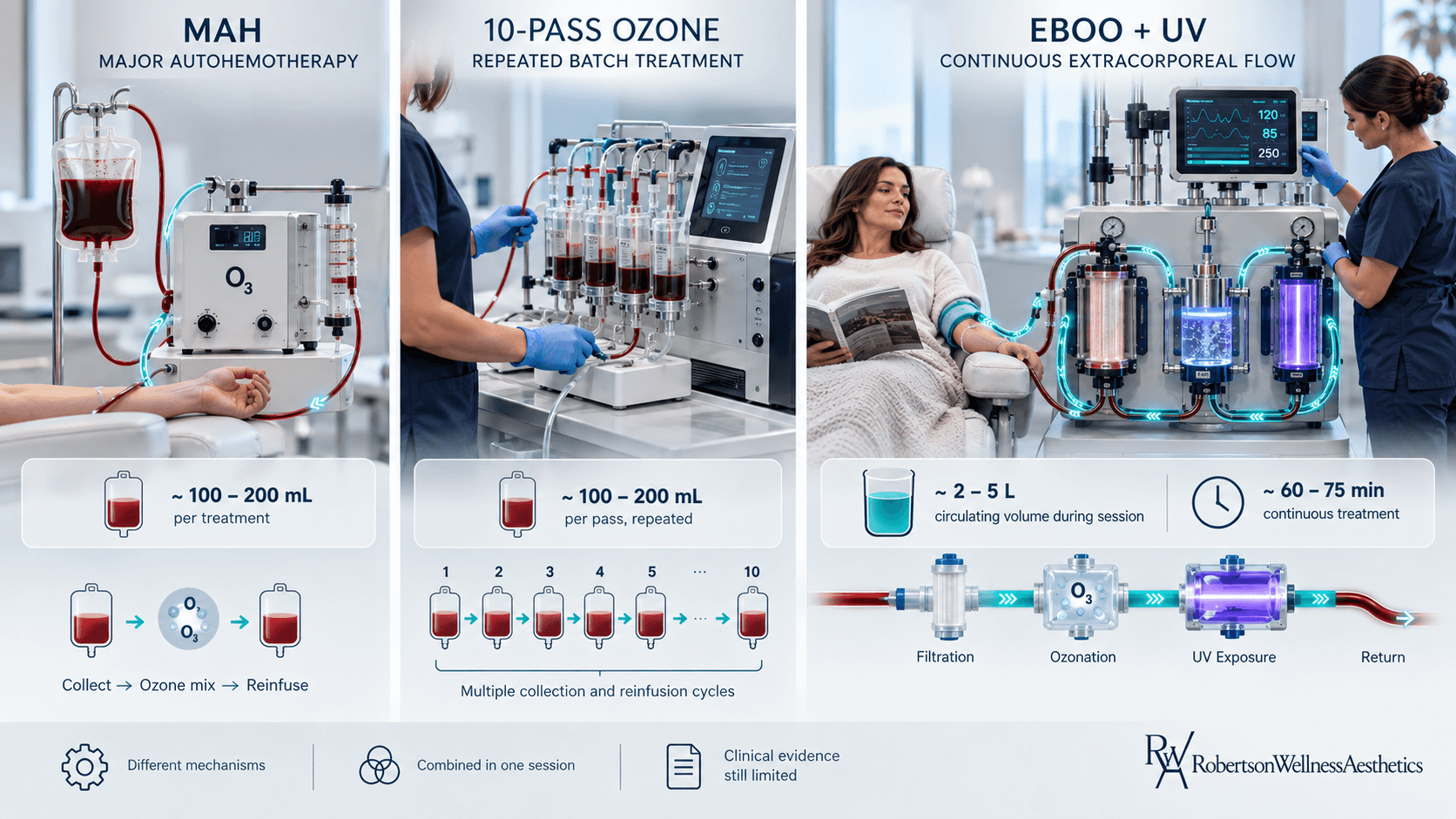
For a side-by-side of the three approaches, see our comparison of EBOO vs 10-pass ozone vs UBI.
How does EBOO + UV Light work? The three stages explained
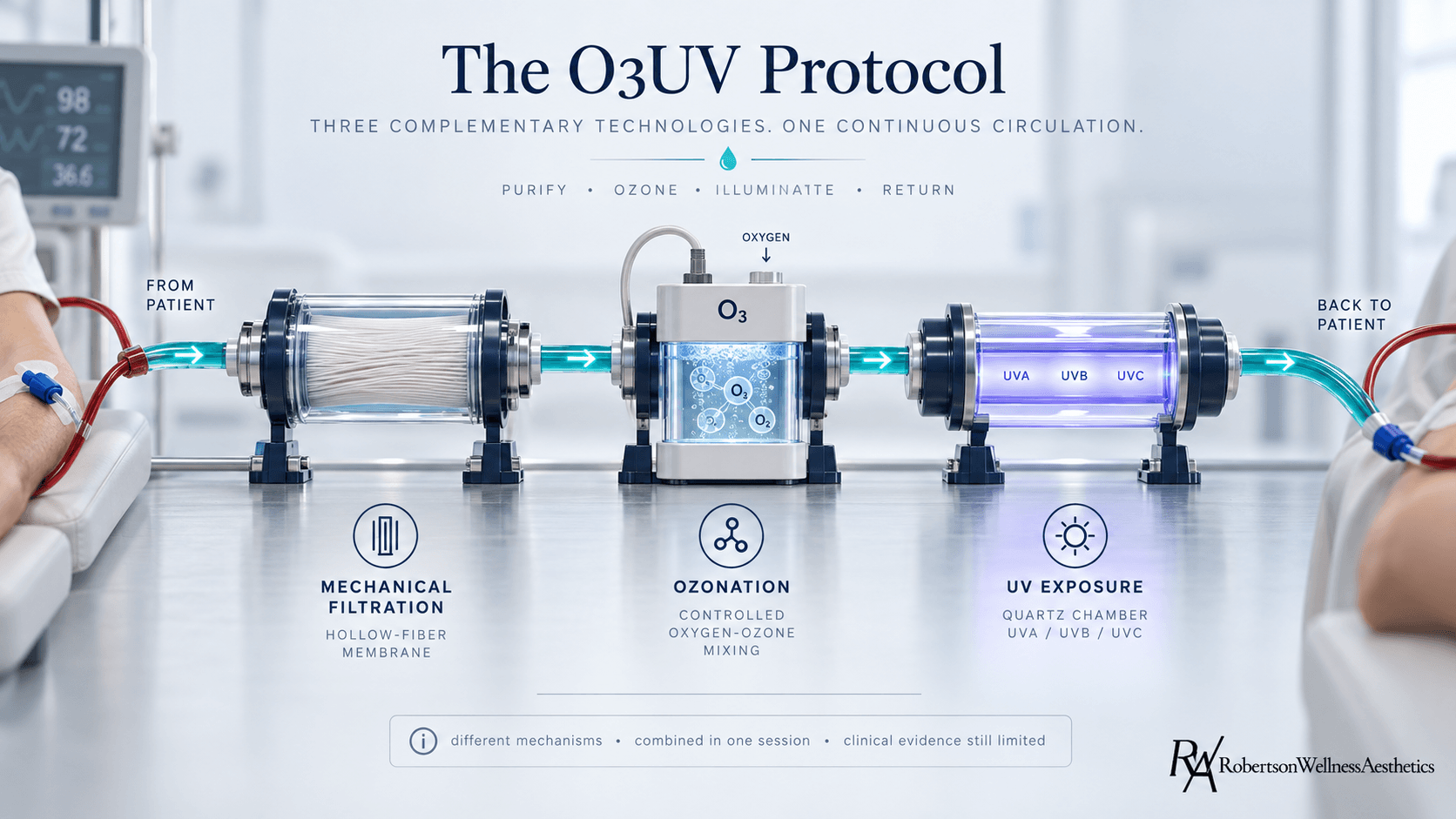
The procedure is best understood as three sequential steps, each with its own proposed biochemistry. The word “proposed” matters: most of what follows comes from laboratory and small clinical studies of ozone and UV blood treatment, not from large randomized trials of EBOO itself.
Stage 1: Mechanical filtration
Blood first passes through a hollow-fiber membrane filter of the type used in extracorporeal medicine. Plasma water and small dissolved molecules can cross the membrane; blood cells and large proteins cannot. In the original EBOO device described by Di Paolo and colleagues, the same gas-exchange membrane that delivers the oxygen-ozone mixture also serves as the filtering surface.
In plain terms: the filter acts like a fine sieve that the blood is pushed across, while the cells you need stay in circulation. Claims that the filter removes a specific percentage of “toxins” have not been measured in published EBOO studies, and we do not make them.
Stage 2: Ozonation
Medical ozone (O3) is a highly reactive three-atom form of oxygen. When a precisely dosed oxygen-ozone mixture contacts blood, the ozone itself disappears within seconds: it reacts with unsaturated fatty acids in cell membranes and with antioxidants in plasma to form short-lived compounds, mainly hydrogen peroxide and lipid ozonation products such as 4-hydroxynonenal. These act as messengers rather than as ozone directly.
Two mechanisms are best supported in the literature:
- Antioxidant response via Nrf2. A brief, controlled oxidative stimulus activates the transcription factor Nrf2, which in turn increases the cell’s own antioxidant enzymes (superoxide dismutase, catalase, glutathione peroxidase and others). This “oxidative preconditioning” model is described in detail by Galiè and colleagues in the International Journal of Molecular Sciences (2019) and in Bocci, Zanardi and Travagli’s review in Medical Gas Research (2011).
- Oxygen delivery. Ozonation has been reported to increase 2,3-diphosphoglycerate (2,3-DPG) in red blood cells, which shifts the oxygen-hemoglobin dissociation curve to the right and makes it easier for red cells to release oxygen into tissues (Bocci et al., 2011). Improved red-cell flexibility and reduced blood viscosity have also been described.
Ozone is also reported to modulate cytokine release from white blood cells at physiological levels; this immune-signaling effect is documented in reviews by Smith and colleagues (Medical Gas Research, 2017) but remains an area of active research rather than settled science.
Stage 3: Ultraviolet blood irradiation
In the O3UV protocol, the ozonated blood is exposed to ultraviolet light inside a quartz chamber before returning to the body. UV blood irradiation was used in US hospitals in the 1940s and 1950s and largely abandoned after antibiotics arrived; interest has returned in recent years. The most thorough modern review, by Wu, Hu and Hamblin in the Journal of Photochemistry and Photobiology B (2016), summarizes the proposed mechanisms:
- UVC (200 to 280 nm) is absorbed by nucleic acids and is germicidal in laboratory conditions.
- UVA and UVB (280 to 400 nm) are thought to act on photosensitive molecules in blood, generating small, transient amounts of reactive oxygen species that may influence immune-cell signaling.
The authors are candid that the human evidence for UBI is mostly historical and that well-designed modern trials are lacking. We share that view, and we present UV light as a complementary component of the protocol rather than a proven therapy in its own right.
Why combine the three?
The rationale for O3UV is that filtration, ozonation and UV act on different targets in the same pass, so a single session addresses oxygen delivery, the antioxidant response and blood rheology together. That rationale is mechanistic; head-to-head trials comparing the combination with ozone alone have not been published.
What does the research actually show?
Honest answer: EBOO has a plausible mechanism and a reassuring safety record in the studies that exist, but the clinical evidence base is small. The key publications are:
- Di Paolo et al., International Journal of Artificial Organs, 2000: the first report of EBOO in humans, establishing that the procedure could be performed safely with an extracorporeal circuit.
- Di Paolo et al., International Journal of Artificial Organs, 2005 (controlled trial): a small trial in patients with peripheral artery disease in which EBOO was well tolerated and the authors reported clinical improvement in the treated group. The study was small, single-center, and has not been independently replicated.
- Di Paolo, Gaggiotti and Galli, International Journal of Artificial Organs, 2005 (review): the developers’ own summary of the clinical and biological implications of ozonation delivered extracorporeally.
Two things follow from this. First, EBOO is not a treatment for any disease, and you should be cautious of any clinic that promises specific results or quotes precise “effectiveness percentages” for it; those numbers do not come from the published literature. Second, the US Food and Drug Administration has not approved ozone for any medical use, and its regulation on ozone-generating devices (21 CFR 801.415) states that ozone is a toxic gas with no known useful medical application in specific, adjunctive, or preventive therapy. At RWA Center, EBOO is offered as an elective wellness procedure under clinical supervision, with that regulatory context disclosed.
Who chooses EBOO + UV Light, and who should not?
The people who come to us for O3UV are typically adults focused on longevity and recovery: executives and entertainment professionals managing demanding schedules, athletes and biohackers interested in oxygen delivery and antioxidant capacity, and patients who describe persistent low energy and want a supervised, evidence-aware option to discuss with a clinician. Many combine EBOO with NAD+ IV therapy or a peptide program as part of a broader plan.
EBOO is not appropriate for everyone. Standard exclusion criteria in ozone therapy practice, as summarized by Bocci and colleagues (2011), include:
- Glucose-6-phosphate dehydrogenase (G6PD) deficiency, because ozone can trigger red-cell breakdown in people with this enzyme deficiency. We screen for it with a simple blood test before a first session; see blood testing at RWA Center.
- Pregnancy and breastfeeding.
- Uncontrolled hyperthyroidism.
- Significant anemia, active bleeding, or a bleeding or clotting disorder (the extracorporeal circuit requires anticoagulation during the session).
- Recent heart attack or stroke, unstable heart disease, or any condition in which moving blood through an external circuit would be unsafe.
Every patient completes a medical evaluation before treatment, and the supervising clinician decides whether EBOO is appropriate. If it is not, we will say so.
What to expect during a session
- Consultation and screening. Health history, current medications, and baseline labs including G6PD. This is the point at which most exclusions are identified.
- Two IV lines. A licensed clinician places one line to draw blood and one to return it, most often in opposite arms. Our IV team is experienced with difficult veins.
- The circuit runs. Blood moves continuously through the filter, the oxygen-ozone exchange membrane and the UV chamber, then back to you. The session lasts about 60 to 75 minutes, during which you recline in a private treatment room. You can read, work or rest.
- Aftercare. Lines are removed and the sites dressed. Most patients drive themselves home. We recommend hydration and a light day; some people feel relaxed or tired for a few hours.
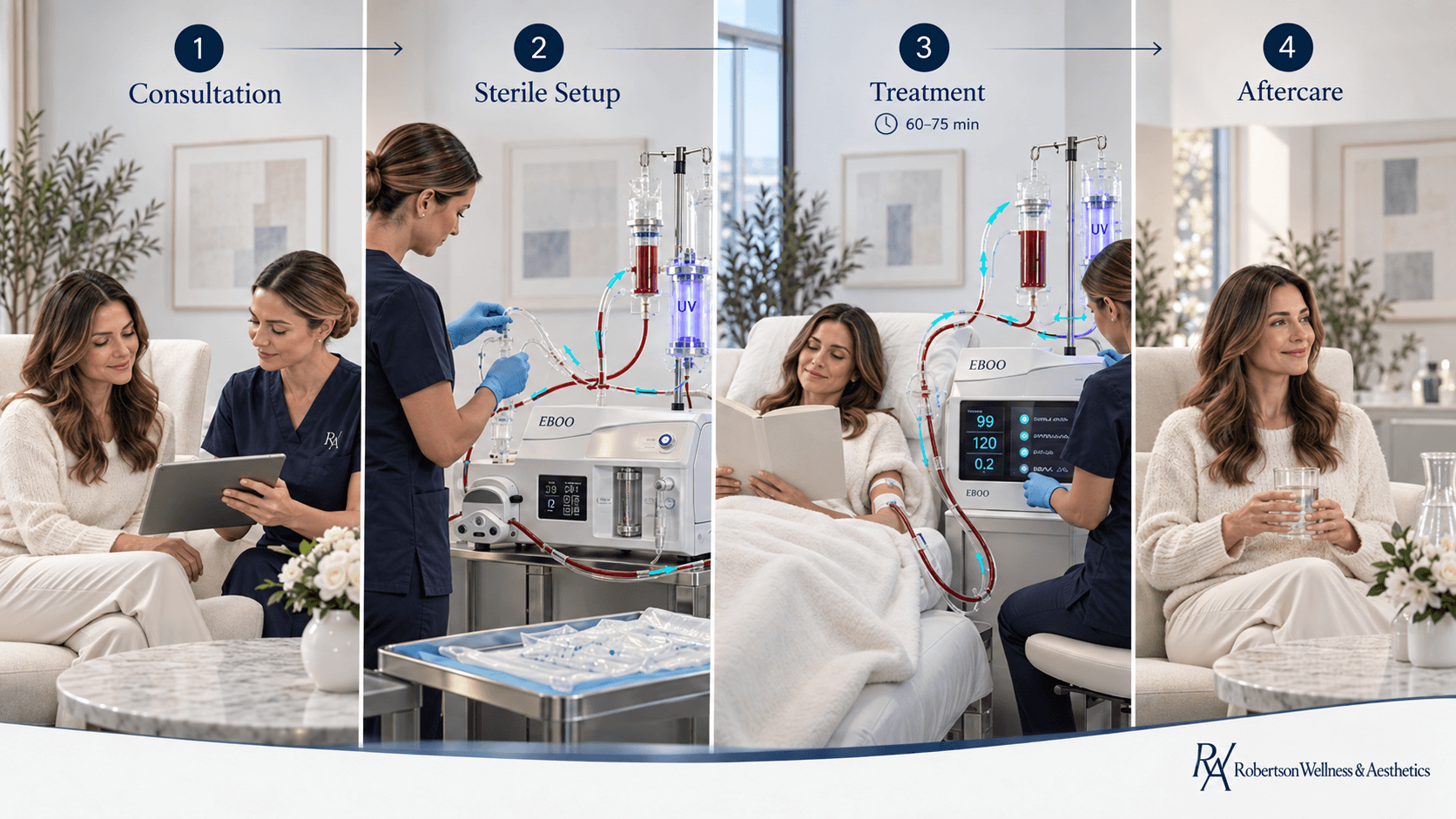
A typical starting course is three to six sessions, spaced one to two weeks apart, with the schedule adjusted to how you respond. If you are worried about discomfort, our article on whether ozone therapy hurts covers it in detail.
Side effects and safety
In the published EBOO studies and in ozone therapy practice more broadly, the procedure is reported to be well tolerated when performed with pharmaceutical-grade oxygen, calibrated ozone dosing and a sterile closed circuit. Effects that patients describe, usually mild and short-lived, include:
- Tenderness or bruising at the needle sites.
- Light-headedness or a drop in blood pressure during or shortly after the session.
- Tiredness for the rest of the day, or occasionally a temporary “flu-like” feeling.
- A metallic taste during treatment.
Because EBOO uses an extracorporeal circuit and anticoagulation, it carries the same category of risks as other extracorporeal procedures: bleeding, clotting within the circuit, and infection if sterile technique fails. These are the reasons the procedure must be performed by trained clinicians using single-use sterile components, with a medical professional present throughout. Ozone must never be inhaled; medical ozone systems are designed so the gas never contacts your airway.
How much does EBOO cost?
At RWA Center in Beverly Hills, a single O3UV (EBOO + UV Light) session is $799. The 4-session package brings that to $699 per session ($2,796 total), which is the option most patients choose when they plan a full course. Across the United States, single EBOO sessions are generally advertised in the $1,000 to $1,500 range. Our detailed guide to EBOO treatment cost breaks down what drives the price and how packages compare, and our ozone therapy cost guide covers 10-pass and single-pass MAH.
EBOO is not covered by insurance because it is not an approved treatment for any diagnosis.
EBOO + UV Light vs other ozone options at a glance
| Feature | EBOO + UV Light (O3UV) | 10-pass ozone (MAH) | UBI alone |
|---|---|---|---|
| Blood treated per session | Continuous flow, roughly 2 to 5 liters | About 200 mL per pass, ten passes | A small drawn volume, UV only |
| Filtration | Yes | No | No |
| Ultraviolet component | Yes, full spectrum | No | Yes |
| Session time | 60 to 75 minutes | About 60 minutes | About 30 to 45 minutes |
| RWA Center pricing | $799 per session; $699 per session in a 4-session package | From $599 per session | See UBI page |
Which one suits you depends on your goals, your health history and your budget; the consultation exists to work that out. Our guide to what the science says about ozone therapy benefits is a good next read if you are still weighing options.
Why patients choose RWA Center for EBOO in Beverly Hills
Our clinic on Wilshire Boulevard, minutes from Cedars-Sinai and the Beverly Hills hotel corridor, performs O3UV in private treatment rooms with single-use sterile circuits, pharmaceutical-grade oxygen and calibrated ozone generation. Every protocol is reviewed by Biana Borchenko, FNP-BC, and administered by licensed clinicians with a medical professional present for the full session. We screen every patient for G6PD deficiency and other exclusions before a first treatment, and we integrate EBOO with peptide therapy, NAD+ and functional lab work when that makes sense for the individual, not as a default upsell. Hotel guests and visiting executives can coordinate sessions through our concierge services.
Frequently asked questions about EBOO + UV Light
Is EBOO the same as a “blood oil change”?
“Blood oil change” is a marketing nickname for EBOO that refers to the filtration step. It is not a medical term, and the comparison overstates what the filter does: it does not replace your blood or remove a measured quantity of “toxins”. EBOO filters, ozonates and (in O3UV) UV-treats your own blood before returning it.
How many EBOO sessions do I need?
Most patients start with three to six sessions spaced one to two weeks apart. There is no published dosing standard, so the schedule is set by the supervising clinician based on your goals and how you respond to the first session.
Does EBOO hurt?
The main discomfort is the two IV placements. Once the lines are in, most people find the session comfortable and use the time to rest or work. See our full article on ozone therapy and pain.
Is EBOO FDA-approved?
No. The FDA has not approved ozone for any medical use, and ozone-generating devices are regulated under 21 CFR 801.415. EBOO is offered as an elective wellness procedure, and no clinic can lawfully claim it treats a disease.
Can I do EBOO if I take blood thinners?
Not without a specific medical review. The procedure uses anticoagulation in the circuit, so existing blood-thinning medication, bleeding disorders and recent surgery all need to be assessed by the supervising clinician before you are scheduled.
What is the difference between EBOO and EBO2?
They describe the same category of procedure. EBO2 is a trade name used by one equipment manufacturer for its extracorporeal blood oxygenation and ozonation system; EBOO is the generic term from the original research. RWA Center’s O3UV protocol adds full-spectrum UV to the EBOO process.
Board-certified Family Nurse Practitioner and member of the American Academy of Anti-Aging Medicine (A4M). Biana oversees IV, ozone and peptide protocols at Robertson Wellness & Aesthetics in Beverly Hills and reviews all clinical content on this site.