


Tirzepatide is dosed once weekly and titrated upward slowly: everyone starts at 2.5 mg for four weeks, moves to 5 mg, and from there increases in 2.5 mg steps — never sooner than every four weeks — up to a maximum of 15 mg per week. The six available doses are 2.5, 5, 7.5, 10, 12.5, and 15 mg. The 2.5 mg starting dose exists to let your body adapt, not to produce results, and approved maintenance doses for weight management are 5, 10, or 15 mg. If you miss a dose, you have a four-day window to take it. Below is the full titration chart, what each stage is actually for, missed-dose rules, and the compounding changes that reshaped access in 2026. Dosing decisions belong to your prescriber — this is the framework they work within.
Tirzepatide dosage chart
This schedule follows the FDA prescribing information for Zepbound (tirzepatide for weight management). Mounjaro, the same molecule prescribed for type 2 diabetes, follows the same titration structure.
| Dose | Typical timing | Purpose |
|---|---|---|
| 2.5 mg | Weeks 1–4 | Starting dose only. For treatment initiation and tolerability — not an approved maintenance dose |
| 5 mg | Week 5 onward | First approved maintenance dose. Many people stay here |
| 7.5 mg | After ≥4 weeks at 5 mg | Intermediate step toward a higher maintenance dose |
| 10 mg | After ≥4 weeks at 7.5 mg | Approved maintenance dose |
| 12.5 mg | After ≥4 weeks at 10 mg | Intermediate step |
| 15 mg | After ≥4 weeks at 12.5 mg | Maximum recommended dose. Approved maintenance dose |
Two details from the label are worth emphasizing because they are frequently misread. First, 2.5 mg is not a maintenance dose — it is a four-week on-ramp. Second, the approved maintenance doses for weight management are 5, 10, and 15 mg; 7.5 and 12.5 mg exist as titration steps between them, though a prescriber may keep a patient at an intermediate dose if that is where they are doing well and tolerating treatment.
Why titration is slow — and why that matters
The four-week minimum between increases is not bureaucratic caution. Tirzepatide slows gastric emptying and acts on appetite signaling, and the gastrointestinal side effects that follow — nausea, constipation, reflux — are dose-related. Escalating gradually gives the body time to adapt at each level, which is the single most effective way to keep treatment tolerable.

This is also why rushing rarely pays off. Moving up faster than the schedule tends to produce more side effects without a corresponding benefit, and side effects are the most common reason people abandon GLP-1 therapy altogether. Conversely, there is no requirement to climb to 15 mg. If you are responding well and feeling good at 5 or 10 mg, staying there is a legitimate clinical decision — the goal is the lowest effective dose, not the highest tolerated one. For a fuller breakdown of what to expect symptom-wise, see our guide to GLP-1 side effects and how to manage them.
What to expect at each stage
- Weeks 1–4 (2.5 mg). Appetite changes usually begin, often noticeably. Mild nausea in the first day or two after each injection is common. This phase is about tolerance, not results.
- After each increase. Symptoms typically return briefly for a few days, then settle. This pattern repeats at every step up and is expected.
- At a stable maintenance dose. Most people find side effects fade substantially. Persistent or worsening symptoms at a dose you previously tolerated are worth reporting rather than enduring.
- Throughout. Protein intake and resistance training matter from week one, because any substantial weight loss includes some lean mass. Tracking body composition rather than scale weight alone is part of a properly run program.
Individual response varies considerably, and no dose guarantees a particular outcome. Progress is assessed with your provider over months, not weeks.
What if you miss a dose?
The prescribing information gives clear rules, and they are easy to follow once you know them:
- Within 4 days (96 hours) of the missed dose: take it as soon as you remember, then resume your regular weekly schedule.
- More than 4 days late: skip the missed dose entirely and take your next dose on the normally scheduled day. Do not double up.
- Never take two doses within 3 days (72 hours) of each other. This is the hard limit that keeps the missed-dose rule safe.
- Changing your injection day is permitted, provided at least 3 days (72 hours) separate the two doses.
If you have missed several weeks in a row, do not simply resume your previous dose. Extended gaps often mean restarting at a lower dose and re-titrating, because tolerance fades — contact your provider rather than picking up where you left off.
Want your dose managed by a physician, not a chart?
A titration schedule is a starting framework — the right dose for you depends on your response, tolerance, and labs. Our Beverly Hills providers evaluate you, set the schedule, adjust when side effects appear, and monitor progress with follow-up testing rather than leaving you to self-manage.
*$450 initial consultation can be waived with the purchase of a package. These statements have not been evaluated by the FDA. Tirzepatide is a prescription medication provided only after a medical evaluation by a licensed provider, is not appropriate for everyone, and individual results vary. Do not adjust your dose without your provider.
Compounded vs brand tirzepatide: what changed in 2026
This is the part of the tirzepatide landscape that shifted most, and anyone researching dosing should understand it. During the 2022–2024 shortage, tirzepatide was widely available in compounded form at a fraction of brand pricing. That era has ended.
The FDA declared the tirzepatide shortage resolved in late 2024, and enforcement discretion for outsourcing (503B) facilities ended in March 2025. In May 2026 the FDA proposed excluding tirzepatide from the 503B bulks list altogether, citing no clinical need for it to be compounded, and legal challenges from compounding industry groups did not succeed in blocking the direction of travel. The practical result: compounding a product that is “essentially a copy” of an FDA-approved tirzepatide is no longer permissible for either 503A or 503B pharmacies.
A narrower path remains. A state-licensed 503A pharmacy may still compound tirzepatide for an individual patient when a prescriber documents a specific clinical need that the FDA-approved product cannot meet — an excipient allergy, for example. That is a genuine exception for an individual, not a route to routine mass-produced supply.
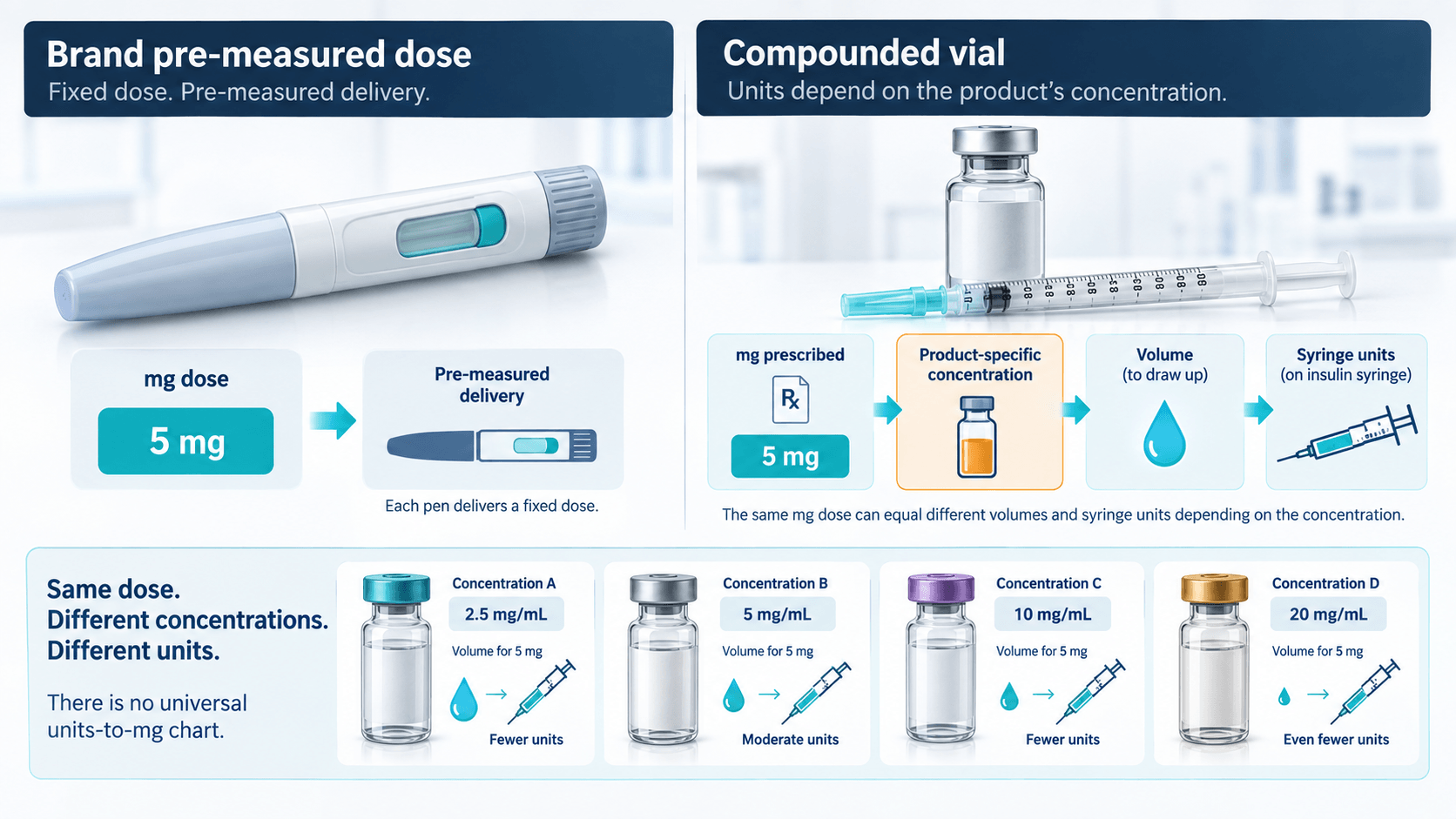
Why it matters for dosing specifically: brand pens deliver a fixed, pre-measured dose, so “5 mg” means the same thing every time. Compounded vials do not standardize concentration, which is why online “units to mg” conversion charts are unreliable — the number of units equal to a given dose depends entirely on the concentration your pharmacy dispensed. Never convert from a generic chart. If you have a vial and syringe, the conversion must come from your prescribing provider and your specific product label.
Side effects, warnings, and who should not take tirzepatide
The most common side effects are gastrointestinal: nausea, diarrhea, vomiting, constipation, abdominal pain, and reflux. These are dose-related and usually most noticeable after starting or increasing a dose.
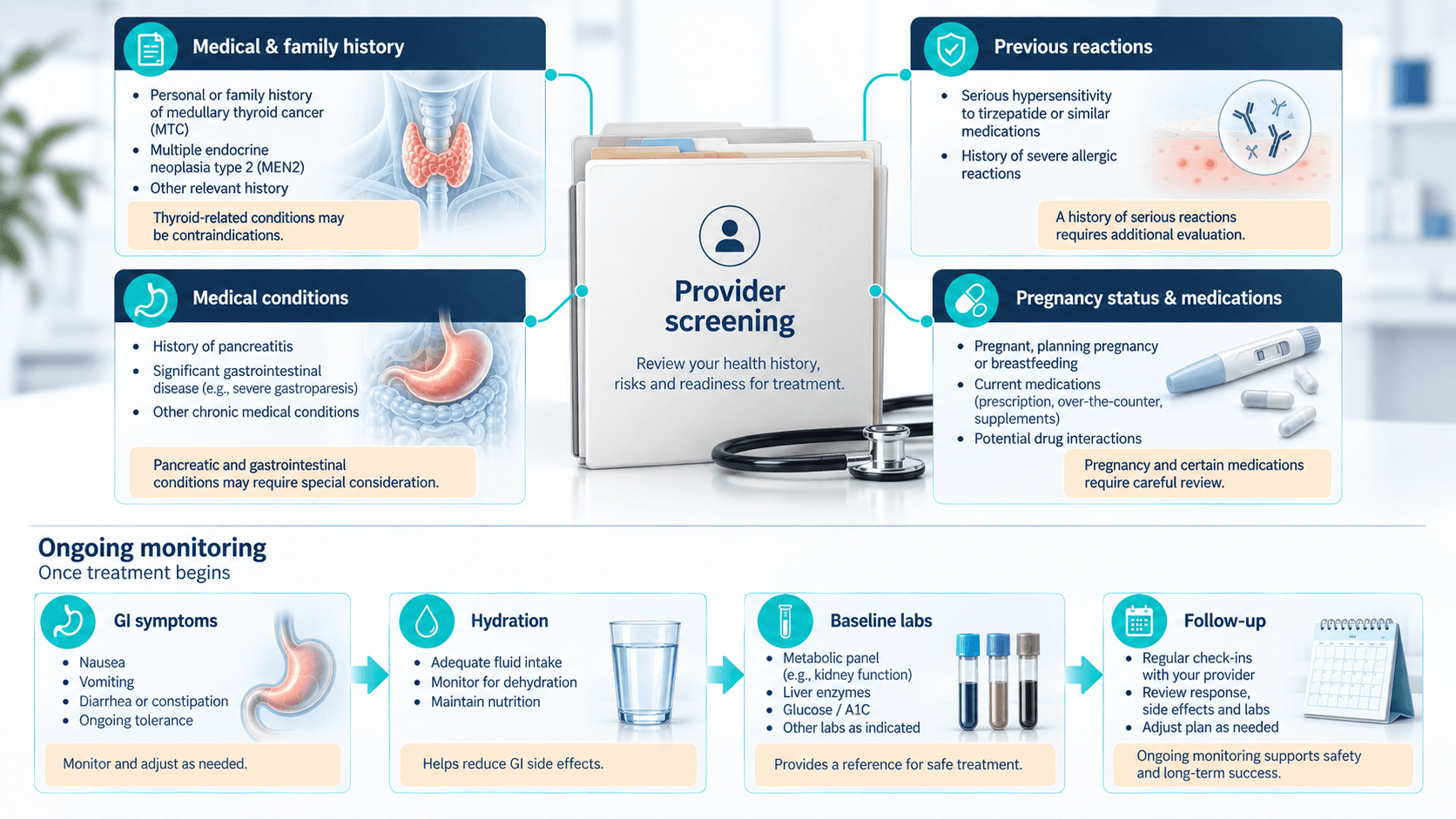
Tirzepatide carries the FDA’s boxed warning regarding thyroid C-cell tumors observed in rodent studies. It is contraindicated in anyone with a personal or family history of medullary thyroid carcinoma (MTC) or Multiple Endocrine Neoplasia syndrome type 2 (MEN 2), and in anyone with a prior serious hypersensitivity reaction to tirzepatide. It is generally avoided in people with a history of pancreatitis and is not used during pregnancy. Report promptly: severe or persistent abdominal pain (especially radiating to the back), a neck lump or swelling, hoarseness or trouble swallowing, inability to keep fluids down, or signs of an allergic reaction.
Screening for these before a first prescription is standard practice, alongside baseline blood testing — and is one of the clearest differences between supervised care and an unvetted online prescription. Tirzepatide is not appropriate for everyone.
Medical Disclaimer
These statements have not been evaluated by the Food and Drug Administration for all uses discussed. This article is for educational purposes only, reflects the FDA prescribing information at the time of writing, and is not individualized medical advice. Tirzepatide is a prescription medication that must be prescribed and supervised by a licensed healthcare provider following a medical evaluation. It carries a boxed warning regarding thyroid C-cell tumors and is contraindicated in patients with a personal or family history of medullary thyroid carcinoma or MEN 2. Do not start, stop, or change a dose without consulting your provider. Compounded formulations are not FDA-approved, and the FDA does not verify the safety or effectiveness of compounded drugs; compounding rules for tirzepatide changed in 2025–2026 and continue to evolve. Individual results vary and are not guaranteed. If you experience severe abdominal pain or signs of an allergic reaction, seek medical care immediately.
Frequently asked questions
What is the tirzepatide titration schedule?
Start at 2.5 mg once weekly for four weeks, then increase to 5 mg once weekly. After that, the dose may be increased in 2.5 mg increments — to 7.5, 10, 12.5, and 15 mg — with at least four weeks at each dose before moving up. The maximum recommended dose is 15 mg once weekly.
How long do you stay on 2.5 mg of tirzepatide?
Four weeks. The 2.5 mg dose is a starting dose intended for treatment initiation and tolerability, and it is not an approved maintenance dose. Some providers extend it if side effects are significant, but it is not designed to be a long-term dose.
What happens if I miss a dose of tirzepatide?
If it has been 4 days (96 hours) or less since the missed dose, take it as soon as you remember and continue your usual weekly schedule. If more than 4 days have passed, skip it and take your next dose as normally scheduled. Never take two doses within 3 days (72 hours) of each other, and never double up.
Do I have to go up to 15 mg?
No. Approved maintenance doses for weight management are 5, 10, and 15 mg, and many people do well without reaching the maximum. The aim is the lowest dose that achieves your goals while remaining tolerable — a decision made with your provider, not a target to chase.
Can I increase my dose faster than every four weeks?
It is not recommended. The four-week minimum allows your body to adapt and is the main reason side effects stay manageable. Faster escalation generally increases gastrointestinal side effects without added benefit.
Is compounded tirzepatide still available in 2026?
Routine compounded tirzepatide is no longer legally available as it was during the shortage. The FDA declared the shortage resolved, ended 503B enforcement discretion in March 2025, and in May 2026 proposed excluding tirzepatide from the 503B bulks list. A 503A pharmacy may still compound it for an individual patient when a prescriber documents a specific clinical need the approved product cannot meet, but mass-produced copies are not permitted.
How many units of tirzepatide equal my dose?
There is no universal answer, because unit-to-milligram conversion depends entirely on the concentration of the specific product dispensed. Online conversion charts are unreliable for this reason. Your prescribing provider and your product label are the only correct source for that calculation.
Is tirzepatide the same as semaglutide?
No. Tirzepatide acts on two receptors (GIP and GLP-1), while semaglutide acts on GLP-1 alone, and their dosing schedules differ. See our comparison of semaglutide vs tirzepatide for how they differ in mechanism, results, and side effects.
Get your titration managed properly
A dosage chart tells you the framework; it cannot tell you the right dose for your body, your tolerance, or your health history. Robertson Wellness and Aesthetics provides physician-supervised GLP-1 weight management in Beverly Hills, with individualized titration, side-effect troubleshooting, and follow-up labs. New to these medications? Start with GLP-1 for weight loss without diabetes, or book a consultation with our clinical team. Concierge visits are available across Greater LA through our concierge services.
Medically reviewed by Biana Borchenko, FNP-BC — Family Nurse Practitioner, Board-Certified; A4M. Biana oversees medical weight management and hormone optimization at Robertson Wellness and Aesthetics in Beverly Hills, where every GLP-1 program begins with a full evaluation, baseline labs, and a candid discussion of risks, benefits, and realistic expectations.


