


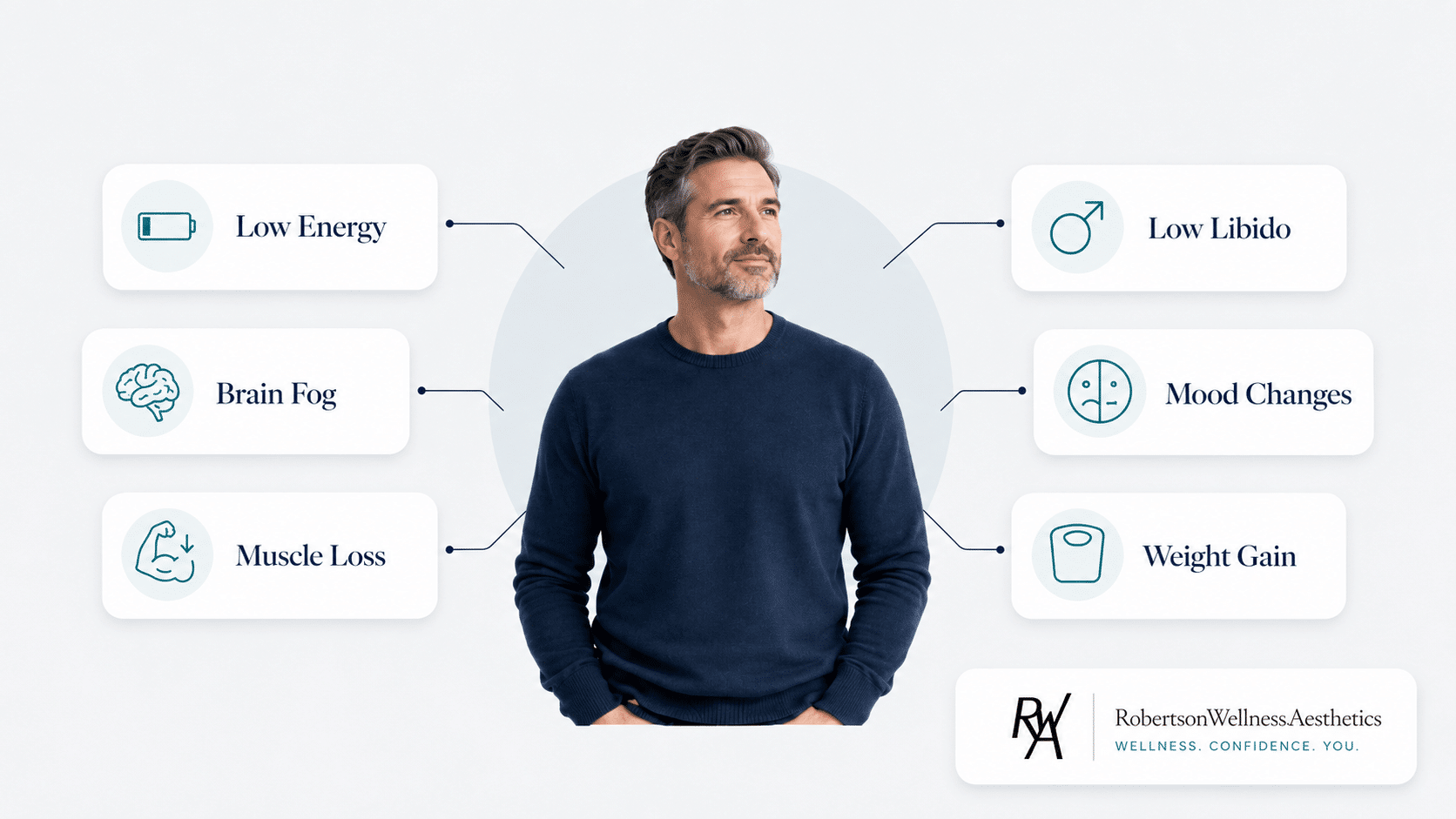
The short answer: Low testosterone (often called “low T”) in men tends to show up as a recognizable cluster of symptoms — reduced sex drive, persistent fatigue, low mood and motivation, difficulty concentrating or “brain fog,” loss of muscle, and increased body fat, especially around the midsection. Because these signs are nonspecific and overlap with normal aging, stress, poor sleep, and other medical conditions, low testosterone should be confirmed with blood testing on two separate mornings — not on symptoms alone.
What is low testosterone?
Testosterone is the primary male sex hormone. It supports libido and sexual function, muscle mass and strength, bone density, red blood cell production, mood, and energy. When levels fall below the normal range and a man has matching symptoms, the condition is called hypogonadism, or testosterone deficiency.
Two thresholds are commonly referenced. The Endocrine Society cites a lower limit of normal of roughly 264 ng/dL for total testosterone in healthy, non-obese young men, while the American Urological Association uses a working cutoff of 300 ng/dL to define low testosterone (Endocrine Society Clinical Practice Guideline, JCEM; American Urological Association Testosterone Deficiency Guideline). A number on a lab report alone does not equal a diagnosis — symptoms have to be present too.
Think your symptoms might be low testosterone?
The only way to know is a blood test. Our Beverly Hills providers start every men’s health programwith a comprehensive hormone panel and a consultation — real data, not guesswork.
These statements have not been evaluated by the FDA. Treatment is not intended to diagnose, treat,cure or prevent any disease. TRT is prescribed only after a medical consultation and evaluation by alicensed provider, and is not appropriate for everyone.
Why testosterone declines
Testosterone naturally declines with age — gradually, by roughly 1% per year after about age 30 to 40 — which is why symptoms often surface in a man’s 40s and 50s (Mayo Clinic, “Male menopause: Myth or reality?”). But age is not the only driver. Testosterone is produced in the testes under signals from the brain’s pituitary gland and hypothalamus, so a problem at any point along that axis can lower levels. In practical terms: when the body makes too little testosterone, the downstream signals for libido, muscle, mood, and energy weaken, which is what produces the symptoms below.
Common symptoms of low testosterone in men
Low testosterone rarely announces itself with one dramatic sign. More often it’s a slow accumulation of changes a man may chalk up to stress or “getting older.” The most commonly reported symptoms include the following.
Reduced sex drive and sexual changes
A drop in libido is one of the more specific signs of low testosterone. Men may also notice fewer spontaneous (including morning) erections, erectile difficulties, or delayed ejaculation. Decreased spontaneous erections and low libido are among the symptoms most consistently linked to low testosterone in research (Mayo Clinic Proceedings, adult-onset hypogonadism review).
Fatigue and low energy
Persistent tiredness — feeling drained even after a full night’s sleep — is a frequent complaint. Men often describe reduced stamina and a sense that workouts, work, and daily life take more out of them than they used to.
Low mood, irritability, and reduced motivation
Testosterone influences mood and drive. Low levels can contribute to low mood, irritability, reduced motivation, and a blunted sense of competitive drive; in some men, symptoms can overlap with or worsen anxiety and depression (Cleveland Clinic, low testosterone and mental health). This overlap is also why mood symptoms alone are not enough to diagnose low T — a mental-health evaluation matters too.
Brain fog and trouble concentrating
Some men report difficulty concentrating, poorer memory, and a general mental “fogginess.” These cognitive symptoms are real complaints but are notably nonspecific — sleep, stress, and other factors produce the same feeling.
Loss of muscle and increased body fat
Because testosterone supports muscle protein synthesis, low levels can lead to loss of muscle mass and strength and an increase in body fat, particularly around the abdomen. Many men notice that the same diet and training no longer hold their body composition the way they once did.
Other physical signs
Additional signs can include reduced bone density over time, decreased facial or body hair, low semen volume or fertility concerns, hot flashes, and disrupted sleep. Gynecomastia (enlarged breast tissue) can also occur when the balance of sex hormones shifts.
Important: None of these symptoms is unique to low testosterone. Age, medications, thyroid problems, depression, sleep apnea, diabetes, and other conditions can cause the same picture. That is exactly why diagnosis depends on bloodwork plus symptoms, not symptoms alone.
What causes low testosterone?
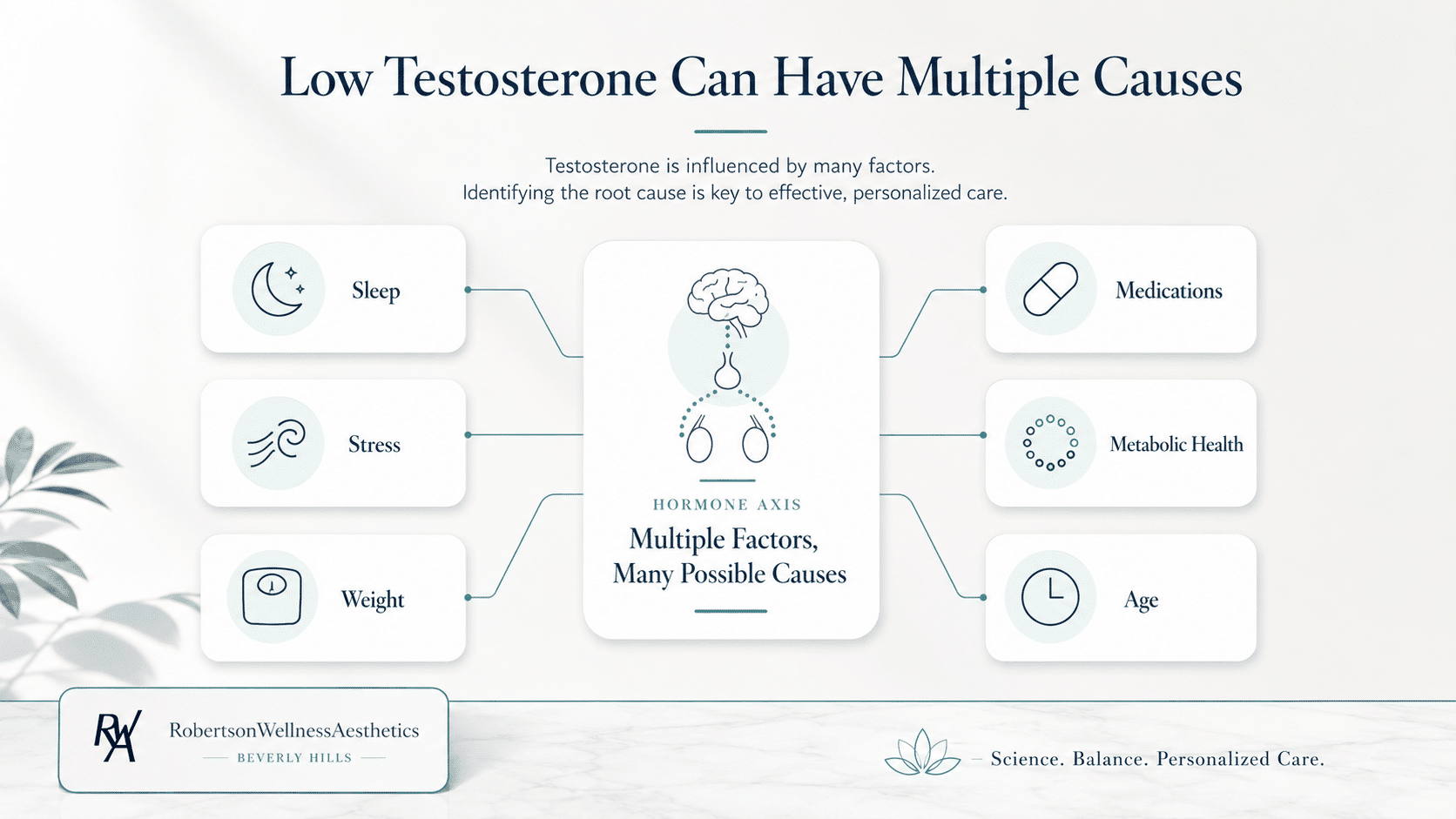
Beyond age-related decline, common contributors include obesity and metabolic syndrome, type 2 diabetes, obstructive sleep apnea, chronic illness, certain medications (notably opioids and some steroids), excessive alcohol use, chronic stress, and prior testicular injury or treatment. Some men have a problem with the testes themselves (primary hypogonadism), while others have a problem with the pituitary/hypothalamic signaling (secondary hypogonadism) — a distinction your physician sorts out with bloodwork. Because several causes (weight, sleep, alcohol, certain medications) are modifiable, identifying the underlying driver is part of good care, not just prescribing a hormone.
When should you get tested?
Consider testing if you have several of the symptoms above — particularly low libido, erectile changes, unexplained fatigue, or loss of muscle — and they are persistent rather than a bad week. The standard diagnostic approach is a blood test for total testosterone drawn in the early morning (typically 7–10 a.m.) while fasting, because levels peak in the morning and fall later in the day. A diagnosis of testosterone deficiency requires low readings on two separate mornings alongside consistent symptoms (Endocrine Society Clinical Practice Guideline). Depending on the results, your physician may also check free testosterone, luteinizing hormone, prolactin, a blood count, and other markers to find the cause. At Robertson Wellness and Aesthetics, every men’s health program begins with a comprehensive hormone blood panel and consultation for exactly this reason.
What treatment can involve
Treatment depends entirely on the cause and severity, and it starts with confirming the diagnosis — not with a prescription. Options a physician may discuss include:
- Addressing underlying drivers first. Weight loss, improved sleep (including treating sleep apnea), reducing alcohol, managing stress, and reviewing medications can meaningfully improve testosterone in some men before any hormone therapy is considered.
- Testosterone replacement therapy (TRT). For men with confirmed, symptomatic deficiency, physician-supervised TRT restores testosterone to a healthy range through injections, gels, pellets, or other formulations, with ongoing lab monitoring. TRT has real benefits and real risks — including effects on red blood cell count, the prostate, and fertility — which is why it requires medical oversight (Harvard Health, “Is testosterone therapy safe?”).
- Growth-hormone peptides as a complement. For some men, peptide therapy is explored alongside or instead of TRT to support recovery, body composition, and sleep. To understand how the two differ and when they’re combined, see our guide to TRT vs. peptides for men over 40.
- Supportive wellness care. Services such as NAD+ IV therapy are sometimes used to support energy and overall wellness as part of a broader plan — supportive care, not a treatment for low testosterone itself.
The right path is individual. It depends on your labs, your symptoms, your goals, and your health history — the kind of evaluation that belongs in a clinic.
Medical Disclaimer: These statements have not been evaluated by the Food and Drug Administration. This information is for educational purposes only and is not intended to diagnose, treat, cure, or prevent any disease. Low testosterone and its treatment must be evaluated and managed by a licensed healthcare provider based on individual testing. Testosterone replacement therapy is not appropriate for everyone, and individual results may vary. Always consult a qualified healthcare provider before beginning any new treatment.
Frequently asked questions
What are the first signs of low testosterone in men?
The earliest and more specific signs tend to be a drop in sex drive, fewer spontaneous erections, and unexplained fatigue. Loss of muscle, increased belly fat, low mood, and trouble concentrating often follow. Because these develop gradually and overlap with normal aging, many men don’t connect them until several appear together.
At what age does testosterone start to drop?
Testosterone generally begins a slow decline of about 1% per year after roughly age 30 to 40, so symptoms most often become noticeable in a man’s 40s and 50s. That said, low testosterone can occur at any age due to medical conditions, medications, or problems with the testes or pituitary gland.
Can low testosterone be diagnosed from symptoms alone?
No. Symptoms are nonspecific and can be caused by many other conditions. A diagnosis requires low total testosterone on two separate early-morning, fasting blood tests, interpreted alongside your symptoms by a physician.
Are low testosterone symptoms reversible?
Often, symptoms improve when the underlying cause is addressed — whether that means weight loss, better sleep, adjusting a medication, or, for confirmed deficiency, supervised testosterone therapy. Results vary by individual and depend on the cause, so a medical evaluation is the place to start.
Is low testosterone the same as “male menopause”?
Not exactly. Unlike menopause, testosterone decline in men is gradual rather than abrupt, and not every man develops symptomatic deficiency. “Male menopause” is a popular term, but the medical condition is age-related or adult-onset hypogonadism.
Get clarity with a simple blood test
If these symptoms sound familiar, the most useful next step is testing — not guessing. Robertson Wellness and Aesthetics offers physician-supervised men’s health evaluations in Beverly Hills, starting with a comprehensive hormone panel, with both in-clinic and concierge options. Book a consultation to find out whether low testosterone is behind how you’ve been feeling.


