


The short answer: Testosterone replacement therapy (TRT) and growth-hormone peptides are not competing versions of the same treatment — they act on two different hormonal systems. TRT directly replaces testosterone in men with diagnosed deficiency, while growth-hormone peptides prompt the body to release its own growth hormone in a more natural, pulse-like pattern. For many men over 40, the most effective plan is not choosing one over the other, but having a physician decide which axis (or both) actually needs support, based on bloodwork and symptoms.
Quick comparison: TRT vs. peptides at a glance
| Dimension | Testosterone Replacement Therapy (TRT) | Growth-Hormone Peptides |
|---|---|---|
| What it does | Replaces testosterone directly to restore levels in men with diagnosed deficiency | Signals the pituitary to release the body’s own growth hormone |
| Hormone system | Androgen (testosterone) axis | Growth hormone / IGF-1 axis |
| Common goals | Libido, energy, mood, lean mass, metabolic support in low-T men | Body composition, recovery, sleep quality, tissue repair |
| Typical form | Injections, gels, pellets, or other prescribed formulations | Subcutaneous injections (e.g., GHRH analogs and ghrelin-receptor peptides) |
| FDA status | FDA-approved formulations exist for diagnosed hypogonadism | Most are not FDA-approved for anti-aging/wellness use; one GHRH analog (tesamorelin) is FDA-approved for a specific HIV-related indication |
| Requires | Confirmed low testosterone + symptoms; ongoing monitoring | Physician evaluation; appropriate candidacy; ongoing monitoring |
| Best for | Men with biochemically confirmed testosterone deficiency | Men seeking recovery, body-composition, and sleep support — often as a complement, not a replacement |
The rest of this guide explains the science behind each, where they overlap, the honest risks, and how a physician at a Beverly Hills practice like Robertson Wellness and Aesthetics structures men’s hormone optimization — including when a combined plan makes sense.
Not sure whether TRT, peptides, or both is right for you?
Men’s hormone optimization isn’t one-size-fits-all. Our Beverly Hills physicians design your plan after a medical consultation and bloodwork, based on your labs, goals and response — not a fixed protocol.
These statements have not been evaluated by the FDA. Treatment is not intended to diagnose, treat, cure or prevent any disease. TRT and peptide therapy are prescribed only after a medical consultation and evaluation by a licensed provider, and are not appropriate for everyone.
What is testosterone replacement therapy (TRT)?
Testosterone replacement therapy restores testosterone in men whose bodies no longer produce enough of it. It is a treatment for diagnosed hypogonadism — clinically low testosterone confirmed by bloodwork — not a general “boost” for any man who feels tired. Clinically, deficiency is typically defined as total testosterone below roughly 300 ng/dL on at least two early-morning blood draws, alongside compatible symptoms, though guideline thresholds vary between about 280 and 350 ng/dL (narrative review of testosterone therapy in men in their 40s, PubMed Central).
How TRT works (mechanism of action)
Once supplemental testosterone enters a target cell, it binds the androgen receptor — either directly, or after being converted to the more potent androgen dihydrotestosterone (DHT) in tissues such as the prostate and hair follicles. In skeletal muscle, testosterone activates the receptor directly to drive protein synthesis (Androgen Physiology, Pharmacology, Use and Misuse, NIH Endotext). In plain terms: TRT tops up the hormone your body is no longer making in sufficient amounts, so the downstream signals for muscle, libido, mood, and energy can fire normally again.
Who TRT is for
TRT offers the clearest benefit to men with biochemically confirmed deficiency plus symptoms such as low libido, erectile changes, fatigue, low mood, or loss of muscle. Late-onset testosterone deficiency is increasingly recognized in men aged 40–49 and is frequently linked to obesity, metabolic syndrome, and sleep apnea; estimates suggest roughly 6–12% of men in this age group have biochemically low testosterone (PubMed Central narrative review). Documented improvements with appropriate TRT include sexual function, gains in lean mass, reductions in fat mass, and metabolic benefits such as improved insulin sensitivity — particularly when paired with structured lifestyle changes. It is not appropriate for men with normal testosterone who simply want a performance edge.
Side effects and contraindications of TRT
TRT is a long-term medical commitment with real risks that require monitoring. Reported side effects include acne or oily skin, fluid retention, gynecomastia (breast tissue enlargement), reduced HDL cholesterol, increased prostate size with urinary changes, and erythrocytosis (a rise in red blood cell count) (Harvard Health, “Is testosterone therapy safe?”). TRT can also suppress the body’s own testosterone production and affect fertility. It is contraindicated in men with breast cancer or known/suspected prostate cancer and must be used cautiously in men with prostate enlargement or significant cardiovascular risk. Long-term cardiovascular and prostate safety remains an area of ongoing study, which is exactly why physician oversight and periodic bloodwork are non-negotiable.
What are growth-hormone peptides?
Growth-hormone peptides (often called growth-hormone secretagogues) are short chains of amino acids that signal the pituitary gland to release the body’s own growth hormone, rather than introducing synthetic growth hormone from outside. Common examples discussed in men’s wellness include GHRH analogs such as sermorelin, CJC-1295, and tesamorelin, and the ghrelin-receptor peptide ipamorelin.
How peptides work (mechanism of action)
The hypothalamus normally releases growth-hormone-releasing hormone (GHRH) to prompt the pituitary to secrete growth hormone, which then acts directly on tissues or stimulates the liver to produce insulin-like growth factor 1 (IGF-1) (neuroendocrine regulation of growth hormone secretion, PubMed Central). GHRH-analog peptides mimic that hypothalamic signal, while ghrelin-receptor peptides like ipamorelin act through a separate pathway; combining the two can amplify the release. Crucially, because peptides work through your own pituitary, they tend to preserve the natural pulse-like rhythm of growth-hormone release and keep output within physiologic ranges, rather than flooding the system. In a study of hypogonadal men, growth-hormone secretagogue treatment raised serum IGF-1 levels, the downstream marker of growth-hormone activity (Sigalos et al., growth hormone secretagogue treatment in hypogonadal men, PubMed/SAGE).
Who peptides are for
Peptides are generally explored by men over 40 whose primary goals are recovery, body composition, sleep quality, and tissue repair rather than libido or mood per se — the symptoms more tied to the growth-hormone/IGF-1 axis. They are also considered for men with mild-to-moderate symptoms who prefer a signaling approach over direct hormone replacement, or as a complement to other therapies. Candidacy is a clinical decision: it depends on goals, baseline labs, and medical history, and peptides are not appropriate for everyone.
Side effects, safety, and regulatory status of peptides
Reported side effects of growth-hormone peptides can include injection-site reactions, water retention, joint discomfort, tingling, and changes in blood-sugar handling; long-term safety data in healthy aging men is more limited than for testosterone. Just as important is the regulatory picture, which patients deserve to understand clearly. Most peptides marketed for anti-aging or wellness are not FDA-approved for those uses — their use is off-label. The notable exception is tesamorelin (Egrifta), a GHRH analog that holds FDA approval for a specific HIV-associated lipodystrophy indication, not for general anti-aging. The compounding landscape is also actively shifting: U.S. regulators have been re-evaluating which peptide substances pharmacies may compound, with formal advisory-committee review ongoing in 2026 (FDA Law Blog analysis of peptide compounding; Lexology summary of FDA 503A bulk-substance changes). For a reputable clinic, this means peptide protocols should be physician-supervised and sourced from compliant pharmacies — not bought online.
TRT, peptides, or both after 40?
They act on different hormonal systems and often work together. Our Beverly Hills physicians build a combined plan after labs and a consultation.
TRT and peptide therapies are provided by a licensed physician after evaluation. These statements have not been evaluated by the FDA and are not intended to diagnose, treat, cure or prevent any disease.
TRT vs. peptides: the key differences
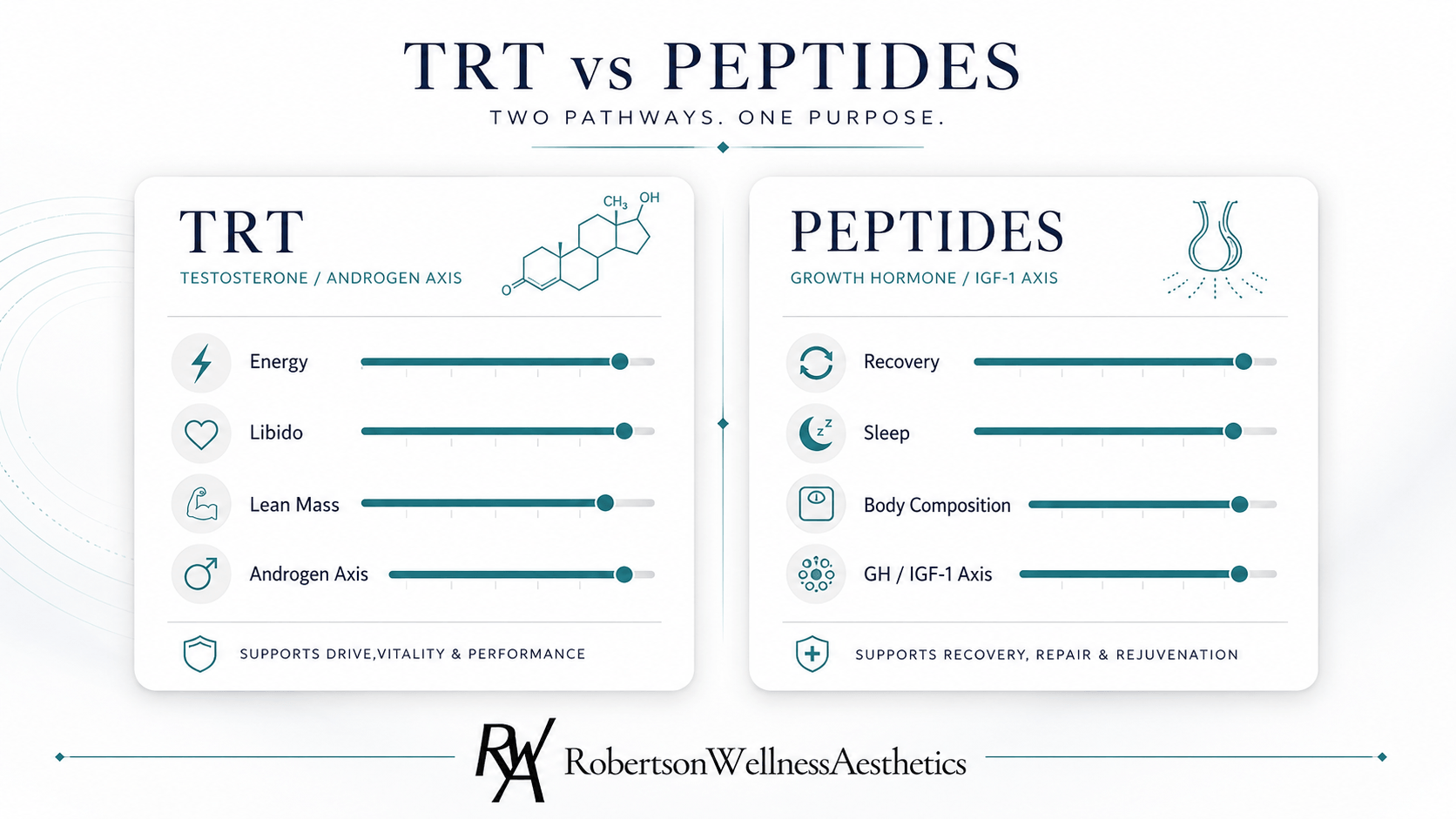
Mechanism: replace vs. stimulate
This is the core distinction. TRT replaces a hormone the body is no longer producing in adequate amounts. Peptides stimulate the body to produce more of its own growth hormone. One adds the end product directly; the other nudges an upstream signal. They also act on entirely different hormonal axes — androgen versus growth-hormone/IGF-1 — which is why they address overlapping but distinct symptoms.
Effectiveness and what to expect
For a man with genuine testosterone deficiency, nothing substitutes for restoring testosterone — peptides will not fix low testosterone. Conversely, if a man’s testosterone is adequate but he struggles with recovery, sleep, and body composition, more testosterone is not the answer, and growth-hormone support may be more relevant. Expectations should be measured for both: changes unfold over weeks to months, vary by individual, and depend heavily on dose, adherence, sleep, nutrition, and training. No responsible clinic promises a fixed outcome or timeline.
Side effects and safety
TRT has decades of clinical use and well-characterized risks (erythrocytosis, prostate considerations, fertility suppression, cardiovascular questions) that are managed with regular monitoring. Peptides have a different risk profile and, for most wellness uses, less long-term human data and an unsettled regulatory status. Neither is “safer” in the abstract — safety depends on the right candidate, correct dosing, legitimate sourcing, and ongoing physician oversight.
Cost and commitment
Both are ongoing programs rather than one-time fixes, and both require periodic lab monitoring that adds to the true cost of care. Pricing varies by protocol, formulation, and clinic, so specific figures should come from a consultation rather than a blog. What matters more than headline price is whether the therapy is targeting a problem you actually have — which only bloodwork and a clinical evaluation can establish.
Who each is best for
In broad terms: TRT is for men with diagnosed, symptomatic testosterone deficiency. Peptides are for men — often with normal or only mildly reduced testosterone — whose goals center on recovery, body composition, and sleep, frequently as a complement to other longevity-focused care. The honest answer for many men over 40, though, is “it depends on your labs,” which is why the decision belongs in a clinic, not a checkout cart.
How a combined hormone plan is structured under medical supervision
Because testosterone and growth hormone govern different systems, some men over 40 are candidates for a carefully supervised plan that supports both axes — testosterone for libido, mood, drive, and lean mass, and growth-hormone peptides for recovery, sleep, and body composition. The two are not redundant; they address different sides of how men age. But a combined plan is a clinical decision, not a default upsell, and at a reputable Beverly Hills practice it follows a deliberate sequence:
- Comprehensive evaluation and bloodwork first. A combined plan starts with advanced lab testing and biomarker analysis — total and free testosterone, relevant hormone panels, metabolic markers, blood count, and prostate screening where appropriate — plus a full symptom and medical-history review.
- Treat the confirmed problem. If labs confirm testosterone deficiency, physician-supervised TRT is established and stabilized first. Peptides are layered in only when goals (recovery, body composition, sleep) and candidacy support it.
- Physician oversight and monitoring throughout. Both therapies require follow-up labs and dose adjustment over time. This is medical care, delivered in a sterile clinical environment with licensed-provider supervision — the standard RWA also applies to its peptide therapy programs.
- Integration with the broader longevity picture. For many high-consideration patients, hormone optimization sits alongside other supportive services — from NAD+ IV therapy to a structured medical weight-management program — coordinated so the pieces work together rather than at cross-purposes.
The goal of a combined plan is never “more hormones.” It is restoring what bloodwork shows is actually low or suboptimal, safely, with monitoring — the kind of concierge-level, evidence-based care that men in Beverly Hills, Bel Air, and West Hollywood, as well as visiting executives and hotel guests, increasingly expect.
How to choose: a consultation-first approach
You cannot reliably choose between TRT and peptides from symptoms alone, because the two address different hormonal systems and several symptoms overlap. The right starting point is a physician evaluation with comprehensive bloodwork. From there, a clinician can determine whether your testosterone genuinely needs replacing, whether growth-hormone support fits your goals, whether a combined plan is appropriate, or whether something else entirely (sleep, metabolic health, or lifestyle factors) is the real driver. The best therapy is the one matched to what your labs and history actually show.
Medical Disclaimer: These statements have not been evaluated by the Food and Drug Administration. This information is for educational purposes only and is not intended to diagnose, treat, cure, or prevent any disease. Testosterone replacement therapy and peptide therapy are medical treatments that must be prescribed and supervised by a licensed healthcare provider following an individual evaluation. They are not appropriate for everyone, and individual results may vary. Always consult a qualified healthcare provider before beginning any new treatment.
Frequently asked questions
Is TRT or peptide therapy better for men over 40?
Neither is universally “better” — they treat different things. TRT is the right choice for men with confirmed, symptomatic testosterone deficiency. Growth-hormone peptides are aimed at recovery, sleep, and body composition and are often used as a complement. The correct answer for an individual depends on bloodwork and a physician’s evaluation.
Can you take TRT and peptides at the same time?
In some cases, yes, under medical supervision. Because testosterone and growth-hormone peptides act on different hormonal systems, a physician may structure a combined plan when both axes warrant support. This should always follow comprehensive lab testing and be monitored over time — it is not something to self-manage.
Do peptides raise testosterone?
Growth-hormone peptides primarily affect the growth-hormone/IGF-1 axis, not testosterone directly, so they should not be expected to correct clinically low testosterone. If your testosterone is genuinely deficient, TRT — not peptides — is the therapy designed to address it.
Are growth-hormone peptides FDA-approved?
Most peptides used for anti-aging or wellness are not FDA-approved for those purposes; their use is off-label. One GHRH analog, tesamorelin, is FDA-approved for a specific HIV-associated condition, not for general anti-aging. Regulatory rules on which peptides pharmacies may compound are actively evolving, which is why physician supervision and compliant sourcing matter.
How soon will I see results?
Results from either therapy typically unfold over weeks to months and vary considerably between individuals depending on dose, adherence, sleep, nutrition, and activity. Reputable clinics set realistic expectations and re-check labs rather than promising a fixed outcome by a fixed date.
Talk to a physician before you decide
If you’re a man over 40 weighing TRT, peptides, or both, the most valuable next step is a consultation and comprehensive bloodwork — not a purchase. Robertson Wellness and Aesthetics offers physician-supervised men’s hormone optimization in Beverly Hills, with both in-clinic and concierge options. Book a consultation to find out which approach fits your labs, your goals, and your health history.
Build your men’s health protocol
Talk to a physician about combining TRT and peptides for energy, recovery and performance.
TRT and peptide therapies are provided by a licensed physician after evaluation. These statements have not been evaluated by the FDA and are not intended to diagnose, treat, cure or prevent any disease.


