


Most of the uncomfortable things people feel during a NAD+ IV are caused by how fast the drip is running, not by how much NAD+ is in the bag. Flushing, a tight or heavy feeling in the chest, abdominal cramping, nausea and a general sense of being wound up are the classic ones, they arrive within minutes of the rate going up, and they settle within minutes of it coming back down. That is the single most useful thing to know before a first infusion, because it turns the most alarming part of the experience into something with an obvious fix: slow it down.
This article covers what is normal during and after a NAD+ infusion, how the oral supplement question differs from the IV question, the symptoms that genuinely warrant stopping, who should not have NAD+ IV therapy at all, and what the evidence does not yet tell us.
Why a NAD+ drip can make you feel strange
NAD+, nicotinamide adenine dinucleotide, is a coenzyme your cells already use constantly. It is a substrate for enzymes including the sirtuins and the PARPs, which are involved in DNA repair and in regulating cellular metabolism. In plain terms, it is part of the machinery your cells use to produce energy and maintain themselves, and your body makes it on its own.
An infusion puts a relatively large amount of that molecule into your circulation over a short period. The sensations people describe track the rate of delivery rather than the total amount delivered. The same 250 mg can feel like nothing over two hours and distinctly unpleasant over forty minutes. This is why a NAD+ infusion is scheduled in hours rather than minutes, why two clinics quoting the same dose can produce completely different experiences, and why an experienced provider treats “I feel tight in my chest” as an instruction to adjust the pump rather than as an emergency.
It is also the honest argument for an unhurried, supervised infusion over a fast one. There is no clinical advantage to pushing NAD+ quickly. There is only a worse hour.
What is normal during a NAD+ infusion
The following are common, rate-related, and expected to resolve when the drip is slowed. None of them is a reason to abandon treatment.
| What you may feel | When | What it usually means |
|---|---|---|
| Flushing, warmth in the face and neck | Within minutes of a rate increase | The most common rate-related effect. Settles as the rate comes down |
| Chest tightness or pressure | During the infusion, often early | Alarming but typically rate-related. Say something immediately so the rate can be reduced |
| Abdominal cramping or a gut-tightening feeling | During the infusion | Rate-related. Often the first thing people notice |
| Nausea | During, occasionally just after | Usually eases with a slower rate. Eating beforehand helps |
| Feeling restless, wired or short of breath | During the infusion | Commonly reported. Worth reporting even though it is usually benign |
| Headache or light-headedness | During or shortly after | Often improves with hydration and a slower rate |
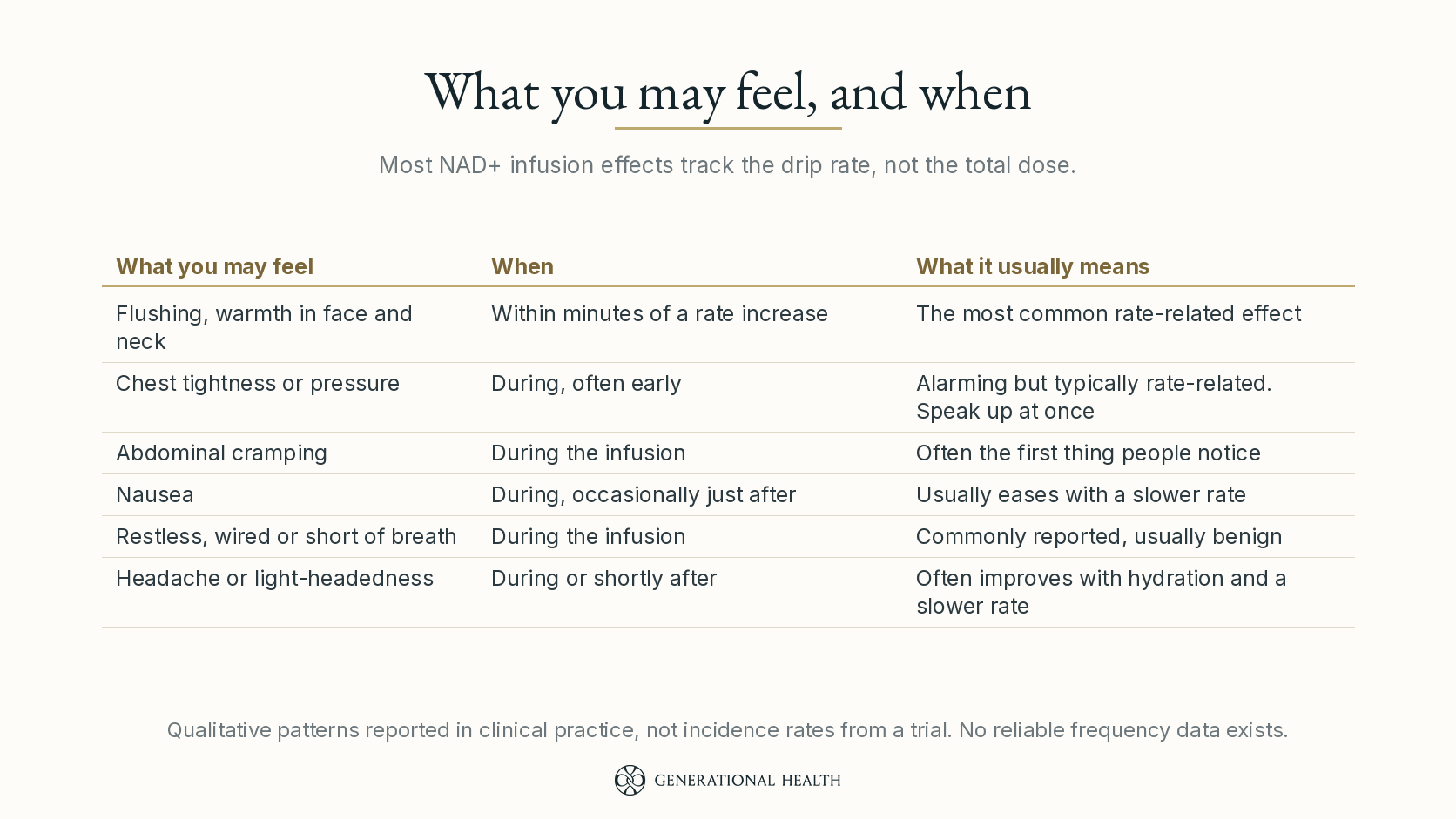
Two practical notes. First, these are qualitative patterns reported in clinical practice, not incidence figures from a trial; nobody has published reliable frequency data for NAD+ infusion effects, and any page quoting you a precise percentage is inventing it. Second, tell the person running your infusion the moment you feel any of this. The adjustment takes seconds and it is the entire reason they are in the room.
What is normal after the session
Most people leave a NAD+ infusion and go about their day. Where after-effects occur they tend to be mild and short-lived: tiredness for the rest of the afternoon, a lingering headache, occasional mild nausea, and bruising or tenderness where the cannula sat. Some people report feeling unusually alert that evening and sleeping poorly, which is worth mentioning at the next visit so the timing of your appointment can be moved earlier in the day.
Injection-site effects for NAD+ shots are a slightly different and generally smaller list, which our guide to NAD+ injections and how they compare with IV therapy covers in detail alongside the route comparison.
A NAD+ drip should run at your pace
There is no clinical reason to rush a NAD+ infusion. At our Beverly Hills clinic the rate is set for your tolerance and adjusted during the session, and most first-time patients start at an entry dose rather than a high one. If you have had an uncomfortable NAD+ drip somewhere else, the rate is usually the reason.
These statements have not been evaluated by the FDA. NAD+ therapy is not FDA-approved to diagnose, treat, cure or prevent any disease, and is provided only after a medical evaluation by a licensed provider. Not appropriate for everyone. NAD+ is not included in the IV membership. Individual results vary.
Oral NAD+ supplements are a different question
Search results for NAD+ side effects mix two things that do not belong together. Much of what ranks is about oral NAD+ precursor supplements, usually nicotinamide, nicotinamide riboside or NMN, taken as capsules. That is not the same product, the same route, or the same safety conversation as an infusion.
On the oral side, the concerns in the literature are about sustained high-dose intake rather than a single session. A 2020 review in Biomolecules, “Possible Adverse Effects of High-Dose Nicotinamide: Mechanisms and Safety Assessment”, sets out several proposed mechanisms: nicotinamide itself inhibits PARPs, the enzymes that help protect genome integrity; raising the NAD+ pool alters cellular energy metabolism; and high-level nicotinamide affects cellular methyl metabolism and the methylation of DNA and proteins. The authors are explicit that possible adverse effects and their mechanisms remain poorly understood, and they raise the question of long-term safety rather than answering it.
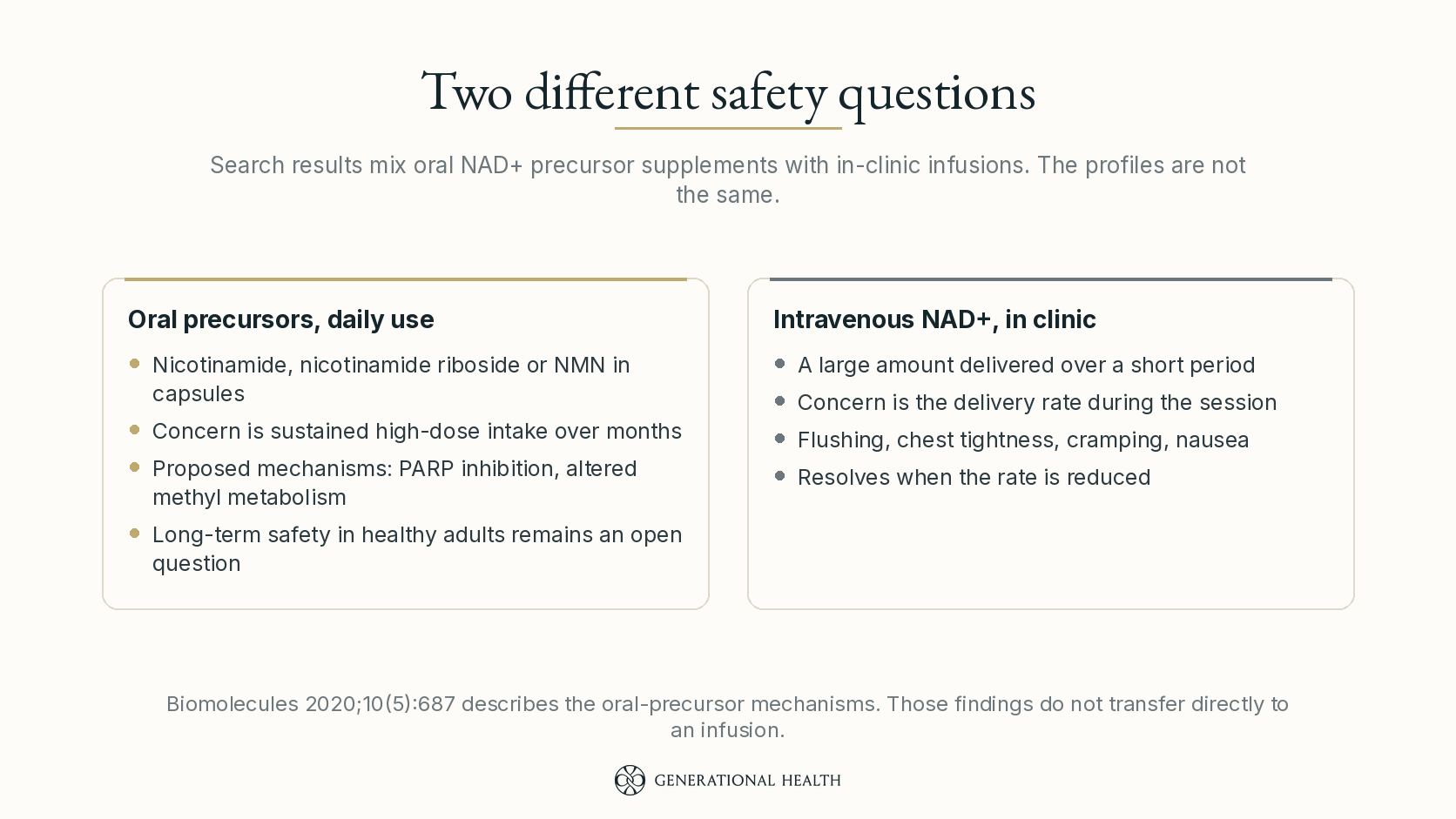
None of that transfers directly to an in-clinic infusion, and it would be misleading to present it as though it did. What it does establish is that “your body already makes it” is not by itself a safety argument for taking a lot of something for a long time. If you are considering both routes, our comparison of NAD+ and NADH explains what the different forms actually are, and the NAD+ dosage guide covers how much is used by each route and where the practical ceilings sit.
Red flags: when to speak up and when to stop
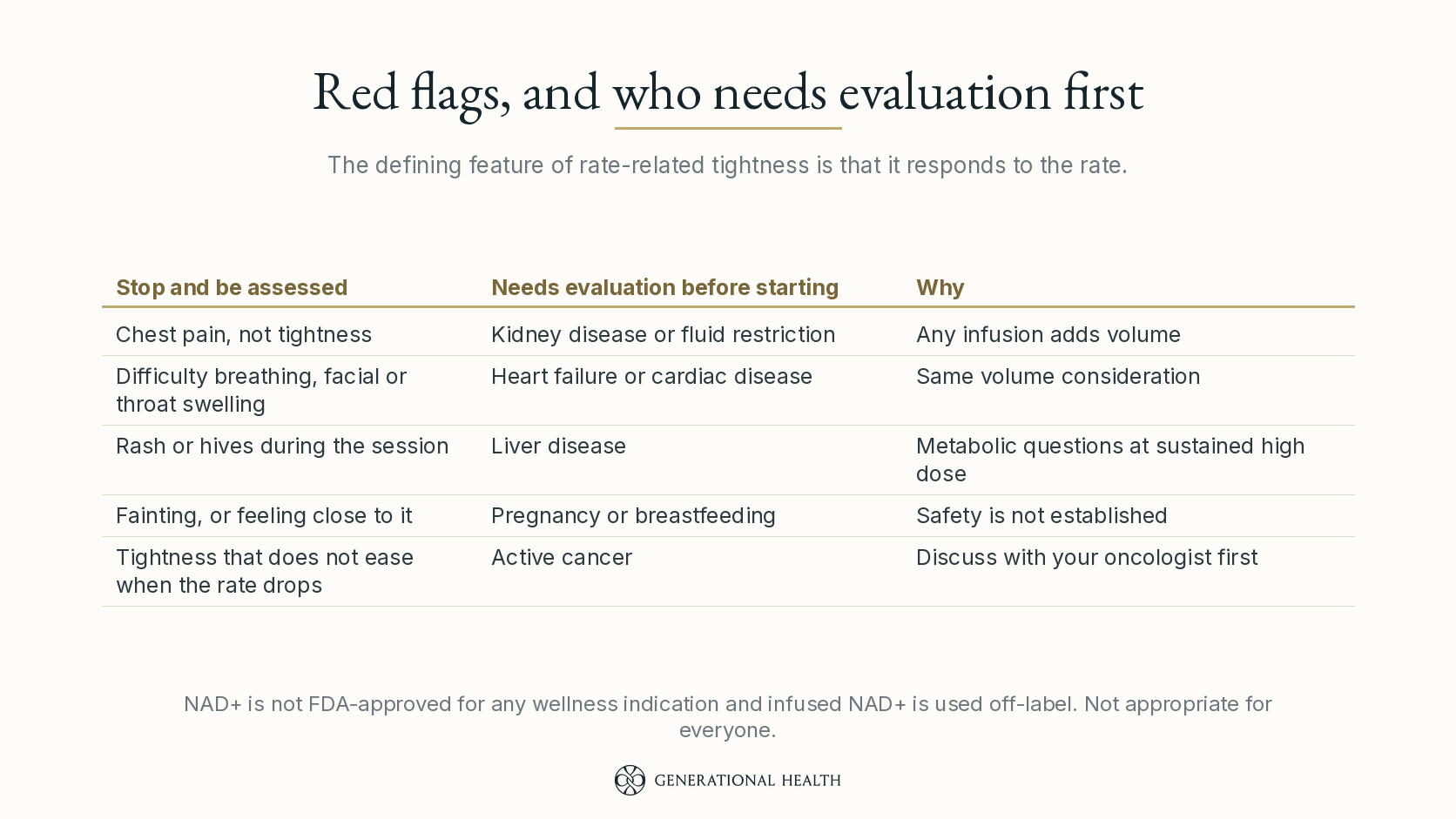
The symptoms above are common and manageable. The following are not, and they warrant stopping the infusion and being assessed rather than pushing through:
- Chest pain rather than chest tightness, particularly if it radiates to the arm or jaw, or comes with sweating or a sense of dread.
- Difficulty breathing, wheezing, or swelling of the face, lips, tongue or throat, which can indicate an allergic reaction.
- A rash or hives appearing during the session.
- Fainting, or feeling that you are about to.
- A fast or irregular heartbeat that does not settle when the rate is reduced.
- Chest tightness that does not improve within a few minutes of slowing or pausing the drip. The defining feature of rate-related tightness is that it responds to the rate.
Separately, any IV carries its own procedural risks regardless of what is in the bag: bruising, infiltration where fluid leaks into the surrounding tissue, phlebitis, vasovagal light-headedness, and rare allergic reaction. Repeated high-volume infusions can also disturb electrolytes, which is one reason a course is planned rather than open-ended.
Who should not have NAD+ IV therapy
NAD+ IV therapy is not appropriate for everyone, and some of these require evaluation rather than being absolute:
- Kidney disease or reduced renal function, or any condition in which fluid volume must be restricted.
- Heart failure or significant cardiac disease.
- Liver disease, given the metabolic questions around sustained high-dose NAD+ precursor exposure.
- Pregnancy or breastfeeding, where safety is not established.
- A known allergy to NAD+ or any component of the infusion.
- Active cancer, which should be discussed with your oncologist first given NAD+’s role in cellular energy metabolism and DNA repair pathways.
- Anyone seeking treatment for a diagnosed condition. NAD+ is not a treatment for any disease, and persistent fatigue or cognitive symptoms deserve a proper medical work-up before an infusion.
Baseline laboratory work before starting a course is sensible, particularly where kidney or liver function is a question. Candidacy is settled at consultation, and our NAD+ IV therapy FAQ walks through what the appointment itself involves.
What we do not know yet
Worth stating plainly, because almost nobody selling NAD+ does. NAD+ is not FDA-approved for energy, cognition, longevity, addiction recovery or any other indication discussed in wellness settings, and infused NAD+ is used off-label. The mechanistic rationale is real and well described. The long-term safety data in healthy adults receiving repeated infusions is limited, and the human outcome trials that would settle the benefit questions have largely not been done. A 2022 review in PMC on current uncertainties regarding NAD+ precursor supplementation makes the same point from the supplement side.
That is not an argument against it. It is an argument for modest expectations, a provider who screens you properly, and a dose and rate chosen for you rather than copied from a chart.
Medical Disclaimer
These statements have not been evaluated by the Food and Drug Administration. This article is for educational purposes only, is not medical advice, and is not intended to diagnose, treat, cure, or prevent any disease. NAD+ is not FDA-approved for any of the uses discussed here, and intravenous or injectable NAD+ is used off-label. The side effects described are qualitative patterns reported in clinical practice and in the literature, not incidence rates from controlled trials; no reliable frequency data exists for NAD+ infusion effects. NAD+ therapy at Generational Health (formerly Robertson Wellness and Aesthetics), Beverly Hills, is provided only after a medical evaluation by a licensed provider, and is not appropriate for everyone, including in pregnancy, significant kidney or cardiac disease, and active cancer without oncology input. Individual results vary and are not guaranteed. If you experience chest pain, difficulty breathing, swelling of the face or throat, or fainting during any infusion, tell your provider immediately and seek emergency care if symptoms are severe. Always consult a qualified healthcare provider before beginning any new treatment.
Frequently asked questions
Why do I feel weird after taking NAD?
If it happened during an infusion, the usual explanation is the drip rate. Flushing, chest tightness, cramping and nausea track how fast NAD+ is delivered rather than the total dose, and they typically settle within minutes of slowing the rate. If it happened after an oral supplement, the explanation is different and depends on which precursor you took and at what dose. Either way, persistent or severe symptoms are worth reporting to your provider rather than tolerating.
What should you not mix with NAD?
Bring your provider a complete list of prescriptions, over-the-counter medicines and supplements before your first session, including any other NAD+ precursors you are already taking orally, since stacking an oral precursor with an infusion is a dose question nobody has characterised well. There is no definitive published interaction list for infused NAD+, which is itself a reason to have the conversation rather than assume it is fine.
What happens when you take NAD+ every day?
For infusions, daily dosing is not a normal protocol; courses are spaced, and frequency is set by a provider. For oral precursors, daily use is the usual pattern, and that is precisely the scenario the long-term safety questions in the literature are about. The honest answer is that sustained daily high-dose use has not been studied long enough in healthy adults to say with confidence what happens, which is worth knowing before committing to it indefinitely.
Does NAD+ cause weight gain?
There is no good evidence that NAD+ causes weight gain. It is not a hormone and it does not work through appetite pathways the way a GLP-1 medication does. Some people report appetite changes in either direction, but these are anecdotal reports rather than trial findings, and weight change during a course of infusions usually has a simpler explanation elsewhere in someone’s routine.
How long do NAD+ side effects last?
The rate-related effects during an infusion generally ease within minutes of the rate being reduced and are gone by the time you leave. After-effects such as tiredness or a mild headache usually resolve within the same day. Anything persisting beyond that, or any symptom that was severe at the time, should be reported to your provider.
Is a NAD+ shot gentler than an IV?
A shot delivers a smaller amount over a much shorter time, so the drawn-out rate-related sensations of an infusion do not apply in the same way, though facial flushing is still commonly reported. The trade-off is a different one and it is not purely about comfort; our comparison of NAD+ injections and IV therapy sets out how the two routes actually differ.
Where to go from here
If a previous NAD+ drip left you feeling awful, that is worth raising specifically rather than concluding the therapy is not for you, because the rate is adjustable and the dose is a separate decision. Generational Health provides physician-supervised NAD+ IV therapy in Beverly Hills, minutes from Cedars-Sinai, with in-clinic and concierge appointments, and the rate is set and adjusted in the room. Request a consultation to review your history and decide on a sensible starting point.
Written and medically reviewed by Biana Borchenko, FNP-BC, Family Nurse Practitioner, Board-Certified, with fellowship training through the American Academy of Anti-Aging Medicine (A4M), at Generational Health (formerly Robertson Wellness and Aesthetics), Beverly Hills. Biana oversees the clinic’s IV and injectable protocols, where every infusion begins with a review of personal and family history, current medications and laboratory work, and where infusion rate is treated as a clinical setting to be managed rather than a fixed number on a pump.
Sources cited in this article: “Possible Adverse Effects of High-Dose Nicotinamide: Mechanisms and Safety Assessment”, Biomolecules, 2020;10(5):687. “Current Uncertainties and Future Challenges Regarding NAD+ Boosting Strategies”, available through PubMed Central, 2022. US Food and Drug Administration, guidance on compounded and unapproved drug products.


