
The simplest way to tell these three apart is by how much blood each one treats and what it treats the blood with. UBI passes a small volume — around 60 mL — under ultraviolet light and returns it. Ten-pass ozone treats 150 to 200 mL at a time with medical-grade ozone, repeating the cycle up to ten times in one session. EBOO is the most intensive: it runs 2 to 5 liters of blood through a dialysis-like filter, ozonating it continuously, and at RWA also exposes it to UV light. More intensive is not automatically better — the right choice depends on your goals, your tolerance, and screening results, including a G6PD test. Here is how each one actually works and how providers decide between them.
EBOO vs 10-pass ozone vs UBI at a glance
| UBI | 10-Pass Ozone | EBOO + UV | |
|---|---|---|---|
| Treats blood with | UV light only | Ozone only | Ozone + UV light |
| Blood volume | ~60 mL | 150–200 mL per pass | 2–5 liters |
| Method | Single batch, dual UV exposure | Batch cycles, repeated up to 10× | Continuous flow through a filter |
| Session length | Short | ~7–10 min per pass | 60–75 minutes |
| Intensity | Gentlest | Moderate to high | Most intensive |
| Typical series | 6–8 sessions, 2×/week | Varies; packages of 3–10 | 3–10 sessions |
| Price at RWA | $175 (or +$75 added to ozone) | $599 per session; MAH from $250 | $799 per session; $699 per session in a 4-session package |
How ultraviolet blood irradiation (UBI) works
UBI is the gentlest of the three and the only one that uses no ozone at all. A small volume of blood — roughly 60 mL — is drawn through a catheter into a sterile, UV-transparent system, passed under ultraviolet light across UVA, UVB and UVC wavelengths, and returned to circulation. At RWA the blood receives UV exposure twice: once on the way out and again through the tubing as it is reinfused.
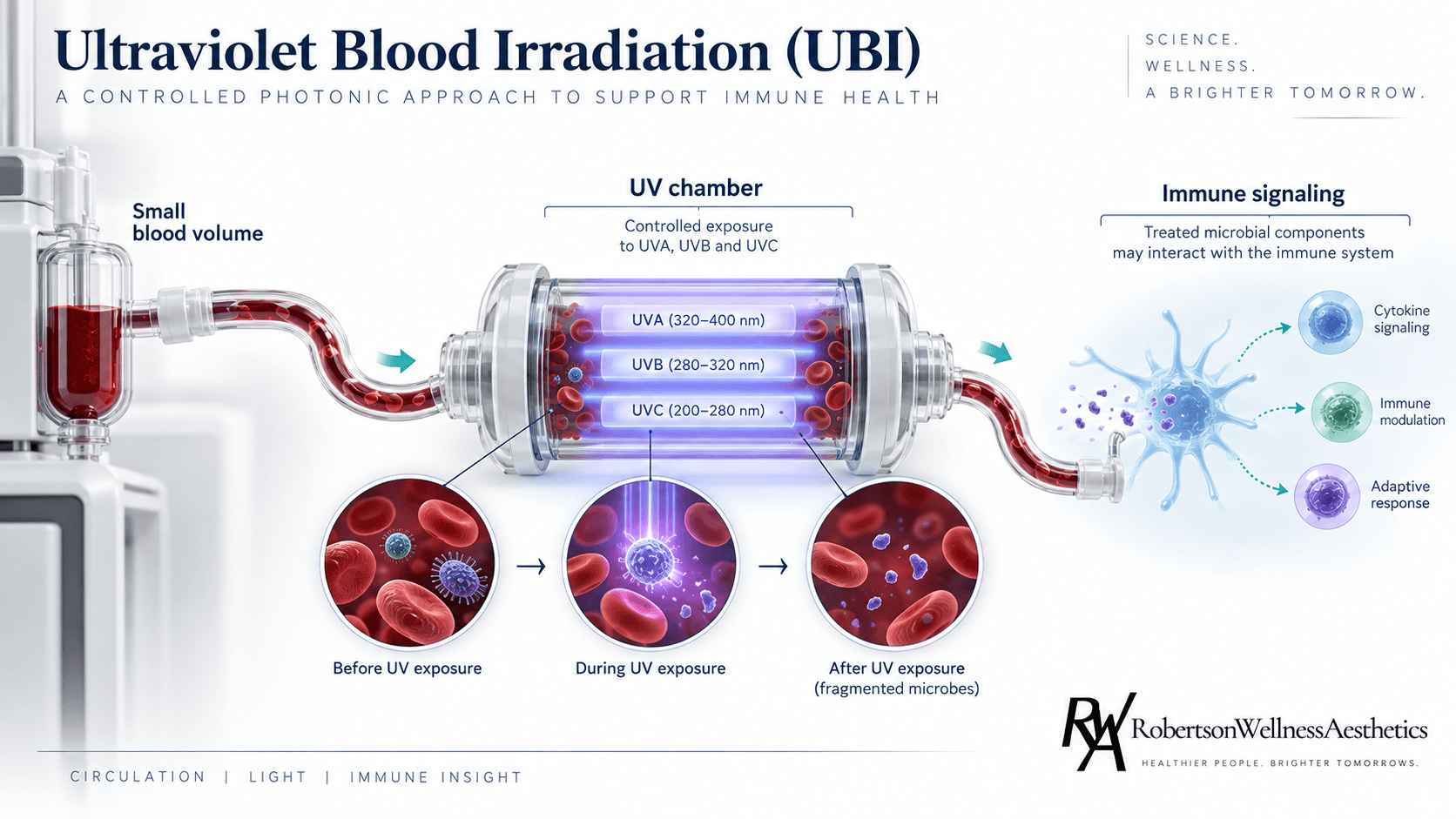
The rationale is a difference in how light is absorbed. Pathogens in the bloodstream take up substantially more photonic energy than your own red and white blood cells, so a dose that is well tolerated by your cells is disproportionately damaging to microbes. Fragments of those inactivated organisms are then thought to prompt an immune response similar in principle to a vaccination — a first direct effect, followed by a second, immune-mediated one. UBI has a long history: it was used clinically in the 1940s and 1950s, before modern antibiotics became widespread, and the modern evidence base is reviewed by Hamblin (Advances in Experimental Medicine and Biology, 2017).
Because the volume is small and no oxidative agent is introduced, UBI is often the entry point — and it is frequently paired with ozone rather than used alone. See the UBI therapy page for the full protocol.
How 10-pass ozone therapy works
Ten-pass is a high-dose form of major autohemotherapy (MAH). In standard MAH, a volume of blood is drawn, mixed with medical-grade ozone at a precise concentration, and reinfused — one complete cycle is called a “pass.” Ten-pass simply repeats that cycle, drawing 150 to 200 mL each time, ozonating it at roughly 60–75 µg/mL, and returning it, up to ten times in a single session. Each pass takes about 7 to 10 minutes.
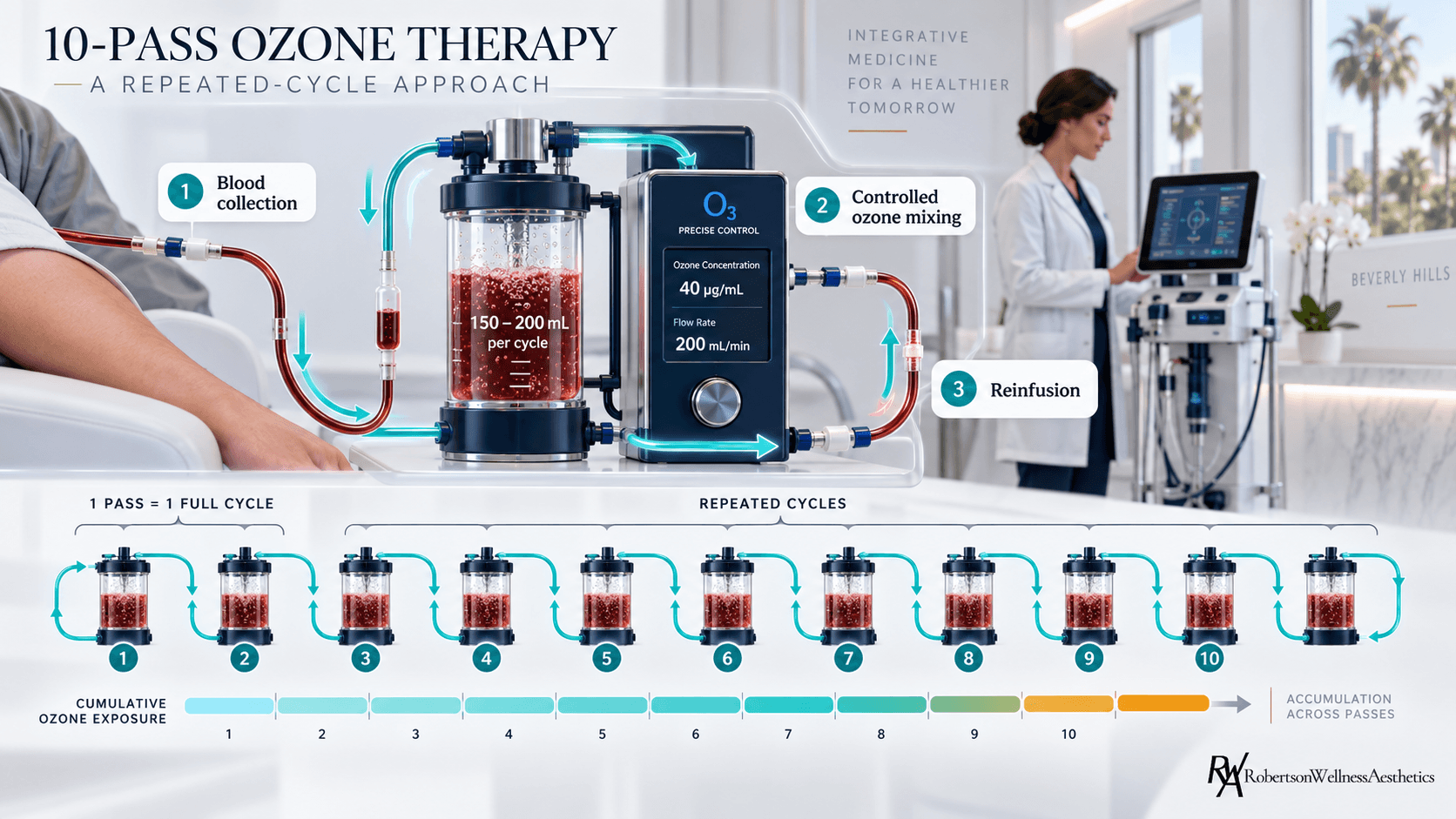
The mechanism is hormesis: a controlled, low-level oxidative stimulus that prompts the body to upregulate its own antioxidant defenses, while also influencing oxygen delivery and immune signaling. The reasoning behind repeating the cycle is cumulative dose — each pass delivers roughly 14,000 µg of ozone, so a full ten-pass session represents a substantially larger total exposure than a single MAH. For more on the mechanism and what the research supports, see our guide to ozone therapy benefits and what the science says.
Because the dose escalates quickly, first visits at RWA are limited to one, two, or three passes. Going beyond three requires a G6PD blood test first — more on why below. Full protocol and package options are on the ozone IV therapy page.
How EBOO + UV light works
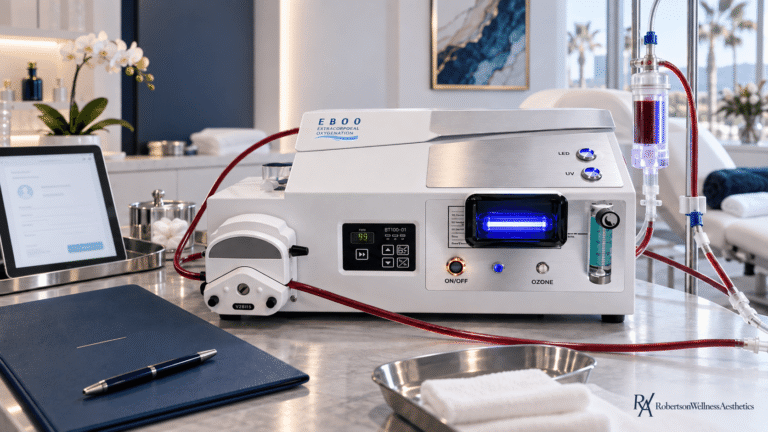
EBOO — extracorporeal blood oxygenation and ozonation — is structurally different from the other two. Rather than treating discrete batches, it runs blood continuously through a dialysis-like membrane filter where it is ozonated, then returns it in a closed loop. Over a session of roughly 60 to 75 minutes, 2 to 5 liters of blood pass through the system — an order of magnitude more than ten-pass. At RWA the circuit also includes ultraviolet exposure across UVA, UVB and UVC, which is why the service is offered as O3UV rather than EBOO alone.
In practical terms, EBOO combines the two mechanisms above and applies them to far more of your circulating volume in one sitting. That is its appeal — and also why it is the most clinically demanding option, requiring larger-bore access, dedicated equipment, and continuous monitoring. Details are on the EBOO + UV light page.
Not sure which ozone therapy fits you?
Choosing between UBI, ten-pass and EBOO is a clinical decision, not a menu pick. Our Beverly Hills clinicians review your history, run the required screening, and start at an intensity that suits you rather than the most aggressive option available.
These statements have not been evaluated by the FDA. Ozone and UBI therapies are considered investigational, are not FDA-approved for the indications discussed, are not intended to diagnose, treat, cure or prevent any disease, and are not appropriate for everyone. Provided only after evaluation by a licensed provider.
What to expect during a session
All three begin the same way: an intake and review of your medical history, screening bloodwork where indicated, and IV access placed by a clinician. From there the experience differs mainly in duration and how much you notice.
UBI is the shortest and least eventful — most people feel little beyond the IV placement. Ten-pass is longer, with each cycle taking several minutes, and some people notice mild chest tightness or warmth as blood returns; the pace is adjusted if so. EBOO is the longest at 60 to 75 minutes, and because the circuit is continuous you remain connected throughout, with a clinician monitoring you for the full session.
Afterward, mild and short-lived effects are common across all three: fatigue, light-headedness, soreness at the IV site, or a brief flu-like feeling. These typically settle within 24 to 48 hours. Hydration before and after helps. Anything more than mild — or anything that persists — should be reported to your provider rather than waited out.
Safety: the G6PD screen and who should not have these treatments
The most important safety step for any ozone-based therapy is testing for G6PD deficiency. G6PD is an enzyme that protects red blood cells from oxidative damage. In people who are deficient, an oxidative therapy can trigger hemolysis — the breakdown of red blood cells. This is why RWA limits first visits to three passes or fewer and requires a G6PD blood test before any higher-dose protocol. It is a genuine safety gate, not a formality, and it is worth asking any clinic whether they run it. Screening is part of comprehensive blood testing before treatment.
These therapies are generally not appropriate for people who:
- Have G6PD deficiency — a clear contraindication for ozone-based treatment.
- Are pregnant or breastfeeding.
- Have significant cardiovascular disease, including heart failure, or recent cardiac events — the fluid shifts and circuit volume involved in EBOO in particular require caution.
- Have impaired kidney function, which affects how the body handles the metabolic load.
- Have bleeding disorders, are on anticoagulation, or have active bleeding.
- Have uncontrolled hyperthyroidism.
One more point that applies to all ozone therapy: ozone is toxic when inhaled and is never administered by breathing. Anyone offering inhaled ozone is not following accepted practice. It is also worth stating plainly that ozone therapy is not FDA-approved for general medical treatment and is used in the integrative space under physician supervision — which is exactly why screening, dosing and oversight matter more here than the brand name of the machine.
How to choose between them
In practice the decision comes down to three questions a clinician works through with you: what are you trying to support, how much intensity is appropriate for your physiology, and what does your screening show.
Starting gentler and escalating is the norm, not a compromise. Many patients begin with UBI or standard MAH, see how they respond, and move to higher-dose protocols only if it makes sense. Combining is also common — UBI added to an ozone session costs $75 on top and brings both mechanisms into one visit without the demands of a full EBOO circuit. EBOO tends to be considered for patients who have tolerated ozone well and want the most comprehensive option, and it is selected based on intake and lab results rather than offered by default. At RWA, EBOO + UV light is $799 per session, or $699 per session in a 4-session package; our EBOO cost guide has the full breakdown. If cost is part of the calculation, our guide to how much ozone therapy costs breaks down sessions and packages.
Medical Disclaimer
These statements have not been evaluated by the Food and Drug Administration. This article is for educational purposes only and is not intended to diagnose, treat, cure, or prevent any disease. Ozone therapy, EBOO and ultraviolet blood irradiation are considered investigational and are not FDA-approved for the indications discussed; they are used in integrative medicine under the supervision of a licensed provider. They are not appropriate for everyone, require G6PD screening before higher-dose treatment, and carry contraindications including pregnancy, significant cardiovascular or kidney disease, and bleeding disorders. Individual results may vary and are not guaranteed. Always consult a qualified healthcare provider before beginning any new treatment.
Frequently asked questions
What is the difference between EBOO and 10-pass ozone?
Volume and method. Ten-pass treats 150 to 200 mL of blood per cycle, repeating up to ten times in batches. EBOO runs 2 to 5 liters continuously through a dialysis-like filter in a single 60 to 75 minute session, and at RWA also adds UV light. EBOO processes far more blood per visit; ten-pass delivers a high cumulative ozone dose in discrete cycles.
Is EBOO better than 10-pass ozone?
Not inherently. EBOO is more intensive and treats more blood, but more intensive is not automatically more appropriate. The right protocol depends on your goals, how you tolerate ozone, and your screening results. Many patients do well starting with standard MAH or UBI and escalating only if indicated.
What is the difference between UBI and ozone therapy?
UBI uses ultraviolet light with no ozone involved, relying on pathogens absorbing more photonic energy than your own cells and on the immune response that follows. Ozone therapy introduces medical-grade ozone to create a controlled oxidative stimulus. They work through different mechanisms, which is why they are often combined rather than treated as alternatives.
Can UBI and ozone be done together?
Yes, and it is a common approach. At RWA, UBI can be added to an ozone session for $75 in addition to the ozone cost, delivering both mechanisms in one visit.
Why do I need a G6PD test before ozone therapy?
G6PD is an enzyme that protects red blood cells from oxidative damage. People with G6PD deficiency can experience hemolysis when exposed to an oxidative therapy like ozone. Testing identifies that risk in advance, which is why first visits are limited to three passes or fewer and higher-dose protocols require a normal result first.
How many sessions will I need?
It varies by protocol and individual. UBI is typically given as a series of six to eight sessions, twice weekly. EBOO is commonly planned as three to ten sessions. Ozone packages at RWA are structured in sets of three, five or ten. Your provider sets the plan after evaluation rather than applying a fixed number.
Are these treatments safe?
When performed by trained clinicians at controlled doses with appropriate screening, they are generally well tolerated, with mild and short-lived effects such as fatigue or light-headedness being most common. Safety depends on proper candidacy, G6PD screening, correct dosing and monitoring. They are not appropriate for everyone, and they are not FDA-approved treatments.
Talk to a clinician before choosing
The honest answer to “which one is right for me” is that it should follow an evaluation, not a comparison table. Robertson Wellness and Aesthetics offers physician-supervised ozone therapy, UBI and EBOO + UV light in Beverly Hills, with required screening and individualized protocols overseen by our clinical team. Book a consultation to discuss which approach fits your goals and health history.
Medically reviewed by Biana Borchenko, FNP-BC — Family Nurse Practitioner, Board-Certified; A4M. Biana administers ozone-based therapies at Robertson Wellness and Aesthetics in Beverly Hills, where every patient completes an intake, medical history review and G6PD screening where indicated before a first session, and protocols are individualized rather than standardized.