


Thymosin alpha 1 is a 28 amino acid peptide the thymus gland produces naturally, and its synthetic form, thymalfasin, is approved in more than 35 countries for hepatitis B and hepatitis C. It is not approved in the United States for anything. That gap between “approved somewhere” and “approved here” is the single most important thing to understand about this peptide, and it is the part most of what you will read online quietly skips over.
This guide covers what thymosin alpha 1 does inside the immune system, exactly where it stands with the FDA, what the published research supports and what it does not, the doses used in clinical studies, and who should not take it.
What is thymosin alpha 1?
Thymosin alpha 1, often written as Ta1 or Tα1, is a short peptide first isolated from thymus tissue in 1977. The thymus is the small immune organ sitting above the heart, and it is where T cells mature before entering circulation. The thymus shrinks with age, which is the observation most marketing around this peptide is built on.
Its mechanism is better characterised than most peptides sold in wellness settings. A 2020 narrative review in the World Journal of Virology by Dominari and colleagues describes thymosin alpha 1 as functioning as “a toll-like receptor (TLR)-9 and TLR-2 agonist in both myeloid and dendritic cells, the professional antigen-presenting cells.” Toll-like receptors are the sensors your innate immune cells use to recognise that something is wrong. By acting on two of them, thymosin alpha 1 influences how antigen-presenting cells signal to the rest of the immune system.
Downstream of that, the review describes several effects: it “potentiates T cell-mediated immune responses via differentiation and maturation of T-cell progenitor cells”, activates natural killer cells and CD8+ T cells, and raises levels of interleukin-2, interleukin-10, interleukin-12, interferon-alpha and interferon-gamma.
The part that gets less attention is that it works in both directions. The same review notes it “has a negative effect on IL-1β and tumor necrosis factor-α, which in turn leads to a decreased inflammatory response”, and describes the peptide as “a regulator of immunity, tolerance and inflammation”. So it is not purely a stimulant. Whether that bidirectional behaviour is an advantage depends entirely on the clinical situation, and it is one reason this is a peptide that belongs under medical supervision rather than self-direction.
Where thymosin alpha 1 is approved, and where it is not
This is where the online conversation goes wrong. Posts that reach hundreds of thousands of people describe thymosin alpha 1 as “approved in 35+ countries” alongside a mortality statistic, and readers reasonably conclude it is an established medicine they simply have not heard of. Both halves of that sentence are true in isolation. Put together without the geography, they are misleading.
| Jurisdiction | Status | For what |
|---|---|---|
| More than 35 countries | Approved as thymalfasin | Hepatitis B and hepatitis C, plus use as an immune enhancer in some other conditions |
| United States | No FDA-approved drug product | Nothing. Orphan-drug designation exists for certain rare indications, but designation is a development incentive, not a marketing approval |
| China | Included in a national guideline | Listed by the National Health Commission as an alternative option for patients with lymphocytopenia or immunodeficiency. Guideline inclusion is not the same as approval |
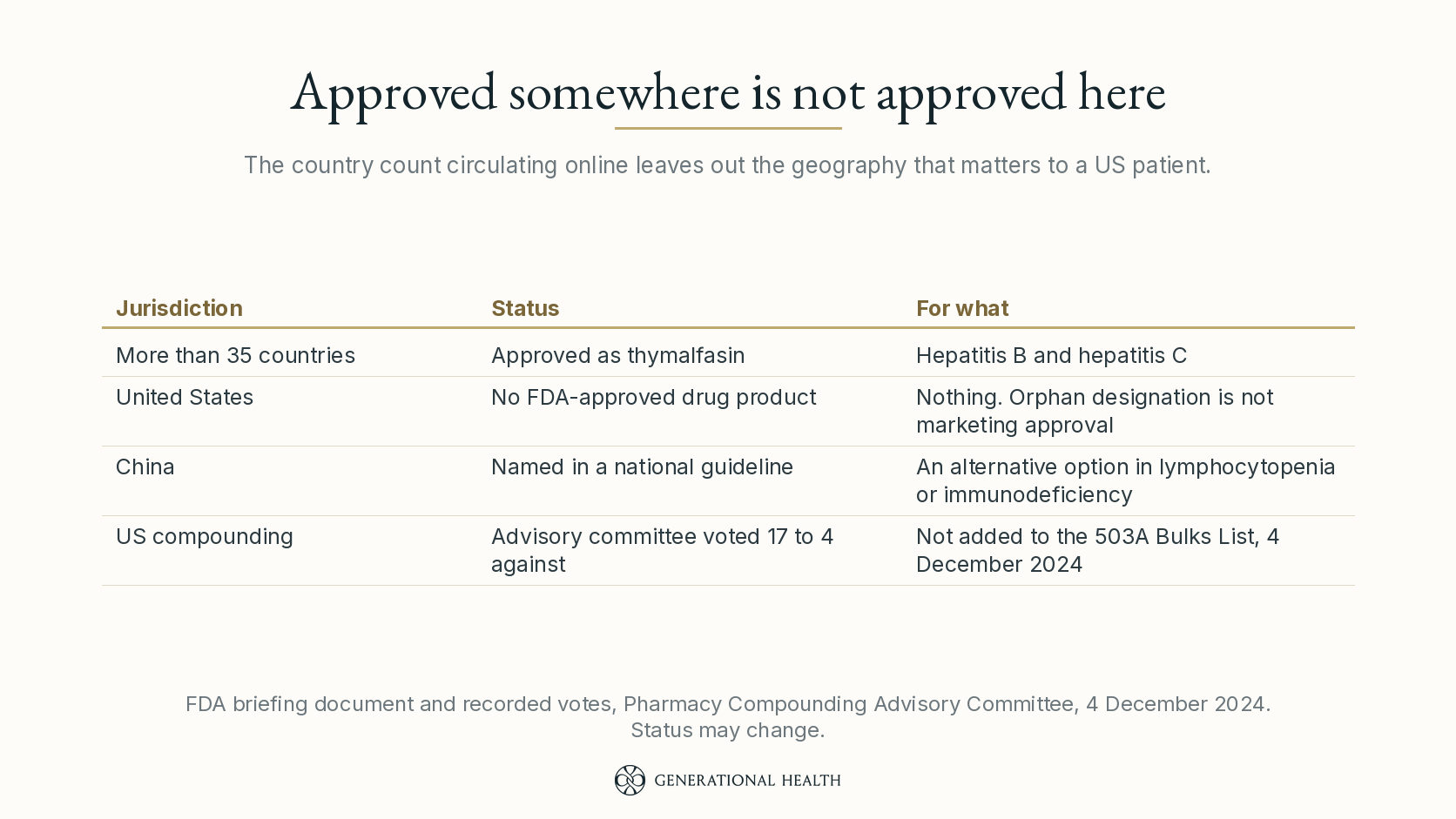
There is a second detail almost nobody mentions, and it matters more than the country count. The two indications thymalfasin is actually approved for abroad are the two that modern hepatology has moved past. The same review states that thymosin alpha 1 for hepatitis B “was only used in the era of interferon and is now obsolete in the era post-discovery of direct antiviral agents”, and that its use in hepatitis C “has been discontinued in favor of direct antiviral agents”. It also concludes that as a standalone treatment for hepatitis C, “thymosin alpha 1 as a monotherapy does not seem to be useful”.
Read plainly: the strongest regulatory credential this peptide has is an approval for a use that has been superseded.
What the FDA compounding decision means in the United States
For a US patient, the practical question is not what Italy or China permits. It is whether a compounding pharmacy may legally prepare it.
On 4 December 2024 the FDA’s Pharmacy Compounding Advisory Committee reviewed thymosin alpha 1 for inclusion on the 503A Bulks List, which governs what bulk substances compounding pharmacies may use. FDA’s own briefing document proposed that both thymosin alpha 1 free base and thymosin alpha 1 acetate not be added. The committee voted against both forms, 4 in favour and 17 against. Members voting no cited the absence of compelling evidence of clinical effectiveness and safety. The briefing document also confirms that FDA has approved no drug product containing thymosin alpha 1.
This is not an obscure procedural note. It is the reason availability has changed, and it is why any clinic discussing this peptide with you should be explaining regulatory status before benefits. If a website is selling you thymosin alpha 1 without mentioning any of this, that omission tells you something about the rest of the page.
Regulatory positions move. Anyone considering this peptide should confirm its current standing with a licensed provider rather than relying on an article, including this one.
Start with the regulatory conversation, not the order form
Peptide availability in the United States has been directly affected by recent FDA decisions, and thymosin alpha 1 is one of the substances involved. At our Beverly Hills clinic every peptide discussion begins with a medical consultation covering your history, current medications and what the evidence does and does not support. We would rather tell you a peptide is not right for you than sell you one.
These statements have not been evaluated by the FDA. Thymosin alpha 1 is not FDA-approved to diagnose, treat, cure or prevent any disease, and no FDA-approved drug product containing it exists in the United States. Any peptide is provided only after a medical evaluation by a licensed provider, and is not appropriate for everyone. Individual results vary.
What the research actually shows
The evidence base is uneven. Grouping it by how strong each piece actually is tells you far more than a list of benefits.
| Area studied | What was found | How strong |
|---|---|---|
| Sepsis | A multicentre randomised trial across six teaching hospitals reported a mortality rate 9.0 percent lower in the treated group | Strongest clinical signal in the literature, but single-blinded and conducted entirely in one country |
| COVID-19 | A retrospective study reported reduced mortality in severe disease; a separate report of 25 patients, 11 treated, found higher lymphocyte counts | Preliminary. The review states clinical studies here are “still limited” |
| Hepatitis B | Virological response rates of 40.6 percent and 26.5 percent in interferon-era trials | Described as “now obsolete” since direct antiviral agents arrived |
| Hepatitis C | Monotherapy “does not seem to be useful”; combination with pegylated interferon outperformed interferon alone | Discontinued in favour of direct antiviral agents |
| Chemotherapy support | Reports of fewer infections during chemotherapy and improved quality of life | No effect sizes or trial designs given for the survival claim. Anti-tumour data are cell-line work |
| Influenza vaccine response | “Promising results” as a vaccine adjuvant in elderly and immunocompromised patients | Weakest wording in the review. Underlying work includes a pilot study; no efficacy percentages reported |
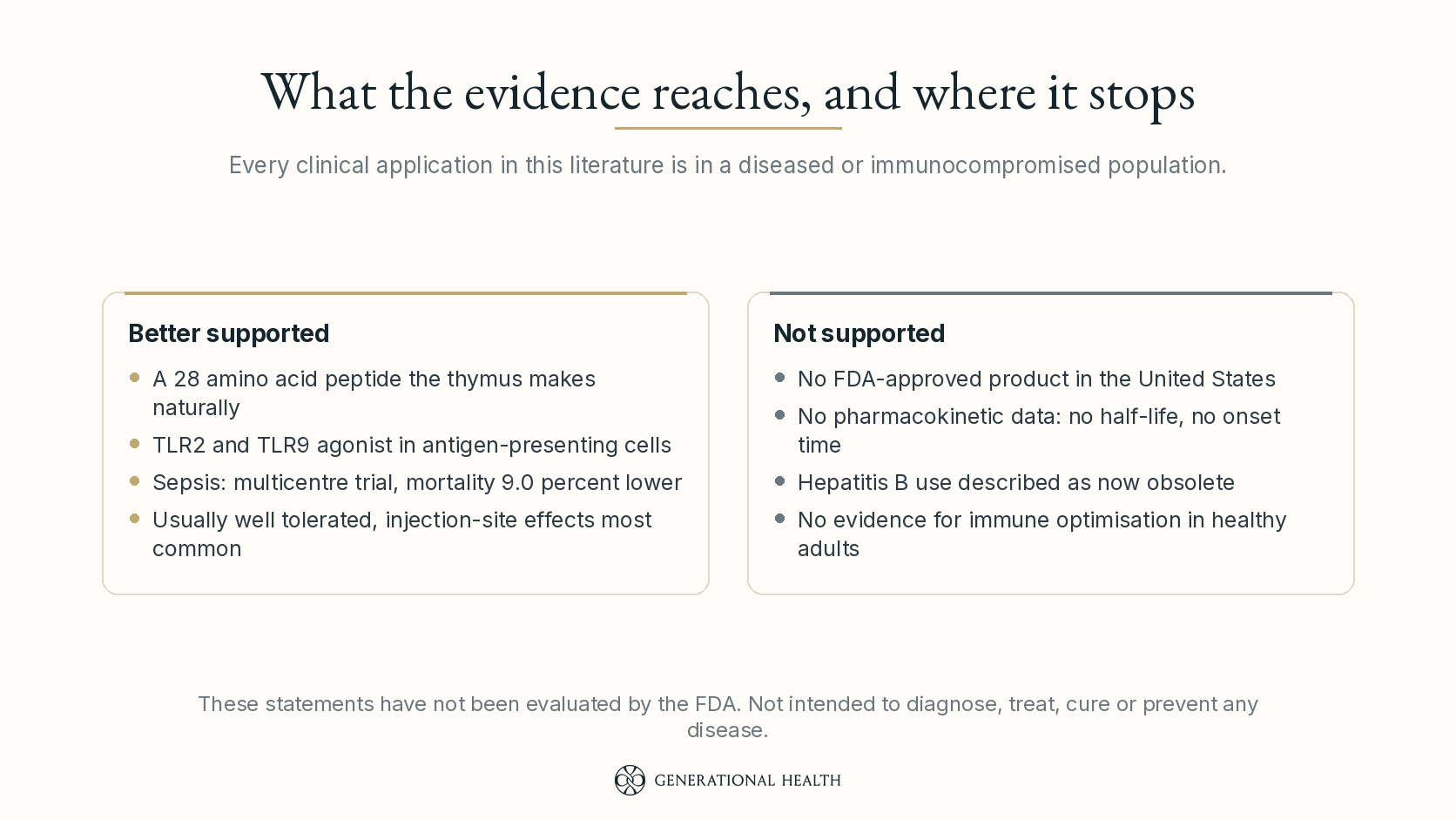
Two things follow from that table, and both are worth saying out loud.
First, the mortality figure circulating on social media comes from retrospective data in severely ill hospitalised patients. It is not a randomised trial, and it has nothing to say about a healthy person taking a peptide for general immune support.
Second, and more importantly: every clinical application in this literature is in a diseased or immunocompromised population. There is no body of evidence supporting thymosin alpha 1 as a longevity, anti-aging or immune-optimisation product for healthy adults. If you are reading about it in that framing, the framing is not coming from the research.
Dosing used in published studies
People search for a thymosin alpha 1 dosage chart, and there is a reason no responsible page publishes one. The figures below are what was used in clinical studies in specific disease populations. They are a record of the literature, not a protocol, and they are not instructions. Dosing for any individual is a prescribing decision made by a licensed provider after evaluation.
- General range reported: single doses of 0.8 mg to 6.4 mg, and multiple-dose regimens of 1.6 mg to 16 mg over five to seven days.
- Usual route and frequency: subcutaneous injection, typically twice a week.
- Hepatitis B trials: 1.6 mg subcutaneously twice weekly.
- Sepsis trial: 1.6 mg twice daily for five days, then reduced to once daily.
- COVID-19 retrospective study: 10 mg subcutaneously once daily for at least seven consecutive days.
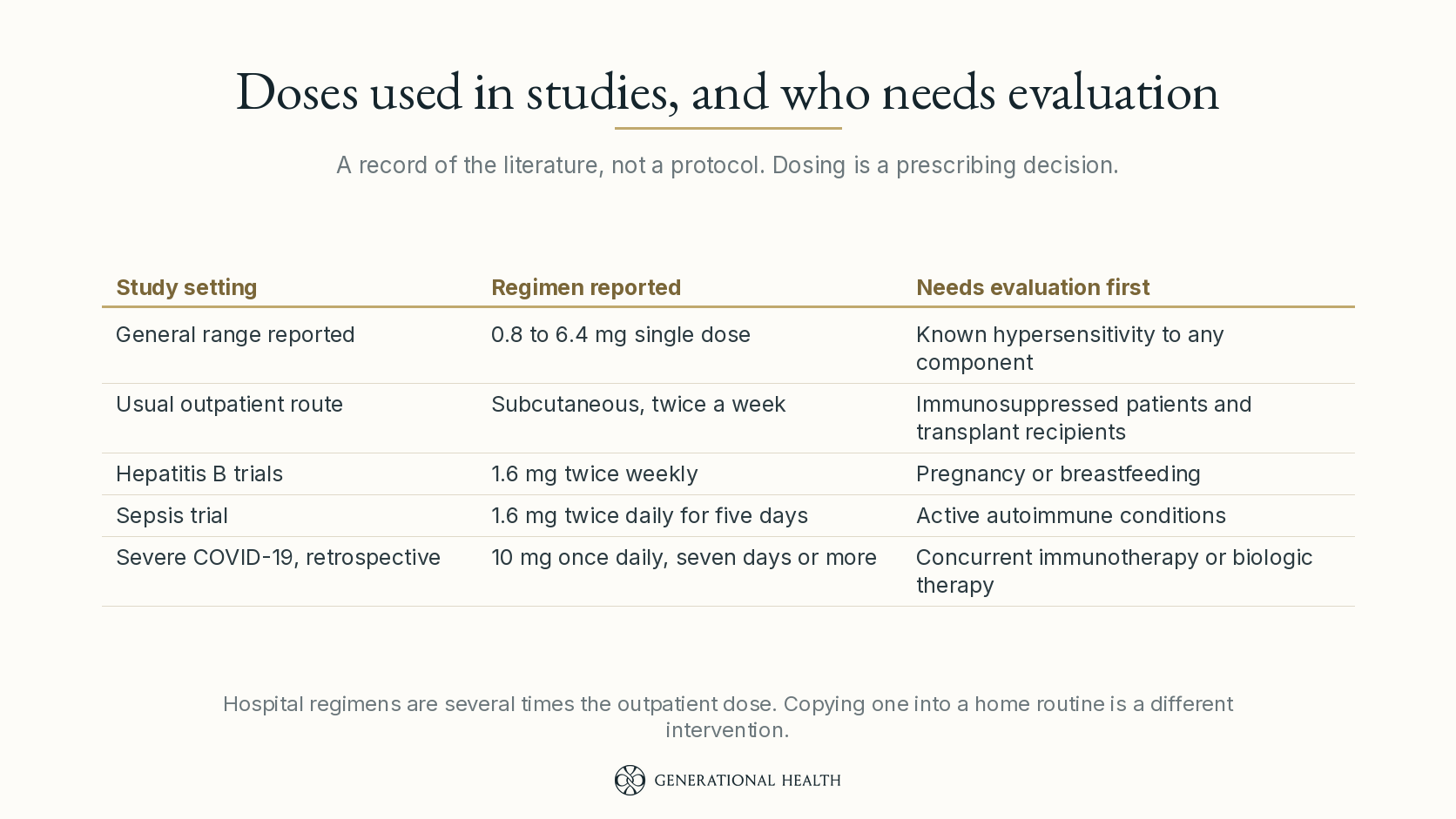
Note the spread. The sepsis and COVID regimens are several times the twice-weekly hepatitis dose, because they were treating acute critical illness in hospital. Copying a hospital regimen into a home routine is not a dose adjustment, it is a different intervention. The review reports no pharmacokinetic data at all for this peptide: no half-life, no time to peak concentration. Anyone quoting you a precise onset time is not getting it from this literature.
Side effects and contraindications
The tolerability record is genuinely reassuring as far as it goes. The review describes thymalfasin as “usually well tolerated”, with the most common adverse effects being “local irritation, redness, or discomfort at the site of injection”. In hepatitis C work it reports the peptide as “well tolerated, with no significant adverse effects observed”.
Context matters, though. Fever, fatigue, muscle aches, nausea, vomiting and neutropenia were reported in trials combining thymalfasin with interferon, which has its own substantial side-effect profile, so those should not be attributed to the peptide alone.
Two contraindications are stated explicitly and should not be skipped:
- Known hypersensitivity to thymosin alpha 1 or any component of the injection.
- Immunosuppressed patients, including organ transplant recipients, unless the benefits clearly exceed the risks. An immunomodulating peptide and a deliberately suppressed immune system are working against each other, and in a transplant recipient that is not a theoretical concern.
Beyond what the literature states, ordinary prescribing caution applies: pregnancy and breastfeeding, where safety is not established; any active autoimmune condition, where modulating immune signalling needs specialist input; and concurrent immunotherapy or biologic therapy, which should be reviewed with the prescribing specialist rather than layered on independently. Baseline laboratory testing before starting any peptide is sensible, and for an immune-directed peptide it is the obvious starting point.
Who thymosin alpha 1 is not for
Stated plainly, because the pages selling it rarely do:
- Anyone seeking treatment for a diagnosed disease. Thymosin alpha 1 is not a treatment for hepatitis, cancer, COVID-19, Lyme disease, chronic fatigue or any autoimmune condition, and Generational Health does not offer it as one. Persistent symptoms deserve a diagnostic work-up, not a peptide.
- Anyone wanting a general immune upgrade while healthy. The evidence does not reach that claim.
- Anyone planning to source it themselves. Research-grade material sold online is not pharmaceutical grade, is not sterile-compounded for human use, and is where most real harm in this category occurs.
- Anyone who wants certainty. This is a peptide with a plausible mechanism, a decent safety record in supervised use, a complicated regulatory position and thin evidence outside hospital settings. If that combination does not sit well with you, that is a reasonable conclusion rather than a failure to understand it.
If immune support during a demanding travel or work season is the actual goal, a vitamin C and zinc immune boost infusion is a far more modest intervention with far clearer expectations, available in clinic or through our concierge service. For anti-inflammatory and gut-directed peptide work the better-studied option in our peptide program is KPV, and for tissue repair the comparison worth reading is TB-500 against BPC-157.
Medical Disclaimer
These statements have not been evaluated by the Food and Drug Administration. This article is for educational purposes only, is not medical advice, and is not intended to diagnose, treat, cure, or prevent any disease. There is no FDA-approved drug product containing thymosin alpha 1 in the United States; approvals referenced in this article are in other jurisdictions, and US orphan-drug designation is a development incentive rather than a marketing approval. On 4 December 2024 the FDA’s Pharmacy Compounding Advisory Committee voted against adding thymosin alpha 1 to the 503A Bulks List, and regulatory status may change. Dosing figures in this article are drawn from published clinical studies in specific patient populations and are not a protocol, a recommendation, or instructions for use. Generational Health (formerly Robertson Wellness and Aesthetics), Beverly Hills, does not offer thymosin alpha 1 as a treatment for hepatitis, cancer, COVID-19, Lyme disease, or any other named disease. Any peptide is provided only after a medical evaluation by a licensed provider, is not appropriate for everyone, and is contraindicated in known hypersensitivity and in immunosuppressed patients including transplant recipients. Individual results vary and are not guaranteed. Always consult a qualified healthcare provider before beginning any new treatment.
Frequently asked questions
What is the peptide thymosin alpha-1 used for?
In countries where it is approved, thymalfasin is used for hepatitis B and hepatitis C, and as an immune enhancer in some other conditions. In the research literature it has also been studied in sepsis, as a chemotherapy adjuvant, and as an influenza vaccine adjuvant in elderly and immunocompromised patients. In the United States it is not approved for any indication, and it is not a treatment for any named disease at this clinic.
Is thymosin alpha 1 legal in the United States?
There is no FDA-approved drug product containing it. On 4 December 2024 the FDA’s Pharmacy Compounding Advisory Committee voted 17 to 4 against adding thymosin alpha 1 to the 503A Bulks List, after FDA’s briefing document proposed excluding both the free base and the acetate form. That decision directly affects what compounding pharmacies may prepare. Because this area is actively changing, confirm current status with a licensed provider rather than with an article.
How long does it take thymosin alpha 1 to work?
The literature does not answer this. The comprehensive review reports no pharmacokinetic data for thymosin alpha 1, meaning no half-life and no time-to-effect figures. Clinical studies measured outcomes over weeks to months, not days, and in hospitalised patients rather than healthy adults. Any specific onset timeline you are quoted is not coming from the published evidence.
Can I take thymosin alpha 1 daily?
Daily dosing appears in the literature only in acute hospital settings, such as the COVID-19 retrospective study that used 10 mg once daily for at least seven days in severely ill patients. The usual regimen in outpatient studies is twice a week. Frequency is a prescribing decision, and transferring an inpatient schedule to routine personal use is not a minor adjustment.
What is the thymosin alpha 1 dosage when sick?
There is no established protocol for taking it at the onset of an ordinary illness, because that scenario has not been studied. The higher-frequency regimens in the literature come from sepsis and severe COVID-19 trials in hospitalised patients, which is a different clinical situation entirely. Increasing a dose because you feel unwell is not supported by evidence and should not be done without your provider.
How is thymosin alpha 1 different from thymosin beta 4?
They are different peptides with different jobs despite the shared name. Thymosin alpha 1 acts on immune signalling through Toll-like receptors and T cell maturation. Thymosin beta 4 is studied primarily for tissue repair and cell migration, and is the parent of the fragment commonly sold as TB-500. Choosing between them is a question about what you are actually trying to address, which is a consultation question rather than a comparison-chart question.
Where to go from here
Thymosin alpha 1 sits in an unusual position: a well-characterised mechanism, a reasonable safety record under supervision, genuine approvals abroad for indications medicine has largely moved past, and no approved product in the United States. None of that makes it worthless and none of it makes it a shortcut. It makes it a conversation to have with a clinician who will tell you where the evidence stops. Our thymosin alpha 1 page lists the presentation and pricing, and like every peptide here it is available only after a consultation.
Generational Health provides physician-supervised peptide therapy in Beverly Hills, minutes from Cedars-Sinai, with every peptide preceded by a medical consultation and, where appropriate, baseline laboratory work. Request a consultation to review your history and find out whether a peptide belongs in your plan at all.
Written and medically reviewed by Biana Borchenko, FNP-BC, Family Nurse Practitioner, Board-Certified, with fellowship training through the American Academy of Anti-Aging Medicine (A4M), at Generational Health (formerly Robertson Wellness and Aesthetics), Beverly Hills. Biana oversees the clinic’s peptide and injectable protocols, where every peptide discussion begins with regulatory status, personal and family history, current medications and laboratory work, and where declining to prescribe is treated as a legitimate outcome of a consultation.
Sources cited in this article: Dominari A, Hathaway D III, Pandav K, et al. “Thymosin alpha 1: A comprehensive review of the literature.” World Journal of Virology. 2020;9(5):67-78. US Food and Drug Administration, Briefing Document, Pharmacy Compounding Advisory Committee Meeting, 4 December 2024, on thymosin alpha 1 free base and thymosin alpha 1 acetate for the 503A Bulks List, and the committee’s recorded votes from that meeting. Wu J, et al. ETASS randomised controlled trial of thymosin alpha 1 in severe sepsis, Critical Care, 2013. Li C, et al. systematic review and meta-analysis of thymosin alpha 1 in sepsis, International Journal of Infectious Diseases, 2015.


