


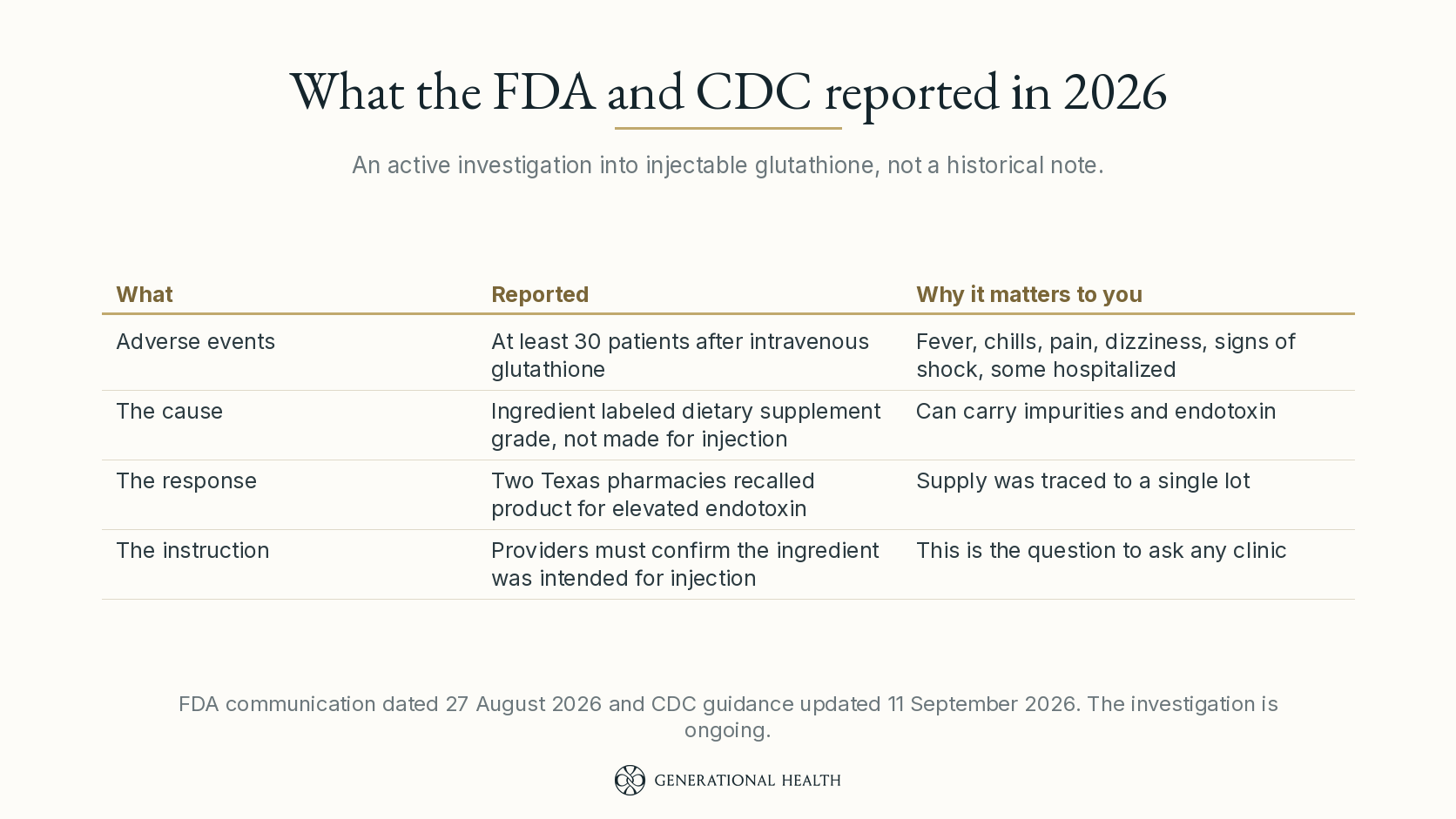
Before anything else about glutathione IV therapy, you need to know that it is currently the subject of an active federal safety investigation. On 27 August 2026 the FDA reported at least 30 patients who experienced adverse events after intravenous glutathione, all traced to a single lot of glutathione labeled dietary supplement grade, which is not an appropriate ingredient for injectable drugs. The CDC, in guidance updated on 11 September 2026, is investigating alongside the FDA and state health departments and has told providers to confirm with their compounding pharmacy that any injectable glutathione was compounded with ingredients intended for injection. That one question is the most useful thing in this article.
Glutathione itself is a tripeptide your body makes, and it is the subject of genuine research interest as an antioxidant. What follows is what it does, what the evidence for cosmetic use actually amounts to, how it is given, who should not have it, and exactly what to ask before you book anywhere.
What is glutathione, and what does an IV actually do?
Glutathione is a tripeptide, a molecule built from three amino acids (cysteine, glycine and glutamic acid), produced naturally in every cell in your body. It is often called the master antioxidant because of its role in neutralizing reactive oxygen species and supporting the liver’s detoxification pathways. In plain terms, it is part of how your cells manage the everyday chemical wear that comes from metabolism, and your body already makes it.
The argument for giving it intravenously is about the route rather than the molecule. Oral glutathione is substantially broken down in digestion, so an IV delivers it directly into the bloodstream and bypasses that. The honest counterpoint, which rarely appears on clinic pages, is that bypassing digestion establishes that more of it reaches your blood. It does not by itself establish that the cosmetic outcome people are hoping for follows.
Glutathione is one component of our Beauty IV drip rather than a standalone product, and our guide to what is inside a beauty IV drip covers how it sits alongside vitamin C, biotin and the B-complex vitamins.
The safety situation you should know about before booking anywhere
This is current, specific, and it is the single most important section here.
According to the FDA’s compounding risk communication dated 27 August 2026, the agency is aware of reports of at least 30 patients who experienced adverse events following intravenous glutathione, given alone or combined with other ingredients. The product had been compounded by several different pharmacies, all of which had obtained their glutathione from the same source and the same lot, and that material was labeled dietary supplement grade. Ingredients labeled for dietary supplement use are not made to injectable standards and may carry impurities and contaminants.
The reported adverse events were fever, chills, pain, dizziness, signs of shock and sepsis-like symptoms, with some patients hospitalized. The FDA describes these as consistent with exposure to excessive endotoxin, a substance produced by certain bacteria that can contaminate a product when quality controls are not followed. Two pharmacies in Texas conducted recalls over elevated endotoxin levels in their glutathione injectables. The supplier notified its US customers on 20 August 2026 not to use its dietary supplement grade glutathione for injectable compounding, and the FDA has said it continues to receive reports and is actively investigating.
The CDC’s guidance, updated 11 September 2026, is working from the same picture and adds the practical instruction: healthcare providers should check with their compounding pharmacy to confirm that injectable glutathione was compounded with ingredients intended for injection, should follow recall notices, and should contact patients who received affected product.
None of this means glutathione is inherently unsafe. It means the sourcing and the compounding pharmacy matter enormously, and that the question above is one every patient is now entitled to ask.
What to ask before a glutathione IV, anywhere
Take this list to any clinic, including ours.
- Which compounding pharmacy supplies your glutathione, and is the ingredient intended for injection? This is the CDC’s own question. A clinic that cannot answer it immediately has not been paying attention.
- Is the pharmacy a licensed 503A or 503B facility? Ask for the name, not a reassurance.
- Are you aware of the current FDA and CDC communications on injectable glutathione, and have you checked your stock against the recalls?
- Who is supervising the infusion, and what happens if I react? An infusion given in a clinical setting with a physician available is not the same as one given at a pop-up event.
- What is in the bag besides glutathione, and at what amounts?
Ask us the sourcing question too
Glutathione is one ingredient in our Beauty IV rather than a standalone drip. If you are considering it, bring the checklist above to your consultation and ask us the same questions you would ask anyone else. Every infusion at our Beverly Hills clinic is given under physician supervision after a review of your history.
These statements have not been evaluated by the FDA. Glutathione is not FDA-approved for any cosmetic use and is not intended to diagnose, treat, cure or prevent any disease. Compounded medications are not FDA-approved, and the FDA does not verify the safety or effectiveness of compounded drugs. Not appropriate for everyone. Individual results vary.
How glutathione is given, and the dosing question
There are three routes in common use, and they are not interchangeable.
| Route | How it is given | What to understand |
|---|---|---|
| Intravenous | Infused into a vein in clinic, often within a wider drip | The route the FDA and CDC communications concern. Also the route a published review links to the most serious reported reactions |
| Intramuscular | A single injection into muscle | Quicker to give, but the same sourcing questions apply |
| Oral or topical | Capsules, or a cream or serum | Not injectable, so it avoids this risk category entirely. Absorption and effect differ |
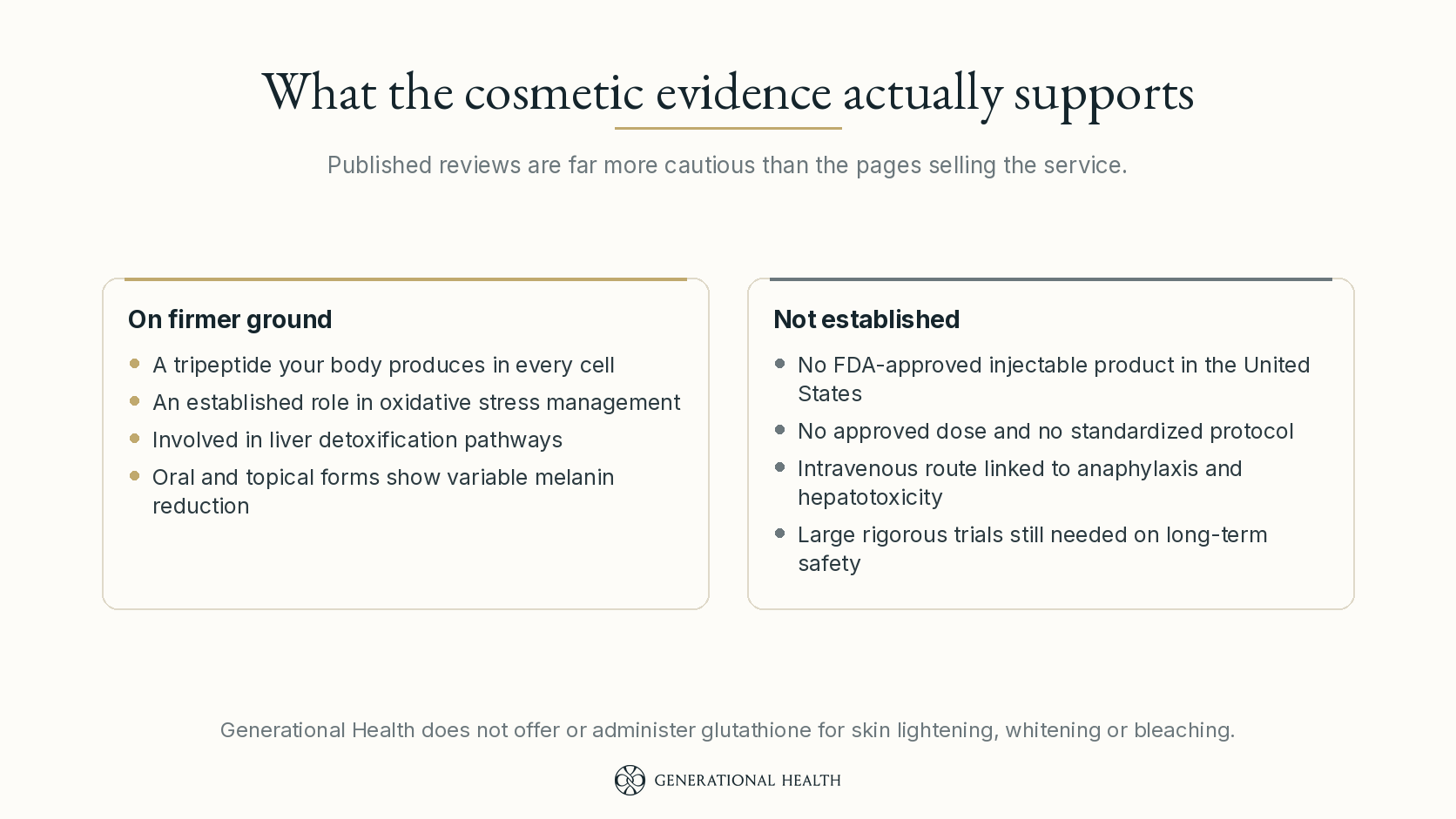
On dosing, the honest answer is the uncomfortable one. There is no FDA-approved injectable glutathione product in the United States and therefore no approved dose, and the Cureus narrative review of glutathione for skin lightening, published in 2025, explicitly names the lack of standardized dosing protocols as a problem that aggravates the safety picture for the intravenous route. The dosage charts circulating online, including the per day and per week figures people search for, are conventions rather than validated schedules. Any amount you are given should be set by a prescriber who has reviewed your history, and it is not something to calculate yourself or to copy from a chart.
What to expect during a session
A glutathione infusion given as part of a beauty drip typically runs 30 to 60 minutes. A cannula is placed in the arm, the infusion runs, and you are observed. There is no downtime and most people return to their day straight afterwards. A single intramuscular injection takes minutes.
Set expectations on timing honestly: any effect on skin appearance is gradual and subtle, people describe it in terms of a general look rather than a measurable change, and it is not an overnight transformation. If a provider promises you a visible result by a particular date, that promise is not coming from the evidence.
What the evidence for cosmetic benefit actually amounts to
Glutathione is researched in dermatology because it influences melanogenesis, the process by which skin produces pigment. That is the mechanism behind its popularity, and it is also why this subject needs careful handling.
Generational Health does not offer, market or administer glutathione for skin lightening, whitening or bleaching. We are stating that plainly because it is the most searched intent around this ingredient and because the clinical and ethical case for it does not hold up. The 2025 Cureus narrative review found that oral glutathione showed significant but variable reductions in melanin with limited side effects, and that topical formulations produced reductions with varying durability, but that the intravenous route, while rapid, is associated with serious safety concerns including anaphylaxis and hepatotoxicity, made worse by the absence of standardized dosing. Its conclusion was that large-scale rigorous trials are still needed to establish long-term safety and optimal dosing. An earlier review published in 2018 asked in its own title whether glutathione for skin lightening is a persistent myth or evidence based, which tells you how settled the field considers the question.
Where glutathione is on firmer ground is as an antioxidant involved in oxidative stress and liver detoxification pathways. Even there, being biologically important is not the same as an infusion producing a measurable cosmetic outcome, and we would rather say so than imply otherwise.
Side effects and who should not have a glutathione IV
Reported effects range from the minor and common to the rare and serious. Published literature on the intravenous route specifically names anaphylaxis and hepatotoxicity, meaning liver injury, among the serious concerns. The adverse events in the current federal investigation, fever, chills, pain, dizziness, signs of shock and sepsis-like symptoms, relate to contamination rather than to glutathione itself, but they are part of the real-world risk of an injectable compounded product.
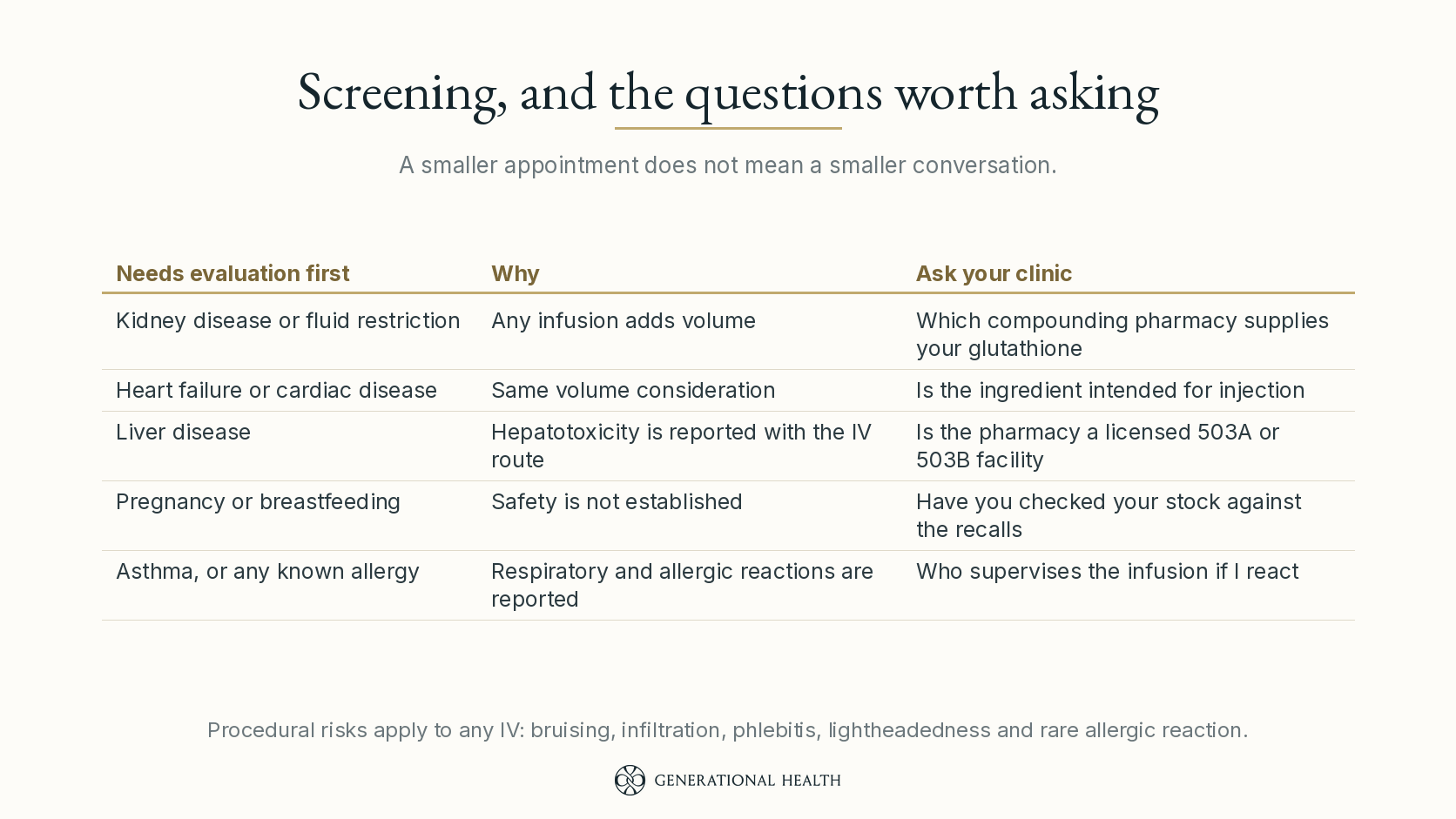
Any IV infusion also carries procedural risks: bruising, infiltration where fluid leaks into surrounding tissue, phlebitis, vasovagal lightheadedness, and rare allergic reaction.
Glutathione IV therapy is generally not appropriate, or requires evaluation first, if you have:
- Kidney disease or reduced renal function, or any condition in which fluid volume must be restricted.
- Heart failure or significant cardiac disease.
- Liver disease, given the hepatotoxicity signal reported with the intravenous route.
- Pregnancy or breastfeeding.
- A known allergy to glutathione or to any component of the infusion.
- Asthma. Caution is reasonable here: respiratory reactions have been reported in the literature around glutathione, and this is worth raising with your provider rather than assuming it is irrelevant.
Baseline laboratory work before starting any infusion series is sensible rather than an upsell, particularly where liver or kidney function is a question. If you are weighing drips generally, our guide to choosing the right IV therapy and the full IV menu set out the alternatives, including hydration and immune support drips.
Medical Disclaimer
These statements have not been evaluated by the Food and Drug Administration. This article is for educational purposes only, is not medical advice, and is not intended to diagnose, treat, cure, or prevent any disease. There is no FDA-approved injectable glutathione product in the United States, and glutathione is not FDA-approved for any cosmetic indication; any such use is off-label and compounded. Compounded medications are not FDA-approved and the FDA does not verify the safety or effectiveness of compounded drugs. Generational Health (formerly Robertson Wellness and Aesthetics), Beverly Hills, does not offer, market or administer glutathione for skin lightening, whitening or bleaching. Glutathione is included as one component of our Beauty IV drip and is given only after a medical evaluation by a licensed provider, and it is not appropriate for everyone. The FDA and CDC communications described here were accurate as published on 27 August 2026 and 11 September 2026 respectively; that investigation is ongoing and readers should check the agencies’ current guidance. Individual results vary and are not guaranteed. Always consult a qualified healthcare provider before beginning any new treatment.
Frequently asked questions
What does a glutathione IV do?
It delivers glutathione, an antioxidant tripeptide your body already produces, directly into the bloodstream, bypassing the digestion that breaks down much of an oral dose. Glutathione has established roles in managing oxidative stress and supporting liver detoxification pathways. What an infusion does not have is approval or settled evidence for a cosmetic outcome, and the published reviews are clear that large rigorous trials are still needed.
What is the downside of taking glutathione?
For the intravenous route specifically, published literature names anaphylaxis and hepatotoxicity among the serious concerns, and notes that the absence of standardized dosing makes the picture worse. Separately, there is an active FDA and CDC investigation into adverse events linked to injectable glutathione compounded from dietary supplement grade ingredient, where contamination with endotoxin caused fever, chills, signs of shock and in some cases hospitalization. The practical downside is that product quality and sourcing matter more here than most patients realize.
How long does IV glutathione last?
Blood levels rise quickly after an infusion and fall over the following period, which is why clinics schedule repeat sessions rather than single ones. There is no reliable published figure for how long any cosmetic effect persists, because the trials needed to establish that have not been done. Anyone quoting you a precise duration is going beyond the evidence.
How many sessions of a glutathione drip do you need to see results?
No evidence-based session count exists. Clinics commonly work in courses of several sessions spaced over weeks, but that is practice convention rather than a validated protocol, and expectations should be modest and gradual. We would rather set that expectation at consultation than sell you a package against an outcome nobody has demonstrated.
Is glutathione IV FDA approved?
No. There is no FDA-approved injectable glutathione product in the United States. What is administered is a compounded preparation, which means the FDA has not verified its safety or effectiveness, and which makes the choice of compounding pharmacy a central safety question rather than a detail.
Does glutathione lighten skin?
This is the most common reason people search for it, and the honest answer is that the evidence does not support marketing it that way. Reviews have found variable melanin reduction with oral and topical forms, but conclude that rigorous large-scale trials are still needed, and the intravenous route carries the serious safety concerns described above. Generational Health does not offer or administer glutathione for skin lightening.
Where to go from here
If you were considering a glutathione IV, the most valuable thing you can do this week is not to book one. It is to ask whichever clinic you are considering, including this one, which compounding pharmacy supplies their glutathione and whether the ingredient is intended for injection. Generational Health provides physician-supervised Beauty IV therapy in Beverly Hills, minutes from Cedars-Sinai, with in-clinic and concierge appointments, and our clinical team will answer that question directly. Request a consultation to talk it through.
Written and medically reviewed by Biana Borchenko, FNP-BC, Family Nurse Practitioner, Board-Certified, with fellowship training through the American Academy of Anti-Aging Medicine (A4M), at Generational Health (formerly Robertson Wellness and Aesthetics), Beverly Hills. Biana oversees the clinic’s IV and injectable protocols, where every infusion begins with a review of personal and family history, current medications and laboratory work, and where sourcing and compounding standards are treated as a clinical matter rather than a purchasing one.
Sources cited in this article: US Food and Drug Administration, “FDA reminds compounders not to use dietary supplement grade glutathione for injectables”, communication dated 27 August 2026. US Centers for Disease Control and Prevention, “Adverse Events Linked to Injectable Glutathione Compounded with Dietary Supplement Grade Ingredient: Current Situation”, updated 11 September 2026. “Exploring the Safety and Efficacy of Glutathione Supplementation for Skin Lightening: A Narrative Review”, Cureus, 2025;17(1):e78045. Sonthalia S, Jha AK, Lallas A, Jain G, Jakhar D. “Glutathione for skin lightening: a regnant myth or evidence-based verity?”, Dermatology Practical & Conceptual, 2018;8(1):15-21.


